
Northrop Grumman Advances B-21 Production While Managing Program Challenges
The latest quarter reveals significant loss accruals on B-21 production but underscores strategic efforts to expand capacity and fulfill growing defense demands.
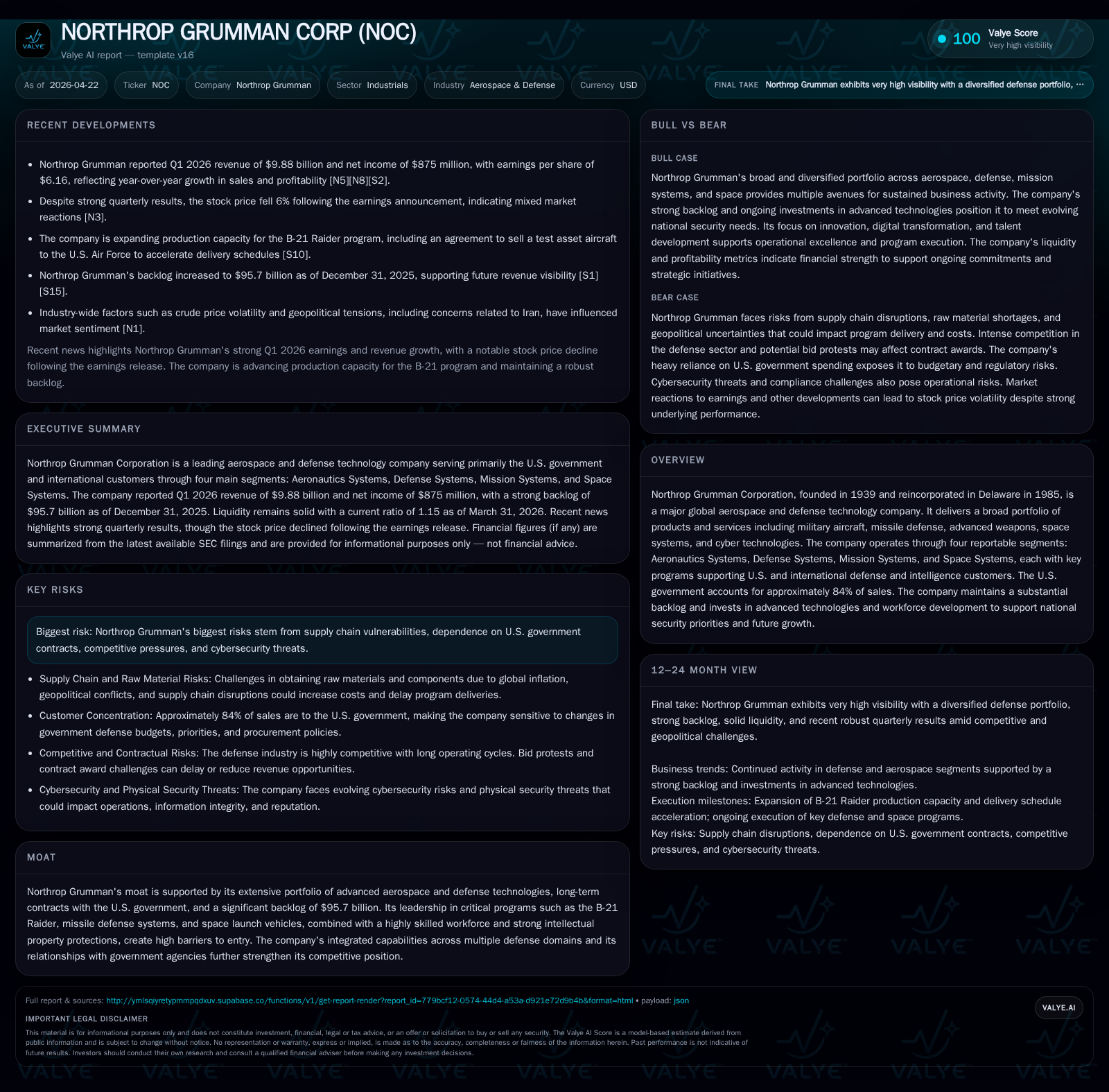
Northrop Grumman’s Q1 2026 10-Q disclosed a remaining $1 billion loss accrual tied to the B-21 Raider low-rate initial production (LRIP), reflecting ongoing challenges in cost management amid advanced aircraft manufacturing. Simultaneously, the company finalized an agreement with the U.S. Air Force to increase production rates by selling a planned test aircraft, signaling commitment to scaling capacity. With roughly 84% of sales dependent on U.S. government contracts across diversified aerospace and defense segments, Northrop maintains a robust backlog (~$95.7 billion) underpinning revenue visibility. While geopolitical tensions and heightened defense spending support growth, exposure to program execution risk, supply chain volatility, and regulatory scrutiny present ongoing operational constraints.
Latest Quarterly Operating Update: B-21 Production Dynamics
Northrop Grumman's Q1 2026 10-Q filing [S2] provides critical insight into the financial and operational status of its marquee B-21 Raider stealth bomber program during the low-rate initial production (LRIP) phase. The company continues to carry a remaining loss accrual of approximately $1.0 billion related to five LRIP contract options as of March 31, 2026. This balance follows substantial loss recognitions in prior quarters: $1.56 billion in Q4 2023 and an additional $477 million in Q1 2025. Such accruals reflect GAAP-required provisioning for estimated future losses due to difficulties estimating costs on cutting-edge aerospace programs still transitioning through early production stages.
Notably, Northrop entered an agreement with the U.S. Air Force this quarter aimed at expanding production capacity for the B-21 fleet. A key operational element is the sale of an aircraft initially intended as a company-owned test asset to the service branch [S2]. This transaction facilitates capital allocation toward ramping up production volume rather than retaining non-revenue generating assets internally.
This dual narrative—heavy near-term losses on early LRIP lots alongside strategic capacity enhancement—illustrates the high fixed-cost nature and developmental complexity inherent in pioneering next-generation stealth bomber programs. Margins are pressured in these formative stages but production scale is expected to improve economics over time if throughput rises as planned. This dynamic is emblematic of advanced military aerospace manufacturing where contract terms often include cost-type elements vulnerable to estimation risk but backed by long-term governmental investment.
Northrop Grumman's Portfolio and Business Model Drivers
At its core, Northrop Grumman derives revenue primarily from U.S. government contracts amounting to about 84% of total sales [S14]. The company's broad product suite splits into four reportable segments:
- Aeronautics Systems: Military aircraft including the B-21 program and associated technologies.
- Defense Systems: Missile defense platforms, precision weapons, and integrated battle management solutions.
- Mission Systems: C4ISR (command, control, communications, computers, intelligence, surveillance, reconnaissance), cyber capabilities, and naval systems.
- Space Systems: Satellites, launch vehicles (e.g., solid rocket motors for NASA’s SLS), and other space-related technologies.
The highly specialized nature of these offerings is buttressed by decades of proprietary research & development investments alongside cumulative intellectual property rights protecting design specifics in stealth technology or missile guidance systems [S1]. Long-dated contracts with fixed-price production lots combined with cost-type developmental agreements provide a mix of recurring revenues plus milestone-driven inflows.
Importantly, Northrop maintains a massive backlog reported at $95.7 billion at the end of 2025 [S1][S21], representing contracted but yet-to-be-recognized revenues that contribute significant visibility into medium-term cash flow streams. This backlog supports capital planning while mitigating some cyclicality typical in defense procurement.
Customer reticence to switch suppliers combined with onerous certification requirements elevate switching costs, reinforcing competitive positioning within government acquisition ecosystems.
Competitive Positioning in Aerospace & Defense
Northrop Grumman operates among a select group of prime contractors with multi-domain reach across air, space, missile defense and cyber warfare segments [S29]. Its competitive moat stems less from commodity-like offerings and more from tightly controlled intellectual property portfolios (e.g., fly-by-wire stealth airframes like B-2 Spirit lineage) and established relationships embedded deeply within U.S. Department of War agencies.
The company's legacy as a developer of flying wing technology has translated into sustained leadership on programs such as the B-21 Raider—considered critical for strategic deterrence—and sophisticated missile defense architectures that benefit from layered sensors and advanced command networks.
However, the industry landscape remains complex with formidable competitors like Lockheed Martin or Boeing also vying aggressively for sizeable defense budgets. Northrop must continuously innovate technologically while managing supply chains fraught with component shortages exacerbated by geopolitical trade dynamics [S15].
Moreover, regulatory compliance—including adherence to contract clauses such as termination for convenience or default provisions—requires robust performance discipline lest reputation damage impede future award opportunities [S4],[S7].
New entrants leveraging commercial or dual-use technologies under Other Transaction Authority (OTA) mechanisms invite further competitive scrutiny but have yet to displace entrenched primes on core weapon systems [S22].
Growth Catalysts and Operational Constraints
Demand for Northrop’s products appears structurally buoyed by intensifying global security concerns including Russian aggression in Eastern Europe, Indo-Pacific geopolitical rivalry, Middle East volatility, and escalations in nuclear posturing worldwide [S1][S16]. These factors drive increased procurement budgets among the U.S. and allied governments which fuel order inflows especially in missile defense payloads and advanced aerospace platforms.
Northrop’s forward-looking investments highlight focus areas such as next-generation overhead persistent infrared satellites for missile warning (Next-Gen OPIR), advanced space launch vehicles supporting NASA missions, cyber resilience solutions suited for modern battlefield contexts—all aligning well with anticipated defense priorities [S21].
Nonetheless, growth trajectories face constraints linked primarily to supply chain risks including semiconductor scarcity affecting avionics integration; labor shortages amid technical recruitment challenges; inflation-induced raw material cost escalations; and logistical delays impacting delivery schedules [S1][S15].
Crucially, large-scale programs like B-21 are subject to Nunn-McCurdy act provisions invoking accountability around cost overruns or schedule slippage that can disrupt contractual status or funding flows considerably [S4][S6]. Such programmatic risk remains pivotal given magnitude of investment required.
Risks Rooted in Program Execution and Government Dependency
A dominant risk is concentrated dependence on the U.S. government which accounted for roughly 84% of sales during 2025—a level consistent over recent years—amplifying vulnerability to shifts in political priorities or federal budget adjustments [S14][S4]. Any abrupt reprioritization could lead to contract modifications or cancellations governed under complex legislative frameworks potentially limiting Northrop’s financial recoveries notably under termination for convenience clauses [S4].
Additionally numerous ongoing legal proceedings related to cost accounting inquiries by DOJ alongside environmental remediation litigations introduce contingent liabilities monitored closely by management though currently not assessed as materially adverse [S6][S8]. The firm is also exposed to cybersecurity threats both internally and from customer networks it supports—an increasingly salient area given evolving threat actors globally [S14].
Losses recognized on the B-21 LRIP program underscore execution complexity endemic within major new weapon systems carrying inherent cost estimation uncertainty compounded by challenging macroeconomic conditions elevating inflationary impacts [S2][S1].
Collectively these risks necessitate vigilant contract oversight balanced against disciplined innovation investment within statutory regulation boundaries.
Near-Term Catalysts and Execution Watchpoints
Key developments warrant monitoring include progress milestones within subsequent LRIP lots on the B-21 program where margin improvement could relieve loss accrual pressure if efficiency gains materialize [S2][N3]. Further Air Force agreements elevating build rates would serve as positive confirmation of scalable production capabilities.
Also pivotal will be quarterly bookings relative to backlog depletion rates alongside updates concerning geopolitical stability influencing U.S. defense appropriations indirectly affecting contracting pipelines [N3][S16]. Supply chain stabilization indicators—such as improvements in semiconductor supply—and wage inflation trends remain important operational barometers impacting unit economics.
Contracts or bids awarded under newer acquisition methods like OTA approaches may reveal evolving competitive dynamics offering insight into disruption potential within traditional prime contractor roles [S22]. Lastly keeping refreshed cognizance on regulatory developments affecting compliance costs or restrictions imposed on share repurchases or dividends is advised given recent executive orders targeting government contractors' capital distributions [S9].
Summary Financial Metrics to Contextualize Operating Performance
Historical performance (annual)
| FY | Rev ($bn) | Net ($bn) | CFO ($bn) | OpInc ($bn) | Rev YoY | Net YoY |
|---|---|---|---|---|---|---|
| 2025 | 42.0 | 4.2 | 4.8 | 4.5 | +2.2% | +0.2% |
| 2024 | 41.0 | 4.2 | 4.4 | 4.4 | +4.4% | +103.0% |
| 2023 | 39.3 | 2.1 | 3.9 | 2.5 | +7.3% | -58.0% |
| 2022 | 36.6 | 4.9 | 2.9 | 3.6 |
Source: SEC companyfacts cache [F1].
Capital returns and efficiency (annual)
| FY | Div ($mm) | Buybacks ($bn) | FCF ($bn) |
|---|---|---|---|
| 2025 | 1293 | 1.6 | 3.3 |
| 2024 | 1186 | 2.5 | 2.6 |
| 2023 | 1116 | 1.5 | 2.1 |
| 2022 | 1052 | 1.5 | 1.5 |
Source: SEC companyfacts cache [F1].
As shown above ([F1]), Northrop delivered modest top-line growth (2.2%) along with improved operating income (+3.2%) and stable net income in fiscal year 2025 compared to prior year results despite ongoing developmental program challenges including the B-21 LRIP losses highlighted earlier.
Strong operating cash flow generation facilitated continued capital expenditures focused on sustaining technological advancement while simultaneously supporting shareholder returns via dividends ($1.29bn paid) and repurchase activity ($1.62bn).
At March-end 2026 current assets remained ample relative to current liabilities yielding a current ratio near 1.15 indicative of sound liquidity management supporting working capital needs ([F1],[S13]).
This analysis integrates SEC-filed disclosures up to April 21st, 2026 alongside market context without hosting investment recommendations or price forecasts per policy guidelines.
Disclaimer: This is research-only, informational analysis and not investment advice. It may include AI-generated interpretation and general industry context. Always verify important details using primary sources.

Comments