
Brag House Amplifies Equity Access with Incentive Plan Expansion and Merger Progress
April 2026 shareholder approvals expand equity incentives and authorize significant share issuance to key financier amidst pending merger.
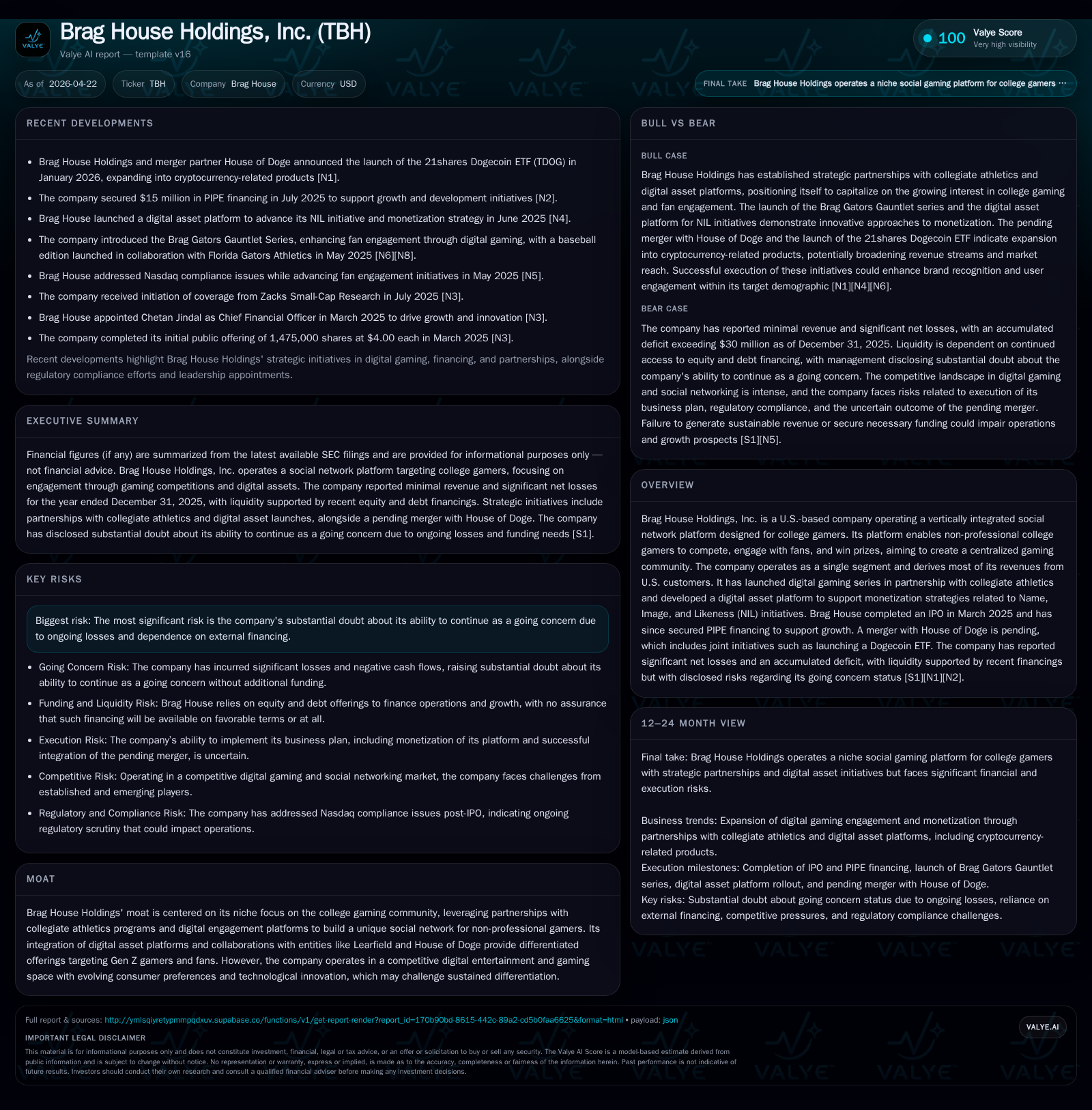
Brag House Holdings secured critical shareholder votes in April 2026 approving a dramatic increase in its omnibus equity incentive plan to 100 million shares, enabling broader employee participation aligned with its scaling ambitions. In parallel, the company obtained Nasdaq-required approval for potentially issuing up to 20% of outstanding shares to Yorkville as part of an equity purchase agreement, underpinning key growth capital. These structural moves coincide with an anticipated merger closure with House of Doge slated for Q2 2026, expected to deepen digital asset integration and broaden product offerings. Despite strategic advances, Brag House faces persistent net losses and liquidity constraints, relying on external financings and transaction milestones to sustain operations.
Recent SEC Event Filing: Equity Issuance and Incentive Plan Expansion
Brag House Holdings reported pivotal corporate actions in an April 7, 2026 Form 8-K filing indicating significant capital structure updates that set the near-term trajectory for the firm. Shareholders approved Proposal No.6 to amend the company's Amended and Restated 2024 Omnibus Incentive Plan by expanding the pool of authorized shares available for issuance to 100 million common shares, with planned annual increases beginning in fiscal year 2027 [S3]. This large pool expansion signals management's intent to broaden employee equity participation as it scales platform operations and nurtures talent retention in a competitive gaming media landscape.
Proposal No.7 gained approval permitting the issuance or potential issuance surpassing Nasdaq's threshold of more than 20% of existing outstanding shares (approximately 3.96 million shares) to YA II PN LTD (Yorkville), a Cayman Islands exempted limited partnership [S3]. This authorization supports a previously executed $100 million aggregate gross purchase price equity agreement involving Yorkville and aligns with Nasdaq's listing requirements. The company retains discretion in share sales timing and amounts within this program but secures access to substantial financing resources necessary for operational continuity amid persistent losses.
These approvals are foundational for Brag House as it navigates upcoming strategic milestones including an expected merger close slated for Q2 2026.
Business Model Overview: A Vertically Integrated Social Network for College Gamers
Brag House operates a vertically integrated digital platform centered on non-professional U.S. college gamers — building a dedicated social network where players compete in esports tournaments, engage supporters, and monetize through prize wins alongside name, image, likeness (NIL) opportunities [S1]. The company runs a single operating segment focused predominantly on U.S. markets.
The platform integrates tightly with digital asset infrastructure enabling NIL-related monetization strategies that resonate with the collegiate gaming community's affinity for digital ownership models and fandom economies. Critical partnerships include agreements with collegiate athletics networks such as Learfield Communications LLC—owners of major NCAA media rights—allowing branded virtual tournaments aligned with prominent university properties like University of Florida [S21].
Revenue generation remains nascent with recorded revenues stable at $105 from FY2024 to FY2025 [F1], powered by sponsorships and content activations linked to these tournament series rather than direct consumer monetization thus far. The offering’s relevance hinges on its capacity to provide compelling engagement mechanisms that embed fans into digital ecosystems at the intersection of gaming culture and college sports.
Competitive Landscape in Digital Collegiate Gaming Platforms
Brag House resides at a confluence where gaming meets collegiate sports branding—a niche attracting Gen Z consumers highly influenced by social networking dynamics and emerging Web3 technologies. Its alliances with Learfield validate access to premium collegiate content rights crucial for user acquisition and sponsor alignment .
However, this space is marked by rapid technological evolution including growing incorporation of crypto assets, NFTs, and decentralized fan engagement tools which present both opportunities and competitive pressures . The pending merger with House of Doge specifically aims to leverage synergies around digital assets including launching a Dogecoin ETF product line [S1], broadening differentiated monetization vectors beyond traditional esports frameworks.
Given shifting consumer consumption modes—particularly short-form streaming competition versus long-format esports—Brag House must continuously innovate product mix while managing volatility in viewership preferences characteristic among college-age demographics.
Growth Opportunities: Merger With House of Doge and Digital Asset Integration
The October 12, 2025 Merger Agreement between Brag House and House of Doge represents a strategic commitment to extend Twitch-like community engagement modalities married with crypto tokenomics [S1]. Pending customary closing conditions inclusive of regulatory greenlights and shareholder consents slated for completion during Q2 2026 [S11], this union is poised to bolster Brag House’s market relevance.
Joint initiatives such as launching a Dogecoin ETF reflect ambitions not merely confined to gaming tournaments but expanding into broader digital asset investment products harnessing burgeoning retail crypto interest . This diversification could address limitations inherent in solely media-rights based sponsorship income streams.
Resource consolidation post-merger may also accelerate technology platform enhancements, data analytics capabilities targeting personalized brand marketing on college campuses via partnerships like Learfield’s extensive network [S20], enhancing revenue scalability alongside community stickiness metrics.
Key Risks: Persistent Losses and Financing Dependencies
Despite strategic partnerships and market positioning efforts, Brag House carries material risks primarily rooted in its financial trajectory. As of December 31, 2025, the company reported an accumulated deficit exceeding $30.5 million plus a net loss approaching $15.9 million for FY2025 alone—a steep worsening compared to prior year losses near $3.3 million [F1]. Operating cash outflows widened drastically from approximately -$570k in FY2024 to over -$6.6 million in FY2025 [F1].
Liquidity is sustained predominantly through equity raises including PIPE financings totaling upward of $15 million Series B Preferred Stock issued during 2025 alongside promissory notes from related parties such as House of Doge totaling over $12 million receivable balances [S26]. However ongoing cash burn necessitates frequent capital infusions increasing dilution risk amid volatile investor appetite typical for early-stage entertainment platforms.
The company explicitly acknowledges substantial doubt about its ability to continue as a going concern without securing additional funding sources or realizing synergies from strategic initiatives such as the pending merger [S11][S13]. Market fluctuations in gamer engagement trends or regulatory setbacks around crypto offerings could exacerbate this uncertainty further.
Near-Term Catalysts: Merger Closing Timeline and Capital Raise Outcomes
Investors should closely monitor several milestones over the next few quarters:
- Final approval by regulators including SEC reviews pertaining chiefly to financial disclosures arising from proposed Dogecoin ETF launch embedded within merger framework [S11]
- Achievement of shareholder consent thresholds given prior positive votes validating transaction terms [S19]
- Execution pace under the Yorkville equity purchase agreement dictating availability of balance sheet working capital necessary for platform investments [S3]
- Initial joint product launches or expanded activations tapping Learfield’s collegiate media channels representing validation points on commercial scale potential [S21]
- Disclosure updates related to share counts post-merger stock issuances impacting overall capitalization structure
Successful navigation through these execution points will be fundamental for bolstering investor confidence amid historical low revenues juxtaposed against strategic growth aspirations.
Financial Position: Liquidity, Capital Structure, and Profitability Trends
Historical performance (annual)
| FY | Rev ($) | Net ($mm) | CFO ($mm) | Rev YoY | Net YoY |
|---|---|---|---|---|---|
| 2025 | 105 | -16 | -7 | 0.0% | -383.2% |
| 2024 | 105 | -3 | -1 |
Source: SEC companyfacts cache [F1].
Capital returns and efficiency (annual)
| FY | ROE% |
|---|---|
| 2025 | -462.6 |
| 2024 | 38.9 |
Source: SEC companyfacts cache [F1].
(Figures sourced from latest available SEC filings consolidated data [F1])
Cash equivalents rose materially into mid-2025 driven largely by PIPE proceeds while current assets ballooned primarily due to related party notes receivable tied to House of Doge advances [S4,S26]. Current liabilities decreased slightly year-over-year despite ongoing operational payables pressure highlighting some ongoing restructuring or settlement activity.
Equity swung positively by approximately $12 million in FY2025 reflecting new capital inflows despite heavy net loss absorption but underscores historic dilution alongside steep negative returns on equity near -462% driven by deep operating deficits [F1]. The current ratio above 1.7 implies reasonable short-term liquidity cushioning yet the absence of operating profitability maintains high dependency on external equity/debt injections moving forward.
Summary
Brag House Holdings' recent shareholder maneuvers represent critical structural steps enabling expanded employee incentivization programs along with fortified access to external growth capital through Yorkville’s committed equity facility. These developments prime it for advancing an ambitious merger path aimed at incorporating leading-edge digital asset integration designed explicitly for Gen Z-engaged college gamer communities.
Nevertheless substantial operational losses persist alongside minimal revenue generation necessitating continuous financing rounds which amplify dilution risk. Realizing synergies from the pending merger involving augmented consumer products like a Dogecoin ETF combined with leveraging established collegiate athletics partnerships remain vital growth complexion factors warranting close attention.
Disclaimer: This analysis is based exclusively on publicly filed SEC documents without any consideration of market pricing or speculative future projections beyond documented information; no investment advice is provided or implied.
Disclaimer: This is research-only, informational analysis and not investment advice. It may include AI-generated interpretation and general industry context. Always verify important details using primary sources.

Comments