
RTX's Q1 2026 Growth Supported by Diversified Aerospace-Defense Portfolio and Backlog Expansion
Strong quarterly performance highlights RTX Corporation’s technological leadership and backlog-driven revenue visibility across its aerospace and defense segments.
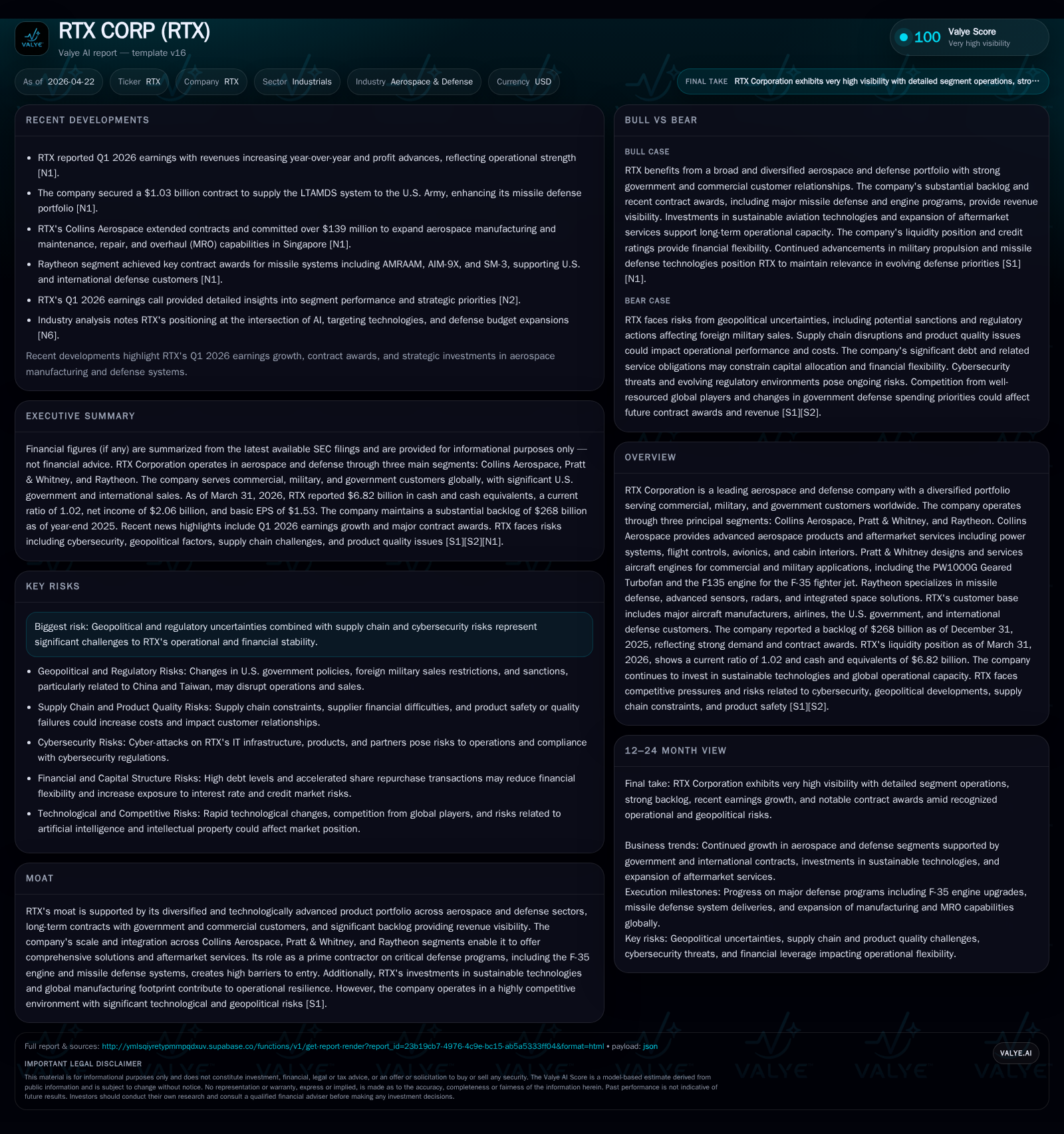
RTX Corporation reported better-than-expected Q1 2026 results reflecting robust demand in both commercial aerospace and defense sectors. A large $268 billion backlog coupled with a diversified product portfolio across Collins Aerospace, Pratt & Whitney, and Raytheon underpins stable revenue streams. Despite geopolitical and regulatory headwinds, RTX’s integration of advanced systems like the F135 engine and missile defense technologies fortifies its competitive moat. Sustained government spending, expanding aftermarket services, and innovation in sustainable aviation fuel-compatible platforms are key growth drivers. Capital allocation remains balanced amid a sizable pension cost structure and manageable leverage.
Recent Operating Update: Q1 2026 Performance Anchors Current View
RTX Corporation’s latest 10-Q filing dated April 21, 2026 [S2] reveals incremental shifts in its financial risk profile with relatively stable third-party guarantees totaling $247 million as of March 31, 2026—largely unchanged from December 31, 2025. Notably, commercial aerospace financing arrangements decreased from a maximum potential payment of $106 million at year-end to $68 million by quarter-end, indicating improved risk management or refinanced exposure.
Defined pension plans remain an operational expense item with service costs steady around $41 million per quarter. The company reported non-operating pension expenses lowered to $505 million from $583 million year-over-year, primarily driven by reduced interest costs coupled with lower expected returns on plan assets ($836M versus $917M prior). Importantly, Q1 also benefited from a net settlement and special termination gain of $4 million.
A contemporaneous press release filed via Form 8-K on the same date [S3] confirms the earnings announcement underpinning these figures. External news sources report that RTX’s revenues have continued their upward trajectory, surpassing analyst estimates for the quarter [N1], with management on the earnings call alluding to improved production rates at Pratt & Whitney and stronger after-sales service demand driving overall top-line growth [N2]. This near-term positive momentum contrasts previous quarters restrained by contract transition delays.
Business Model and Segmentation
RTX's revenue generation streams chiefly arise from three principal business segments delineated in its annual 10-K (February 6, 2026) filing [S1]:
- Collins Aerospace: Provides integrated avionics systems, electric power generation/control units, cabin interiors (including environmental control and oxygen systems), air data sensing systems, landing gear components, and aftermarket maintenance solutions. The segment serves a broad clientele base spanning commercial airlines to military operators.
- Pratt & Whitney: Designs advanced propulsion engines such as the PW1000G Geared Turbofan for commercial jets and the F135 engine powering the F-35 fighter jet. Engine sales combine new build deliveries plus comprehensive aftermarket service offerings vital for lifecycle support.
- Raytheon: Specializes in mission-critical defense technologies including missile defense systems (Patriot launchers), advanced sensors/radars (SPY-6 hardware), integrated space solutions, precision munitions (Javelin), and emerging counter-unmanned aerial systems (LIDS).
Each segment operates with a degree of managerial autonomy yet benefits from cross-divisional technological spillovers—Pratt & Whitney’s propulsion insights feed Collins’ nacelles while Raytheon's missile defense R&D complements aerospace sensors development.
Revenue contributions reflect this blend: substantial portion from commercial aviation markets through Collins and Pratt & Whitney balanced by growing defense contracts via Raytheon. Aftermarket services constitute a stable recurring revenue source helping smooth cyclical fluctuations typical in new aircraft orders.
Industry Structure and Competitive Positioning
RTX holds a formidable competitive position underpinned by:
- Deep Backlog: As per latest available data (Dec '25), total backlog hit $268 billion [S1], rising from $218 billion year-over-year—a key indicator of future revenue visibility with about one-quarter expected within the subsequent twelve months.
- Prime Contractor Status: Particularly for complex government programs like F-35 propulsion integration and missile systems procurement where switching costs are high.
- Technological Leadership: Pioneering geared turbofan engines offering step-changes in fuel efficiency; integrated avionics combining flight controls with connectivity solutions; cutting-edge missile guidance tech meeting evolving geopolitical threats.
- Global Footprint With Manufacturing Scale: Spanning multiple countries helps mitigate localized supply chain risks and supports servicing international customers effectively.
However, RTX contends with intensive competition from other legacy primes (e.g., Lockheed Martin for defense platforms; GE Aviation for engines) as well as emerging challengers focusing on novel propulsion paradigms like electric or hybrid aircraft propulsion systems—an area requiring vigilant R&D dedication.
Growth Drivers and Constraints
Growth catalysts include:
- Sustained Government Defense Spending: Despite cyclical budgetary debates in Washington D.C., continuous funding on major missile defense upgrades (Patriot GEM-T), next-generation radar arrays (SPY-6), and global allied procurements buffer longer-term order flow.
- Commercial Aviation Recovery & Expansion: Rising demand for new-build aircraft equipped with fuel-efficient engines supports Pratt & Whitney's production ramp; increased flying hours boost aftermarket overhaul revenues.
- Aftermarket Services Expansion: Services deliver higher margin opportunities with increasing fleet sizes requiring maintenance support—Collins Aerospace's connected aviation solutions amplify customer stickiness through digital offerings.
- Technology Innovation Focus: Investments into alternative titanium supplies to reduce raw material dependence alongside initiatives on sustainable aviation fuels align with shifting airline emission mandates enhancing RTX’s market relevance.
Growth constraints stem mainly from:
- Geopolitical Uncertainties & Regulatory Risks: Export controls, sanctions regimes linked to Russia/China impact international contracts; compliance costs rise amidst tightening cybersecurity demands [S1].
- Supply Chain Volatility: Delays or cost inflation for critical materials can disrupt manufacturing cadence affecting delivery commitments.
- Pension Funding Obligations: Large pension liabilities impose cash outflow pressures counterbalanced somewhat by expected asset returns but still limiting free cash flow flexibility.
- Government Contract Risks: Potential termination or renegotiation risks exist due to USD-based appropriations processes vulnerable to political shifts which may delay payments or program starts [S1].
What To Watch Next
Key upcoming indicators include:
- Monitoring revised annual guidance updates post-Q1 earnings, which have already been lifted signaling confidence in full-year sales and adjusted EPS trajectories [N10].
- Bookings trends during subsequent quarters especially for Raytheon’s defense orders given geopolitical dynamics impacting US overseas engagements.
- Execution success at Pratt & Whitney relating to engine performance improvement measures announced previously targeting cost optimization without compromising reliability.
- Progress on alternative titanium sourcing initiatives critical to mitigating prior disruptions at Collins Aerospace segment highlighted in earlier filings [S18].
- Pension plan actuarial assumptions updates around discount rates or asset returns influencing net periodic costs going forward.
Financial Profile Overview
Historical performance (annual)
| FY | Rev ($bn) | Net ($bn) | CFO ($bn) | OpInc ($bn) | Rev YoY | Net YoY |
|---|---|---|---|---|---|---|
| 2025 | 6.7 | 10.6 | 9.3 | +41.0% | ||
| 2024 | 80.7 | 4.8 | 7.2 | 6.5 | +17.1% | +49.4% |
| 2023 | 68.9 | 3.2 | 3.6 | +2.8% | -38.5% | |
| 2022 | 67.1 | 5.2 | 5.4 | +4.2% |
Source: SEC companyfacts cache [F1].
Capital returns and efficiency (annual)
| FY | Div ($bn) | Buybacks ($bn) | FCF ($bn) |
|---|---|---|---|
| 2025 | 3.6 | 0.1 | 7.9 |
| 2024 | 3.2 | 0.4 | 4.5 |
| 2023 | 3.2 | 12.9 | |
| 2022 | 3.1 | 2.8 |
Source: SEC companyfacts cache [F1].
RTX’s top-line exhibited robust momentum with reported revenues reaching approximately $80.7 billion for FY 2024 [F1]. Operating income surged sharply to about $9.3 billion as of FY 2025 end—up over 42% year-on-year reflecting operational leverage benefits alongside higher volume execution [F1]. Net income similarly improved from roughly $4.8 billion in FY 2024 to around $6.7 billion in FY 2025 indicating profitable growth expansion [F1].
Liquidity metrics indicate current assets at approximately $60 billion versus current liabilities near $58.5 billion as of Q1 2026 end yielding an adequate current ratio (~1.02) that suggests balanced short-term funding capacity [F1]. Cash and equivalents rose to about $6.8 billion supporting working capital needs.
Operating cash flow reached close to $10.6 billion for FY 2025—highlighting strong cash generation capability underlying capital allocation flexibility [F1]. Capital expenditure remained stable near $2.6 billion annually focused on sustaining manufacturing infrastructure and R&D facilities investment [F1]. Dividends payout rose modestly above $3.5 billion maintaining shareholder return consistency while share repurchases dropped significantly compared to prior years reflecting conservative deployment amid debt servicing priorities post accelerated share repurchase program concluded late 2024 [F1].
This financial positioning supports ongoing investments into technology development while managing the sizeable pension obligations described earlier.
Conclusion
RTX Corporation stands as a heavyweight aerospace-defense conglomerate leveraging a diversified portfolio spanning essential commercial aircraft components to sophisticated missile defense systems. Their substantial backlog supports long-term revenue certainty buttressed by evolving government priorities toward enhanced military readiness globally alongside gradual normalization of global civil aviation sectors after recent disruptions.
While exposure to geopolitical fluctuations remains an overarching risk factor acknowledged explicitly by management, RTX’s entrenched technology leadership, end-to-end solutions approach across multiple flight mission parameters, broad OEM/customer base loyalty, plus consistent execution discipline combine constructively toward resilient growth profiles over medium-term horizons.
This analysis synthesizes publicly available SEC filings and news disclosures without providing investment recommendations.
Disclaimer: This is research-only, informational analysis and not investment advice. It may include AI-generated interpretation and general industry context. Always verify important details using primary sources.

Comments