
Equifax: Strengthening Data Insights Drives Q1 Revenue Beat
Equifax’s Q1 2026 results underscore resilient growth supported by its diversified data and analytics services despite sector seasonality and regulatory headwinds.
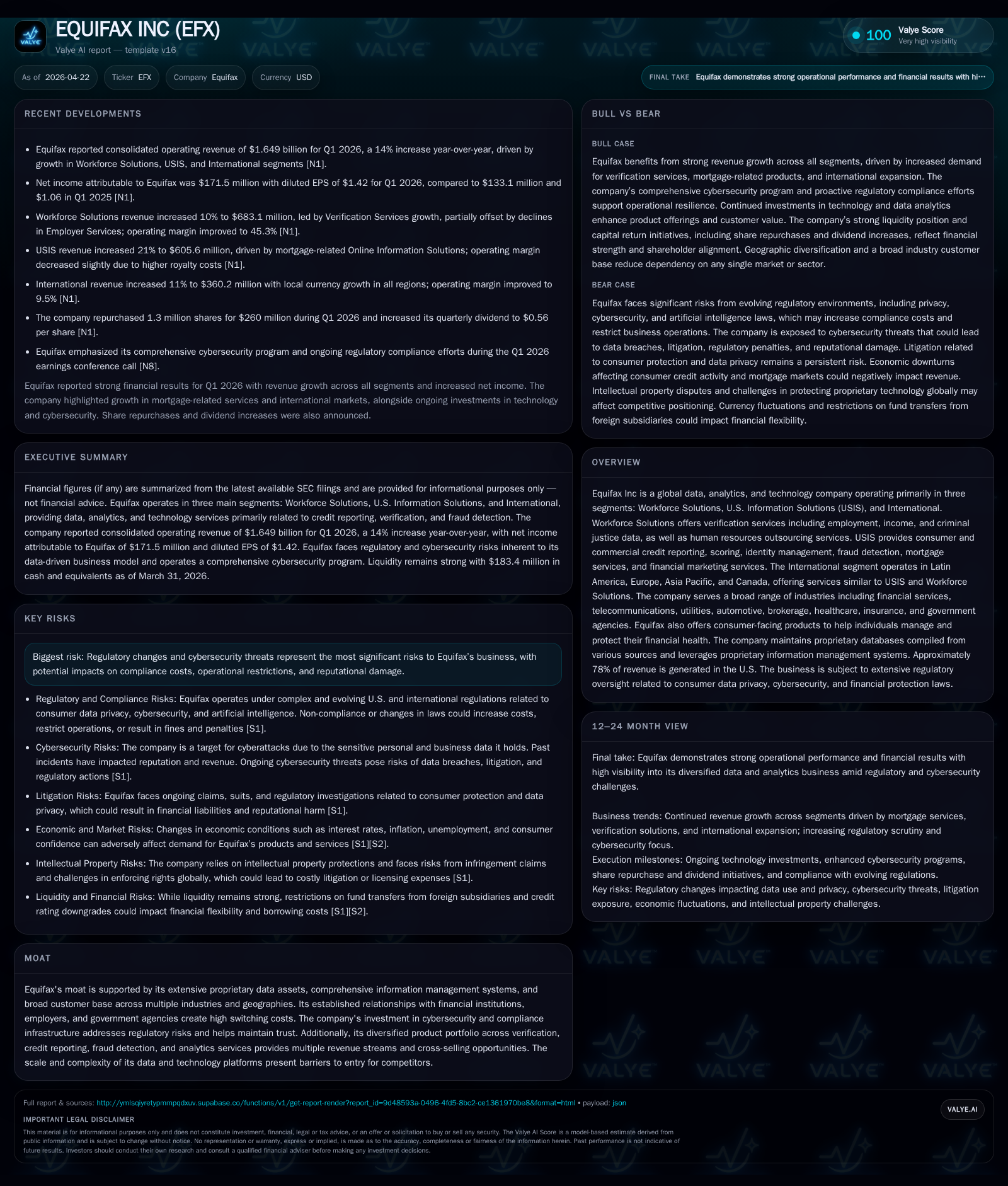
In Q1 2026, Equifax reported a robust 14% year-over-year revenue increase, defying typical seasonal lows in consumer lending activity through strong performance across its Workforce Solutions, U.S. Information Solutions (USIS), and International segments. The company leverages extensive proprietary data assets, subscription and transaction-based revenue streams, and broad industry penetration to maintain competitive advantages amidst evolving regulatory scrutiny and cybersecurity demands. Ongoing growth is propelled by digital lending trends, geographic expansion, and product innovation focused on AI integration for fraud detection and decision analytics. Regulatory investigations, particularly from the CFPB, and antitrust litigation represent material operational risks requiring vigilant compliance investments.
Q1 2026 Operating Update: Revenue Growth Across Key Segments
Equifax reported a marked acceleration in revenue during Q1 2026 with a 14% year-over-year increase despite the traditional seasonal lull in consumer lending that typically suppresses performance in the USIS online consumer information services sub-segment [S2][N4][N7]. This outperformance was due largely to strength in both transactional income verification volumes under Workforce Solutions as well as recurring subscription sales across all major segments. Employer Services within Workforce Solutions enjoyed elevated activity primarily driven by ACA compliance cycles and onboarding services prominent in Q1 [S2][S22]. The International segment also contributed steadily as geographic diversification benefits mitigated isolated regional slowdowns. Seasonality is a known structural factor across Equifax’s businesses — mortgage-related revenues peak midyear while financial marketing services see their highest deliveries in Q4 — but early-year momentum suggests broader business resilience [S2][S13].
During the earnings call accompanying these results [N1], management highlighted sustained demand for real-time employment and income verifications alongside growth in identity verification and fraud detection offerings—areas increasingly critical amidst digitization of financial services.
Business Model and High-Quality Product Suite
Equifax’s revenues derive primarily from three principal segments: Workforce Solutions, U.S. Information Solutions (USIS), and International operations covering Latin America, Europe, Asia Pacific, and Canada [S1][S2][S4]. Each segment blends transaction-based revenues—such as verifications of employment or credit reports—with subscription models that provide steady recurring income streams.
The Workforce Solutions segment offers broad verification capabilities including employment history, income validation, criminal records checks, immigration case management compliance (notably I-9 verification), tax credit administration, and ACA compliance services. These offerings cater heavily to employers integrating automation within human resources workflows alongside regulatory adherence requirements. Contractual arrangements often span multi-year engagements adding predictability to revenue [S1].
USIS blends consumer and commercial credit reporting with advanced analytical tools for risk scoring, portfolio management software, fraud detection analytics models using machine learning techniques, identity protection products sold directly or via resellers, and financial marketing solutions that assist institutions in customer acquisition strategies based on enriched consumer wealth profiles. This segment’s high mix of transactional revenue is complemented by growing subscription components where clients purchase license usage for decisioning software frequently updated through proprietary data asset enhancements [S1].
International operations replicate USIS-like offerings across diverse regulatory environments providing credit data access in emerging markets such as Latin America where digital credit penetration is rising rapidly. Equifax augments these markets with technology-enabled recovery management support services that address local debt collection nuances [S1][S15].
The company’s competitive advantage depends heavily on continuously refreshed proprietary data stores drawn from large-scale partnerships with payroll processors, lenders across industries such as brokerage, insurance,and healthcare—and government agencies—creating entrenched switching costs enforced by compliance overlap especially under the Fair Credit Reporting Act (FCRA) [S19].
Competitive Positioning within the Credit Reporting and Analytics Industry
Within the triopoly of major U.S. credit bureaus alongside TransUnion and Experian, Equifax distinguishes itself through scale—handling billions of verified employment transactions annually—and its broad product suite that extends beyond mere credit reporting into identity management and workforce solutions accessible through sophisticated cloud-based platforms . The resulting ecosystem effect greatly increases client retention rates through integration into their core business processes.
Regulatory complexity forms both a moat and a hurdle; stringent standards around FCRA compliance coupled with evolving AI regulation create high entry barriers that smaller competitors struggle to meet due to the capital intensity of technology investment required for secure data handling infrastructures [S1][S10]. Equifax’s investments in cybersecurity fortification further support trust with clients wary of reputational fallout from breaches. Its global footprint serves not only as a diversification lever but also as an intelligence aggregation advantage enabling more robust fraud patterns identification that smaller regional players cannot match fully [S13].
However, this positioning comes under increasing pressure from ongoing litigation risks—including antitrust claims accusing anti-competitive conduct tied to Workforce Solutions—and heightened CFPB scrutiny checking adherence to dispute resolution processes—a regulatory trend echoed elsewhere impacting cost of compliance materially [S5][S18]. Emerging AI laws present compliance challenges but also opportunities for product differentiation if executed adeptly.
Growth Catalysts: Expanding Demand and Cross-Sell Opportunities
Demand dynamics favor Equifax due to multiple structural trends. Digital lending continues rapid adoption catalyzing need for instantaneous fraud detection tools embedded within origination workflows—Equifax’s fraud analytic models utilize advanced AI capabilities offering superior accuracy which commands premium pricing power [N1]. Meanwhile broader workforce automation adoption accelerates requirements for automated employment verification; legislative environments mandating stringent tax credit documentation (e.g., Work Opportunity Tax Credit) add stickiness to Employer Services.
Geographic growth is notable particularly in Latin America where the burgeoning middle class’s increasing access to credit necessitates better consumer risk evaluation historically constrained by paper-based or siloed bureau systems. Expansion initiatives rely on scalable technology deployments adapting USIS-like services localized for each jurisdiction [S25].
Cross-selling remains a vital vector; existing enterprise clients often contract across multiple segments leveraging integrated insights spanning credit risk profiles aligned with employment stability data thus deepening client wallet share without proportional sales costs increment . The pipeline includes targeted upgrades embedding AI-driven decisioning modules enhancing underwriting speed while reducing losses.
Risk Factors: Regulatory Challenges and Cybersecurity Vigilance
Equifax faces concentrated risk surrounding regulatory compliance mandates prominently flagged by ongoing CFPB investigations probing Workforce Solutions’ handling of data accuracy disputes under FCRA statutes. Repeated Civil Investigative Demands indicate intensive oversight that could result in fines or mandated remediation altering operational practices materially if penalties are assessed adversely [S5][S18].
Antitrust litigation alleging unfair competition introduces episodic uncertainty impacting potential resource diversion irrespective of ultimate legal outcome. Further complicating matters are multifaceted privacy regulations globally including GDPR extensions across Europe or nascent state-level AI frameworks imposing transparency or bias mitigation requirements on algorithmic decision-making tools which underpin core product lines [S10].
Cybersecurity threat vectors remain acute given sensitivity of data processed; any breach not only risks direct remedial cost but severe reputational damage harming client trust critical for renewal rates amid long sales cycles. Management has publicly emphasized ongoing investments raising barriers against such intrusions involving encryption enhancements along with incident response readiness programs .
Performance Metrics and Financial Health Overview
Historical performance (annual)
| FY | Net ($mm) | CFO ($mm) | OpInc ($mm) | Capex ($mm) | Net YoY |
|---|---|---|---|---|---|
| 2025 | 660 | 1616 | 1095 | 481 | +9.3% |
| 2024 | 604 | 1325 | 1042 | 512 | +10.8% |
| 2023 | 545 | 1117 | 934 | 601 | -21.7% |
| 2022 | 696 | 757 | 1056 | 625 |
Source: SEC companyfacts cache [F1].
Capital returns and efficiency (annual)
| FY | Div ($mm) | Buybacks ($mm) | FCF ($mm) |
|---|---|---|---|
| 2025 | 233 | 928 | 1134 |
| 2024 | 193 | 813 | |
| 2023 | 192 | 0 | 516 |
| 2022 | 191 | 0 | 133 |
Source: SEC companyfacts cache [F1].
Supporting this operational narrative is a stable financial profile reflecting disciplined execution [F1]. Fiscal year 2025 operating income grew approximately 5.1% year-over-year to $1.095 billion while net income expanded 9.3% driven by margin improvements from efficient expense control measures despite increased investment in technology infrastructure. Operating cash flow surged 22% to $1.62 billion sustaining significant free cash flow after $481 million in capital expenditures focused predominantly on software development enhancing analytic capabilities plus resilience upgrades [F1].
The balance sheet remains solid although the current ratio at quarter-end March 2026 stands at about 0.61 due largely to elevated short-term liabilities relative to current assets reflecting commercial paper notes outstanding under liquidity facilities—a manageable structure given committed revolving credit availability totaling $1.5 billion maturing beyond August 2028 [F1][S11][S14]. Equity totaled approximately $4.6 billion as of year-end December 2025 underpinning strong returns on equity (~14%). Capital allocation includes shareholder returns manifested by dividends growing modestly to $233 million paid during FY2025 alongside substantial share repurchases totaling $927 million reflecting confidence in intrinsic value capture while investing prudently for growth [F1].
Outlook and Key Milestones to Monitor Moving Forward
Post-Q1 results have prompted an optimistic revision of full-year guidance emphasizing top-line acceleration aligned with improved cross-segment sell-through particularly among financial service enterprise clients embracing AI-powered solutions more broadly [N7][S2][N1]. Important milestones scheduled include resolution developments regarding CFPB inquiries expected over next several quarters which could substantially affect operational freedom or necessitate strategic pivots.
Attention should focus on further integration progress of artificial intelligence within product stacks subject to upcoming regulatory clarity both domestically and internationally shaping permissible use cases alongside compliance regimes tightening globally considering privacy safeguards simultaneously balancing innovation incentives.
Continued expansion execution into growth geographies—especially Latin America—and measurement against projected volume upticks relating to loan originations post-pandemic recovery remain pertinent demand markers signaling sustainability beyond cyclical factors related to mortgage or lending seasonality experienced historically each year quarter-to-quarter [S13][N7]. Monitoring margin trajectory concurrent with technology spend scaling will determine efficiency gains sustainability amid competitive pressures.
This analysis synthesizes recent disclosure filings paired with thematic industry insights designed exclusively for informational purposes without expressing investment advice or valuations.
Disclaimer: This is research-only, informational analysis and not investment advice. It may include AI-generated interpretation and general industry context. Always verify important details using primary sources.

Comments