
AUNA S.A. Leverages Latin American Footprint to Drive Ambulatory and Oncology Services Momentum
AUNA's Q1 2026 update highlights growth acceleration in specialty health services across Peru, Colombia, and Mexico amid operational leverage and governance complexities.
AUNA S.A.’s first quarter 2026 preliminary results reveal momentum in utilization and revenue growth driven by oncology expansion in Mexico and enhanced ambulatory care utilization in Peru. The company’s multi-national healthcare platform benefits from strategic public-private partnerships and diversified service lines, particularly prepaid oncology plans through Oncosalud Peru. Although liquidity remains tight, with current ratios under 1.0, AUNA manages leverage cautiously amid shareholder governance influence and regulatory challenges inherent in Latin American healthcare markets. Upcoming milestones include continued acquisition integration and evolving payer contracts that will shape near-term growth trajectories.
Quarter 1 2026 Operating Highlights and Key Metrics
AUNA S.A.’s latest quarterly filing dated April 17, 2026 [S2] delivers preliminary key performance indicators for Q1 ending March 31, 2026 that reflect sustained operational momentum following its full-year 2025 results [S3]. Notably, the company reports increases in patient utilization rates across its core geographies, with Mexican oncology initiatives driving higher throughput of complex treatments. The Oncosalud prepaid plan membership continues to rise steadily in Peru, contributing to an enhanced payer mix favoring specialized care.
This uptick in utilization is particularly significant given AUNA’s largely fixed asset base; improved volume amplifies margin expansion through better absorption of operating leverage [S28]. Alongside rising outpatient consultations, diagnostic imaging procedures have expanded — key revenue drivers underpinning the ambulatory services segment’s growth [N5]. The data signals solid demand for both oncology services in Mexico and ambulatory care throughout Peru’s network.
Compared to Q4 2025 results reported in March [S3], Q1 shows early signs of stabilizing Mexican operations after previous softness [N12]. Combined with ongoing enhancements in Colombia via risk-sharing contracts reinforcing revenue sustainability [N1], AUNA's tri-national footprint enables balanced regional performance. The company’s broad service portfolio mitigates exposure to market-specific volatilities.
Business Model: Multi-National Healthcare Services with Specialty Focus
AUNA operates through distinct yet interlinked segments: Oncosalud Peru (prepaid plans focused on oncology), broader healthcare services in Peru beyond Oncosalud facilities, plus comprehensive services in Colombia and Mexico including dental and vision insurance alongside oncology [S20]. This configuration allows cross-segment synergies; for instance, Oncosalud acts as a payer for Peruvian healthcare facilities where specialized services are delivered.
The prepaid model primarily fuels steady cash flow while third-party payers complement revenue streams via in-network arrangements enhancing patient volumes. This duality supports a robust payer mix that buffers revenue against economic cycles affecting out-of-pocket spending [S1]. Higher complexity procedures—such as complex surgeries or advanced cancer treatments—generate superior revenues relative to lower-complexity outpatient care.
Since 2019, aggressive acquisition activity has expanded AUNA’s platform substantially: flagship deals include Grupo OCA (Mexico) and IMAT Oncomedica (Colombia), broadening geographic reach while adding specialty expertise [S1]. Such acquisitions accelerate both scale economies and access to growing specialty service lines.
Industry Context: Latin America Healthcare Dynamics and AUNA's Position
Latin America presents a fragmented healthcare landscape marked by significant unmet demand for specialty care alongside evolving regulatory frameworks that vary country-by-country [N10]. Pricing power tends to be constrained by government mandates and reimbursement policies; however, providers like AUNA with diversified country exposure can leverage structural tailwinds such as urban population growth and rising middle-class demand for quality ambulatory services.
Competition is intense but segmented between large hospital chains, smaller clinics, and public providers. AUNA’s footprint across Peru, Colombia, and Mexico affords it scale advantages absent from more localized operators [N8]. In Mexico specifically, a recent stabilization implies the company is overcoming prior headwinds related to payer negotiations [N12]. Colombian risk-sharing arrangements further support predictable revenue flows amid volatile insurance landscapes [N1].
Capacity remains a bottleneck given capital-intensive nature of specialist care infrastructure; AUNA partially mitigates this via facility leasing strategies embedded in public-private partnership models such as the Centro Ambulatorio Trecca PPP agreement in Peru—a structural moat element [S1].
Growth Drivers: Public-Private Partnerships, Oncology Expansion, and Geographic Diversification
Key growth levers include strategic PPP contracts enabling leveraged access to infrastructure without heavy upfront capital deployment—an important factor given the elongated capital recovery timelines typical of emerging market healthcare projects [S25]. The Trecca PPP exemplifies this approach.
Oncology stands out as a high-growth specialty segment due to demographic shifts coupled with increasing screening rates leading to higher incidence detection. The rising demand for advanced oncological treatments is particularly pronounced in Mexico where AUNA has expanded dedicated oncology centers post Grupo OCA acquisition [N5].
Geographic diversification reduces risk concentration while tapping differing epidemiological profiles; Colombia’s risk-sharing approach promotes prudent utilization management enhancing margins over time [N1]. Organic growth complements M&A-driven expansion through improving outpatient facility utilization rates across Peru’s network [N10]. Enhanced cross-selling of diagnostic imaging and lab services deepens patient engagement.
Operationally, scale economies emerge as fixed costs dilute with increased throughput—a classic operating leverage scenario benefiting EBITDA margin progression. Capital investments have been deployed selectively aligned with facility expansions balanced by efficiency programs targeting process synergies at local and regional levels [S24].
Risks and Constraints: Shareholder Influence, Liquidity Pressures, and Regulatory Landscape
The control consolidation held by Enfoca as majority Class B shareholder wields material influence on strategic decisions potentially constraining responsiveness or precipitating conflicts linked to related-party transactions. Despite formal safeguards requiring audit committee oversight under Luxembourg law ensuring arm’s-length dealings [S1], this ownership dynamic warrants scrutiny.
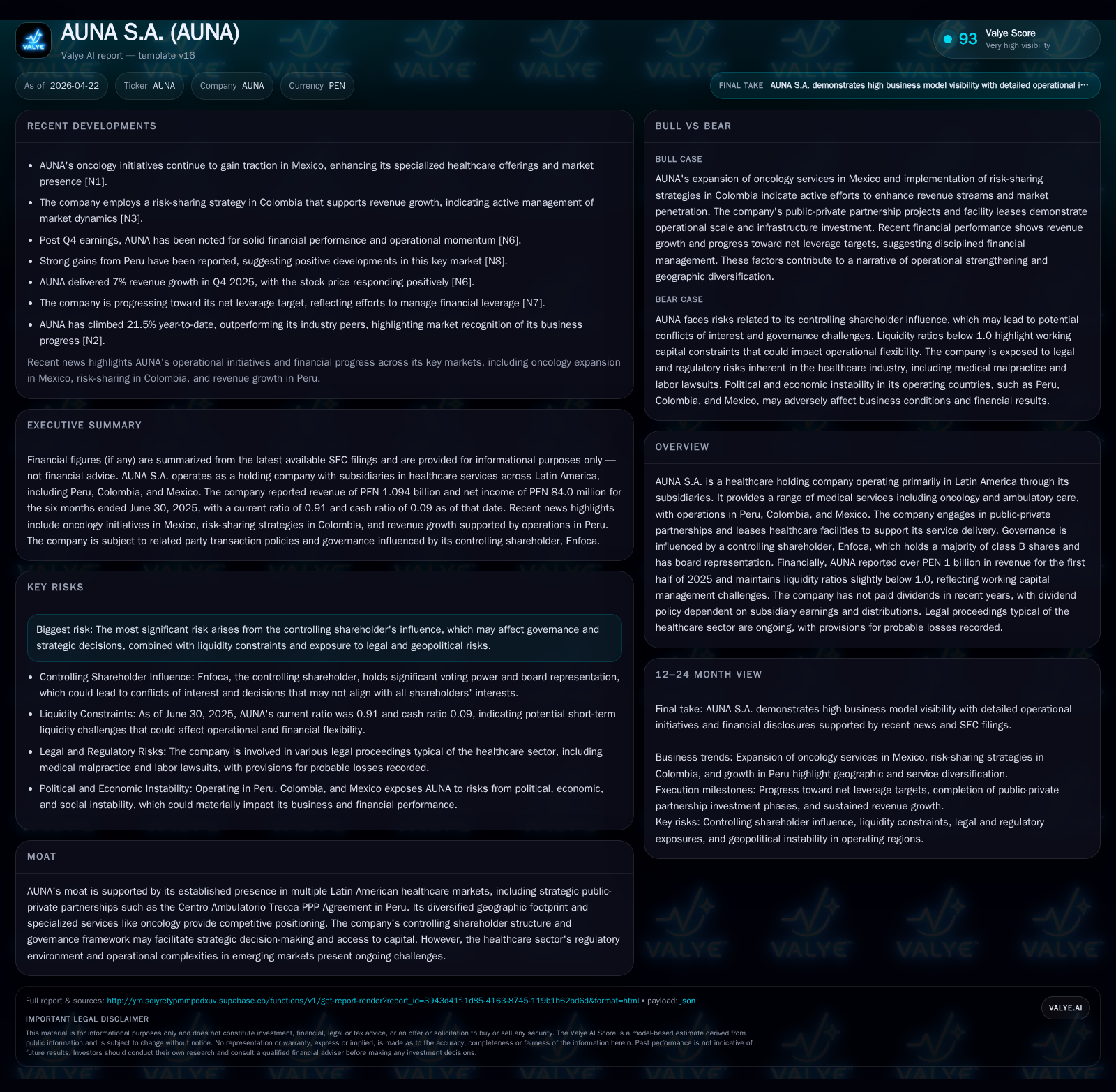
From a financial standpoint, working capital management challenges persist as reflected by sub-1.0 current ratios (0.91 as per mid-2025 data) indicating liquidity tightness that could impact operational agility during demand fluctuations or unexpected disbursements [F1], [S4]. Adjusted leverage around 3.6x underscores moderate indebtedness necessitating covenant adherence imposed by multiple credit instruments with restrictions on dividends and new debt incurrences [S7], [S21].
Regulatory complexity across jurisdictions encompassing licensing requirements, mandatory reporting standards, reimbursement schedules, plus ongoing legal proceedings customary in the sector add execution risk layers. However, these factors impose entry barriers protecting incumbents like AUNA from rapid competitor encroachment.
Governance and Shareholder Structure Impacting Strategy Execution
Ownership is skewed towards Enfoca along with pre-IPO Class B shareholders who collectively hold controlling stakes accompanied by board representation facilitating coordinated governance but raising concerns over minority rights protection [S1]. The company's related person transaction policy mandates stringent evaluation processes by audit committees prior to approving dealings with affiliates or related parties consistent with Luxembourg corporate governance statutes.
Such structure confers potential advantages including strategic coherence during M&A integration phases or negotiating capital initiatives while requiring vigilant transparency standards to mitigate conflicts of interest risks. Given Sponsor Financing arrangements secured on shares held by majority stakeholders bearing change-of-control covenants could trigger forced repayments impacting share stability if breached [S4], [S21].
Financial Overview: Revenue Growth, Liquidity Ratios, and Capital Structure Insights
Supporting the operational narrative, AUNA surpassed PEN 1 billion in revenue for H1 2025 signaling robust topline scale principally from organic volume gains combined with acquisition contributions [F1], [S3]. Net income manifested positive returns reflecting improving cost controls though margin enhancement opportunities remain given fixed cost absorption dynamics.
Liquidity metrics indicate working capital pressures: cash equivalents approximated PEN 175 million mid-2025 against current liabilities exceeding PEN 1.88 billion yielding a current ratio near 0.91 highlighting tight short-term resource availability [F1]. Adjusted consolidated leverage stood near 3.62x amidst a complex debt profile involving senior secured notes maturing through the decade supported by collateralized assets across subsidiaries underpinning financing stability despite covenant constraints [S7], [S9], [S17]. Interest coverage ratios above minimum thresholds convey manageable debt servicing capacity.
Dividend distributions are currently suspended reflecting subsidiary earnings dependency plus covenant-imposed restrictions aimed at preserving capital flexibility amid investment phase continuity [S6], consistent with growing infrastructure commitments.
Outlook: Upcoming Milestones and Market Signals to Monitor
Market watchers should focus on forthcoming comprehensive Q1 financial disclosures refining preliminary KPI impact assessments post-April filings including detailed revenue breakdowns by segment and geography to confirm momentum trajectories outlined earlier this year [S2], [S3]. Integration progress of recent Mexican (Grupo OCA) and Colombian acquisitions remains pivotal for achieving anticipated synergy targets shaping medium-term earnings power.[N2]
Regulatory developments especially changes influencing reimbursement policies or PPP contract renewals could materially affect margins given sensitivity to payment timing across jurisdictions. Similarly, monitoring evolving payer contract negotiations will shed light on pricing adjustments crucial for sustaining top-line growth amid competitive pressure.
Dividend policy changes contingent upon improving subsidiary profitability merit attention alongside any announced adjustments in capital expenditure programs indicative of expansion or modernization priorities.[N9]
Overall, sustained execution on outpatient volume ramp-ups combined with specialty service line penetrations underpinned by disciplined capital management defines the critical watchpoints through mid-2026.
Disclaimer: This analysis is intended solely for informational purposes reflecting AUNA S.A.’s publicly available filings and market data without offering investment advice or recommendations.
Disclaimer: This is research-only, informational analysis and not investment advice. It may include AI-generated interpretation and general industry context. Always verify important details using primary sources.

Comments