
Woori Financial Group Embraces Digital Innovation to Reinforce Market Standing
The latest quarterly update highlights Woori Financial’s ongoing commitment to digital transformation, diversified financial offerings, and strategic growth initiatives.
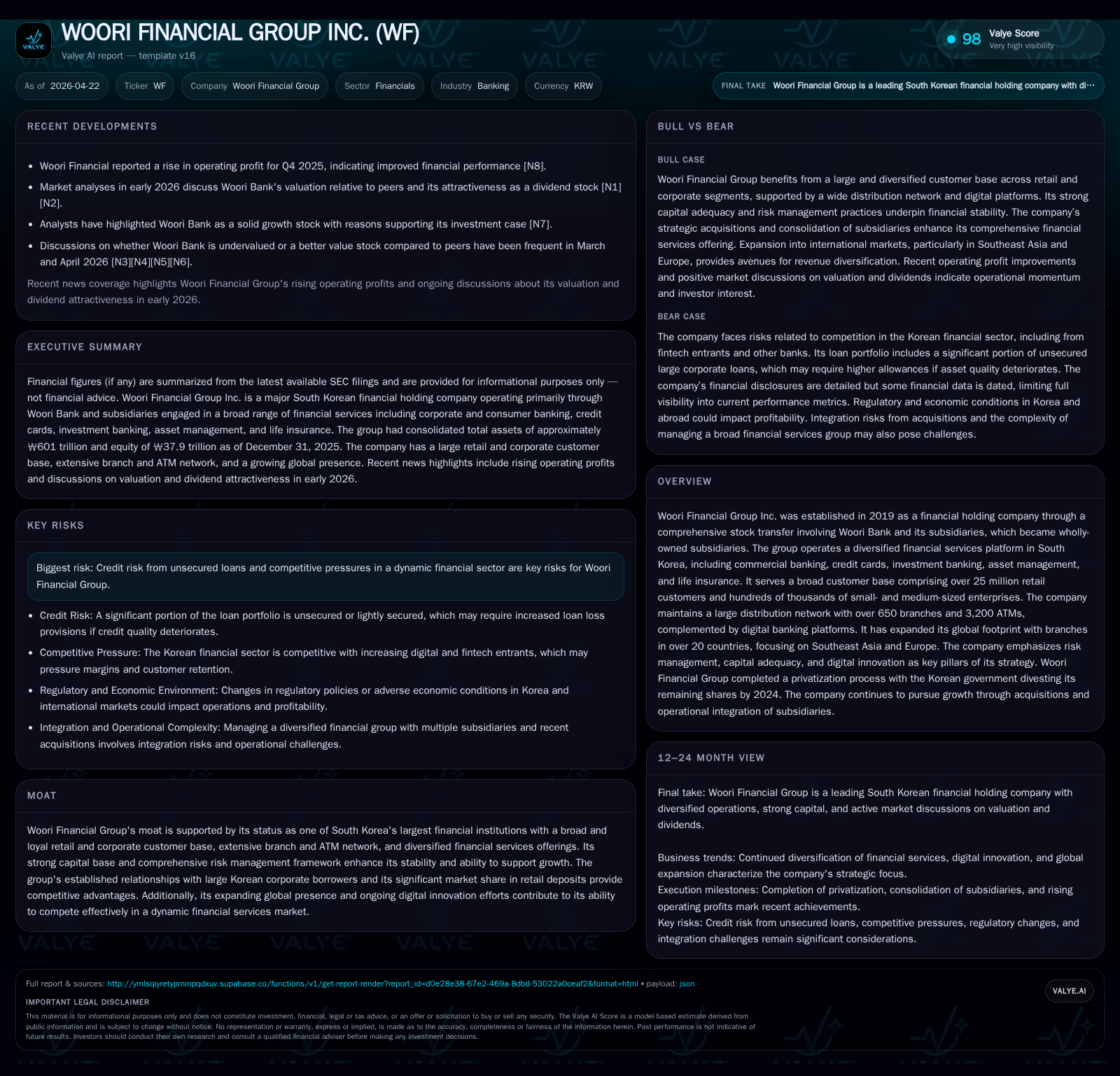
Woori Financial Group’s April 2026 operating disclosures reinforce its transparent investor communications and reveal ongoing momentum ahead of the Q1 earnings release. As South Korea’s major integrated financial services provider, Woori leverages its extensive branch network, comprehensive product suite spanning commercial banking to insurance, and broad customer base. The group’s strategic emphasis on digital innovation—including blockchain-based ID services—and the potential expansion into the insurance sector underscore resilience amid intense industry competition and regulatory evolution. Looking forward, key execution milestones include the upcoming Q1 earnings webcast and decisions on insurance integration, with digital strategy and risk management continuing as growth and stability pillars.
Q1 2026 Operating Update and Market Communication
On April 21, 2026, Woori Financial Group announced the scheduling of its First Quarter Earnings Release Conference for April 24. This event will be conducted via a live audio webcast accessible in both Korean and English with simultaneous interpretation provided, signaling an inclusive approach toward both domestic and international investors [S2]. The availability of IR materials on the corporate website alongside this webcast demonstrates a commitment to enhanced transparency. This timely disclosure serves as a critical near-term communication milestone that precedes the official release of quarterly financial results, setting investor expectations for operational momentum.
Business Model Overview: Integrated Financial Services with Broad Customer Reach
Established as a financial holding company in 2019 through consolidation of Woori Bank and its subsidiaries, Woori Financial Group operates an integrated platform covering commercial banking, credit cards, investment banking, asset management, and life insurance [S1]. It caters to over 25 million retail customers representing much of South Korea’s adult population alongside hundreds of thousands of small- and medium-sized enterprises (SMEs) [S4].
Woori segments retail consumers across mass market, middle class, mass affluent, and high net worth (HNW) tiers. Mass market clients access standardized products—such as mortgages and basic lending—via cost-efficient digital channels including mobile apps and ATMs emphasizing broad accessibility. Meanwhile, HNW customers receive personalized service through exclusive private banking centers staffed with experienced relationship managers offering tailored investment advice and wealth management solutions [S4].
On the corporate side, Woori pursues large corporate clients supported by dedicated corporate banking centers as well as SME customers who benefit from cross-division product offerings extending beyond loans into foreign exchange (FX), trade finance, derivatives risk hedging products, employee retirement benefits, investment trust services and advisory mandates. This wide product integration fosters deep client relationships that contribute to stronger customer retention rates while diversifying revenue beyond traditional net interest income streams [S4].
Competitive Positioning within South Korea’s Banking and Insurance Sectors
Woori Financial is positioned as one of South Korea’s largest financial institutions with an extensive branch network numbering over 650 locations augmented by more than 3,200 ATMs nationwide [S4]. This physical infrastructure supplements its digital platforms to create an omnichannel presence that caters efficiently across various customer segments.
The competitive environment is notably intense within Korea’s financial sector. Woori confronts challenges from both larger domestic players with significant resources and specialized institutions dominant in niche fields such as credit cards or securities brokerage [S1]. Foreign bank branches present further competition domestically. To differentiate itself amidst this crowded landscape requires ongoing investments in product innovation alongside leveraging longstanding relationships especially with large Korean conglomerates where Woori acts frequently as a principal lender.
In insurance—a segment with distinct dynamics—Woori faces established incumbents but aims to leverage acquisitions or integrations (e.g., the proposed inclusion of Tongyang Life Insurance) to broaden its footprints there. Such moves signal attempts at repositioning toward a multichannel financial services model less dependent solely on interest margin spread profits [S3].
Digital Transformation and Innovation as Growth Levers
Digital strategy underpins Woori’s efforts to modernize service delivery. The Chief Digital Officer heads group-wide initiatives encompassing ramping up user engagement across shared platforms while building foundational AI-driven data infrastructure aimed at enhancing personalized service capabilities [S1].
Highlighting innovative deployments is the launch in January 2022 of blockchain-enabled mobile driver’s license authentication based on decentralized identity technology—a pioneering move within Asian banking circles that aligns with broader shifts toward secure digital identity verification solutions.
For mass market clients who prefer low-touch interactions, expanded digital offerings translate into reduced servicing costs without compromising convenience. For premium segments such as private banking clientele, data analytics enable customized product targeting improving wallet share potential.
This technology-centric repositioning remains vital for competing effectively against fintech disruptors nimbly combining customer experience excellence with cost control advantages.
Expanding Insurance Businesses: Potential Integration Plans and Strategic Implications
Recent filings reaffirm ongoing review of potential acquisitions or mergers involving Tongyang Life Insurance with ABL Life Insurance potentially being part of consolidation strategies within Woori Financial Group [S3]. While no binding resolutions have been declared yet pending further regulatory approvals or internal board deliberations, this reflects management's intent to diversify revenue sources beyond traditional lending operations.
Insurance offers higher fee-based income opportunities which can counterbalance cyclicality tied to net interest margins impacted by interest rate fluctuations or macroeconomic cycles affecting loan demand. Entry or expanded presence in life insurance thus represents a strategic hedge adding resilience.
Monitoring disclosure timelines within the coming quarter will be essential to gauge concrete progress there.
Industry Dynamics: Competition, Regulation, and Risk Factors
Competition arises nationwide across commercial banks plus more regionally focused players wielding local knowledge advantages. Specialized entities excel in fee-rich verticals like credit cards historically dominated by exclusivities based on merchant acceptance networks or tailored reward programs complicating scale entrants' efforts.
Regulation has tightened substantially around cyber governance standards following amendments enacted by Korea's Financial Services Commission effective from February 2025 requiring enhanced board-level oversight over electronic finance transactions security [S13]. Woori has responded by strengthening cybersecurity governance structures—CISOs report regularly to boards while ad hoc vulnerability assessments are mandated for electronic infrastructures ensuring proactive risk curtailment.
Other risks encompass credit deterioration primarily via unsecured loans necessitating vigilant underwriting supported by advanced scoring models (e.g., Credit Wizard) calibrated continuously per borrower risk profiles [S10]. Regulatory investigations leading occasionally to fines—for example over collusion claims or anti-money laundering lapses—highlight vigilance needs but have so far not derailed strategic execution though reputational risks remain sensitive areas requiring management focus [S5,S8,S19,S24].
Growth Drivers and Constraints in Domestic and International Markets
Core growth vectors comprise expanding non-interest fee income utilizing trade finance fees, FX transaction volume increases driven by SME globalization trends,and upscale investment banking engagement with large corporates seeking advisory across M&A or capital markets activities [S4]. This strategic shift seeks to reduce dependence on cyclically sensitive interest spreads.
International expansion aims at Southeast Asia—a region with increasing trade flows tied to Korean manufacturing ecosystems—and select European markets reinforcing global franchise reach enabled through overseas branches providing foreign currency loans primarily tied to trade financing requirements [S9,S22].
Constraints predominantly relate to persistent structural margin pressure induced by fierce domestic competition among Korean banks jockeying for similar client bases compounded by macroeconomic headwinds such as tighter monetary policies impacting SMEs' borrowing sentiment. Balancing sustained innovation expenditures against cost discipline remains a key execution nuance.
Cross-selling synergies throughout the group’s diverse customer base represent upside if realized effectively leveraging integrated platform aspects.
Key Developments to Monitor: Quarterly Milestones, Regulatory Signals, and Execution Points
Investors should track outcomes from the April 24 Q1 earnings conference which will provide detailed operational metrics clarifying current trajectory post recent regulatory penalties levied earlier this year notably related to fair trade commission fines now contested in courts but paid under deadline requirements [S2,S5].
Further critical will be disclosures concerning life insurance acquisition deliberations expected either upon deal confirmation or within three months from mid-April communication intimated previously [S3].
Regulatory updates affecting cybersecurity frameworks or capital adequacy norms may also signal directional shifts requiring adaptive responses given heightened supervisory rigor nationally.
Lastly execution cadence related to cross-segment technology platform adoption rates potentially influencing efficiency ratios warrants scrutiny.
Summary Insights on Woori Financial’s Strategic Trajectory
Woori Financial Group is navigating a complex but opportunity-rich environment leveraging its long-established domestic leadership position buttressed by an integrated service model spanning commercial bank lending through investment banking to asset management and life insurance. Recent operational communications affirm steady investor engagement reflecting confidence in transparent governance.
The firm’s strategic emphasis on deepening digital transformation—evidenced by cutting-edge blockchain initiatives blended with AI infrastructure—and broadening non-interest income lines underpin resilience against evolving market competition. Growth ambitions are balanced carefully against regulatory imperatives especially cyber risk governance enhancements stipulated by Korean authorities.
Insurance sector diversification appears aligned with prudent revenue base expansion objectives designed to mitigate interest margin cyclicality inherent in traditional banking businesses. Execution monitoring around upcoming quarterly results alongside regulatory developments will remain crucial barometers for assessing whether these multidimensional initiatives coalesce into sustainable competitive advantage in South Korea's fast-evolving financial ecosystem.
This analysis is based exclusively on publicly filed regulatory disclosures without endorsement or investment judgment. Readers should consider this report informational rather than prescriptive regarding any securities decisions.
Disclaimer: This is research-only, informational analysis and not investment advice. It may include AI-generated interpretation and general industry context. Always verify important details using primary sources.

Comments