
Viridian Therapeutics Charts Path from Clinical Losses to Autoimmune Therapeutics Commercialization
Viridian is transitioning from extensive clinical R&D investments and operating losses towards potential commercialization of innovative autoimmune therapeutics, anchored by its lead thyroid eye disease candidates.
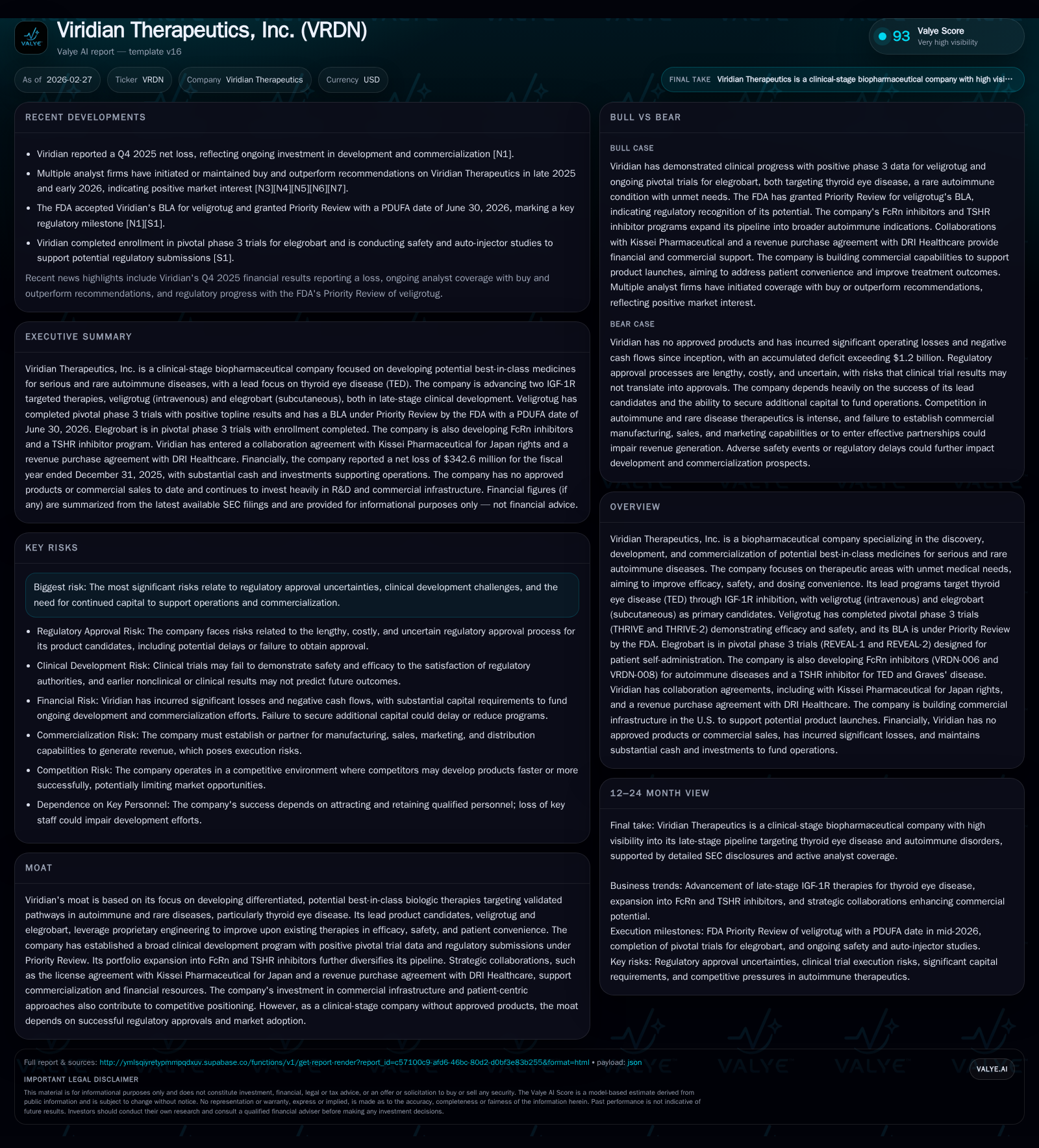
Viridian Therapeutics has historically operated with steep losses driven by heavy R&D and commercial build-out expenditures reflecting its clinical-stage focus. The company’s lead IGF-1R-targeting candidates for thyroid eye disease, veligrotug and elegrobart, are advancing through pivotal phase 3 trials with veligrotug under FDA Priority Review, marking a critical inflection. Efforts to establish commercial operations and market access programs complement its pipeline diversification into FcRn and TSHR inhibitors. Capital raising initiatives including equity offerings and strategic revenue purchase agreements underpin funding runway amid continuing cash burn. Risks remain in regulatory approvals, trial execution, and competitive dynamics as Viridian shifts toward potential product launch readiness.
Historic Financial Performance and Key Growth Drivers
Viridian Therapeutics’ financial history vividly reflects the heavy capital demands typical of a clinical-stage biopharma company advancing novel autoimmune therapies. Revenue remains minimal with only $5.7 million recorded as of FY2015, underscoring the absence of commercial product sales through this period [F1]. Operating income deepened its deficit significantly each year, from -$134 million in FY2022 to -$363 million in FY2025 – a trend driven primarily by escalating R&D expenses supporting multiple pivotal trials as well as early-stage commercial preparations [F1]. Net losses mirrored this pattern, increasing from -$129 million in FY2022 to -$342 million in FY2025.
Operating cash flows have remained negative, widening year-over-year alongside clinical program expansion—from -$93.8 million in FY2022 reaching -$276 million by FY2025. Capital expenditures remained relatively modest (~$0.5 million annually), consistent with outsourcing most manufacturing and infrastructure needs but reflecting some investments in leasehold improvements or equipment supporting commercial readiness [F1].
The stark contrast between limited revenues and ballooning operational costs highlights Viridian’s strategic choice to invest heavily ahead of product approval events—a typical risk-intensive biotech development cycle.
Historical performance (annual)
| FY | Net ($mm) | CFO ($mm) | OpInc ($mm) | Capex ($) | Net YoY |
|---|---|---|---|---|---|
| 2025 | -343 | -276 | -363 | 495000 | -26.9% |
| 2024 | -270 | -232 | -299 | 511000 | -13.6% |
| 2023 | -238 | -184 | -254 | 898000 | -83.0% |
| 2022 | -130 | -94 | -134 | 797000 |
Source: SEC companyfacts cache [F1].
Capital returns and efficiency (annual)
| FY | FCF ($mm) | ROE% |
|---|---|---|
| 2025 | -277 | -47.4 |
| 2024 | -233 | -40.2 |
| 2023 | -185 | -53.8 |
| 2022 | -95 | -32.9 |
Source: SEC companyfacts cache [F1].
Operating losses grew substantially between FY2022-2025 amid pivotal trial activities focused on advancing a differentiated autoimmune biologic platform.
Pipeline Highlights: Innovation in Thyroid Eye Disease and Beyond
Viridian has focused its therapeutic efforts primarily on thyroid eye disease (TED), a rare but debilitating autoimmune condition characterized by inflammation leading to eye bulging, pain, diplopia, and potential vision loss. Central to Viridian’s innovation is targeting the insulin-like growth factor-1 receptor (IGF-1R), a validated pathogenic pathway implicated in TED.
Two leading investigational candidates represent differentiated approaches leveraging proprietary antibody engineering: veligrotug (intravenous administration) and elegrobart (subcutaneous formulation intended for patient self-administration). These candidates target IGF-1R to interrupt pathologic signaling contributing to orbital inflammation.
Veligrotug has completed pivotal Phase 3 THRIVE and THRIVE-2 trials yielding positive efficacy-safety profiles that underpin its current Biologics License Application (BLA) under FDA Priority Review—a designation aimed at expediting decision timelines typically to six months versus standard ten months [N1][S1]. The availability of both IV (veligrotug) and SC (elegrobart) formulations reflects an emphasis on improving dosing convenience—a critical factor enhancing patient adherence especially for chronic autoimmune therapies.
Beyond TED, Viridian is expanding into neonatal Fc receptor (FcRn) inhibitors designed to reduce pathogenic IgG antibody recycling—a mechanism relevant across numerous autoimmune diseases—through candidates VRDN-006 and VRDN-008. Additionally, TSH receptor (TSHR) inhibitors targeting Graves’ disease mechanisms further diversify their autoimmune portfolio.
This molecular specificity coupled with engineering innovation in half-life extension and administration routes underscores Viridian’s moat relative to existing treatments; fostering potential best-in-class status if clinical outcomes sustain.
Regulatory Progress and Upcoming Catalysts
Regulatory bodies define key value inflection points for biotech developers; here Viridian has advanced notable progress. The BLA submission for veligrotug received Priority Review status by the FDA—reflecting Agency recognition of an unmet medical need in TED.[N1][S1]
Complementary Phase 3 REVEAL-1 and REVEAL-2 trials assessing elegrobart are ongoing; these studies emphasize patient-centric designs enabling subcutaneous self-injection which may widen accessibility beyond infusion centers.[S1] Efficacy readouts from REVEAL trials will form critical next-step data points that could expand label claims or support differentiated marketing claims post-veligrotug approval.
Investors should watch for the upcoming PDUFA date providing clarity on veligrotug approval timing—an event likely within the next calendar year given Priority Review timelines—and interim updates from REVEAL studies that may impact roadmaps.
Commercial Infrastructure Build-Out and Market Access Strategy
Concurrent with late-stage development progress, Viridian has initiated efforts to establish elements necessary for successful transition from clinical stage to commercial operations.[S1]
This includes hiring field-based sales representatives trained specifically in rare autoimmune diseases, developing payor engagement strategies critical under evolving healthcare reimbursement dynamics, setting up patient services functions offering education and support through the treatment journey, plus scaling supply chain logistics expected for launch.
Strategic collaborations augment this foundation: notably the exclusive licensing arrangement with Kissei Pharmaceutical granted rights to develop and commercialize veligrotug-related products in Japan. This licensing deal provided $70 million upfront cash inflow enhancing liquidity while enabling local expertise leverage for market access.[S15][N1]
These synergistic commercial choices reflect sector best practices aiming to balance internal control with cost-effective geographic market penetration while prioritizing 'launch readiness'.
Capital Structure, Cash Flow Trends, and Funding Outlook
Viridian’s capital structure evidences active engagement with equity markets alongside structured debt packages aligned with developmental milestones.[S4][S5][S6]
Most recently in October 2025, Viridian raised approximately $289 million gross proceeds via a public stock offering at $22/share pricing—providing essential operational runway amid costly late-stage trials including REVEAL.[S5]
Debt financing comprises an amended Hercules Term Loan facility extended up to $300 million total authorization subject to tranches linked to regulatory milestones.[S9] Interest rates float between ~7.45% minimum to cap at ~9.45%, reflecting high-yield debt typical of biopharma at this growth-risk stage.[S6]
Cash flow dynamics remain heavily negative; FY2025 operating cash flow was approximately -$276 million while capital expenditures stayed minimal under $0.5 million reflecting outsourcing reliance.[F1] No dividends or buybacks exist consistent with reinvestment priorities during pre-revenue status.
With equity injections supplementing milestone-tied loan draws plus a recent revenue purchase agreement providing up to $300 million non-dilutive financing contingent on pipeline events,[S13][S26] Viridian appears equipped for near-term obligations though depending on approval outcomes must manage subsequent funding cycles prudently.
Return on equity currently stands negative around -47%, standard among biopharma firms yet underscoring shareholder value realization depends heavily on successful commercialization execution.[F1]
Risks in Clinical, Regulatory, and Commercial Execution
Clinical development inherent uncertainties persist as foremost risks. Despite positive phase 3 topline results for veligrotug, final regulatory decisions may hinge on longer-term safety data or unforeseen adverse events.[S1][S2]
Priority Review accelerates timelines but does not assure approval nor prevents post-marketing obligations; delays could extend cash burn periods impacting financial flexibility.
Reliance on third-party CMOs/CROs introduces operational dependencies that can affect manufacturing quality or trial integrity potentially disrupting schedules or regulatory compliance.
Competitive landscape pressures loom large as alternative autoimmune biologics emerge; differentiation via molecular target or administration route provides buffer but requires effective commercialization execution.
Intellectual property protections require maintenance amidst patent cliffs risks common in biotech sectors.
Failure scenarios here could materially impair pipeline valuations affecting investor confidence.
What to Watch: Potential Milestones and Value Drivers Ahead
Market participants should closely monitor several key upcoming events:
- FDA PDUFA date decision on veligrotug BLA under Priority Review—approval would mark transition from development phase toward first commercial product;
- Interim or final data readouts from REVEAL-1/REVEAL-2 evaluating elegrobart's safety/efficacy paving post-launch label expansion opportunities;
- Achievement triggers unlocking additional tranche funding under Hercules loan facility affecting cash runway prognosis;
- Additional collaboration or licensing deals expanding geographic reach or therapeutic indications;
- Commercial launch planning progress including payer negotiations impacting expected uptake velocity;
- Competitive developments or new scientific insights altering positioning in autoimmune biologics segment.
These catalysts will collectively shape valuation trajectories as Viridian shifts strategic posture from predominantly research investments toward revenue-generation activities.
This analysis is based solely on information available as of February 27, 2026. It neither constitutes investment advice nor endorses any investment decisions.
Disclaimer: This is research-only, informational analysis and not investment advice. It may include AI-generated interpretation and general industry context. Always verify important details using primary sources.

Comments