
Wah Fu Education Group Shifts Leadership Amid Margin Pressure and AI Investment in Online Education
Recent leadership changes at Wah Fu accompany a challenging revenue environment and strategic AI-driven platform development.
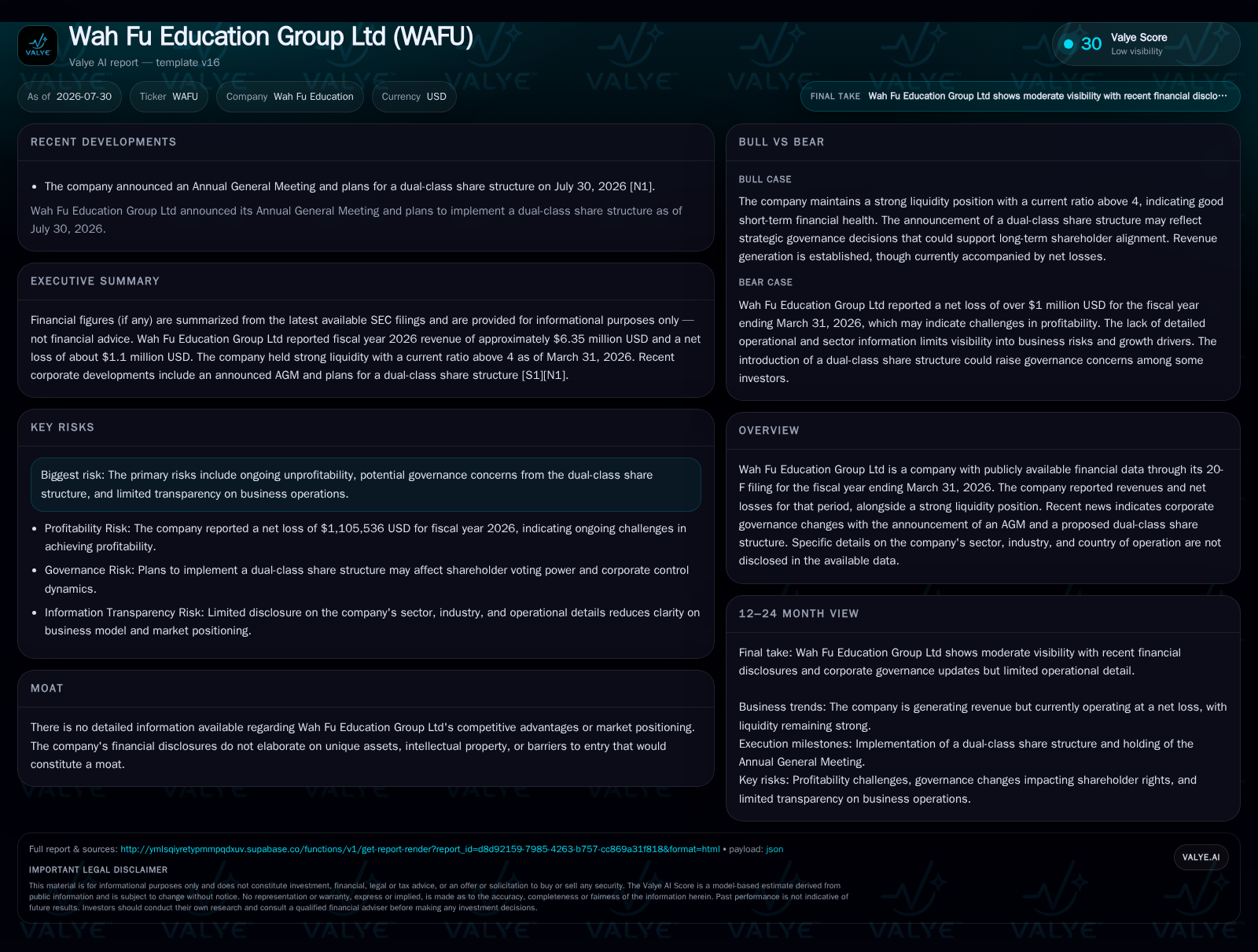
Wah Fu Education Group Ltd reported a decline in gross profit and margins for fiscal 2026 driven by decreased online education revenues and upfront costs related to new platforms. The company appointed its Chairman Yang Yu as CEO, signaling a governance consolidation. Wah Fu operates primarily in China’s online exam preparation and cloud education platform market, facing challenges from local regulatory volatility and competition while investing in AI-enabled digital transformation to enhance service offerings. Its financials reflect ongoing losses despite a strong liquidity position, with risks around regulatory enforcement, customer acquisition, and governance concentration shaping near-term prospects.
Recent Operating Update
In the most recent quarterly filing dated May 21, 2026, Wah Fu Education Group Ltd announced significant changes in its executive leadership that directly affect its strategic direction [S2]. The Board appointed Mr. Yang Yu as Chief Executive Officer effective immediately; he concurrently remains Chairman of the Board. This consolidation places substantial operational and decision-making authority in his hands. The appointment follows the resignation of the prior CEO and was accompanied by the addition of Mr. Xiaoming Tang to the board. Tang brings experience from executive roles spanning investment management and media companies in China, suggesting an infusion of external governance expertise [S2].
This leadership shift occurs against a backdrop of operational challenges highlighted in the annual report for fiscal year ending March 31, 2026 [S1]. Wah Fu reported total revenues of approximately $6.35 million but recorded an operating loss of about $855,800 and a net loss exceeding $1.1 million for that year [F1]. Gross profit from online education services declined by roughly $880,000 (40%) year-on-year due to falling revenues—a trend likely driven by regional policy adjustments adversely impacting student enrollment and course participation in key provinces [S1]. Furthermore, the company's overall gross margin deteriorated sharply to 29% from 42% previously. This deterioration stems partly from diminished revenue bases but also from substantial initial expenses associated with launching new digital education platforms such as their Non-Diploma Training Platform [S1].
Business Model Analysis
Wah Fu Education Group operates primarily within China's online education sector focused on exam preparation services delivered through proprietary cloud-based platforms with a B2B2C model [S1]. Its content portfolio spans standard examinations, professional certifications, vocational training courses, and interactive educational programs beyond traditional test prep. Primary clients include universities and other training institutions that license Wah Fu’s platforms and access customized course materials developed internally.
The company generates revenue chiefly via licensing fees for its learning management systems (LMS), subscriptions or pay-per-course sales from end users connected through institutional partners, plus ancillary technology services supporting these offerings [S1]. In this regard, Wah Fu resembles a mid-tier pure-play EdTech content creator plus platform provider focusing on scalability through institutional relationships rather than direct consumer marketing alone.
Operating expenses are heavily weighted toward content development salaries (teaching support staff, content creators), technology maintenance (site upkeep and IT engineering), lecturer fees paid to contracted educators, server costs including bandwidth leasing, plus commissions to partner institutions facilitating student enrollments [S1]. These cost components directly influence gross margins and reflect fixed scaling challenges typical of licensed digital educational products where upfront R&D costs may suppress profits during growth phases.
Industry Structure and Competitive Position
China's online education market is characterized by rapid technological adoption but subject to intense regulatory scrutiny especially regarding adult higher education exams administered regionally [S1]. Wah Fu operates in an environment where localized government policies can meaningfully alter enrollment quotas or exam participation rules—introducing material volatility to revenue streams tied to examination prep demand.
Competition includes well-capitalized incumbents like New Oriental Education & Technology Group focusing on diversified offerings alongside platforms such as Coursera internationally or Byju's regionally with broad AI-enabled personalized learning tools. Wah Fu’s strategic emphasis on integrating artificial intelligence into teaching systems aims at differentiating their product offerings by enhancing platform interactivity and reducing churn rates via improved engagement and tailored learning pathways [S1]. However, the competitive landscape pressures pricing power due to many alternative providers including lower-cost or free options accessible through mobile devices.
The company’s relatively small scale compared to industry giants implies vulnerability to pricing pressure yet affords nimble deployment of AI-driven innovations rooted in direct institutional collaborations.
Growth Drivers
Key drivers supporting Wah Fu’s growth narrative include:
- Increasing demand for flexible remote learning solutions amid continuing urbanization and digitization trends across China.
- Rising awareness among students and professionals regarding career advancement through additional certifications drives demand for professional online training courses.
- Strategic investments in AI enable more personalized educational experiences expected to increase student retention rates and boost average revenue per user (ARPU).
- Expansion of partnerships with universities supports scale via licensing deals on cloud-based platforms enhancing their Higher Vocational Enrollment Expansion Teaching Platform offerings.
- Growing government support for digital education infrastructure enhances platform accessibility nationwide.
- Enhanced technological capabilities offer an opportunity to create intelligent teaching systems that improve operational efficiency for institutional clients [S1]
While these factors are promising long-term catalysts aligning with industry trends toward digital transformation, realization depends critically on execution against variable regional policies affecting core B2B2C markets.
Risks and Watchpoints
Significant risks temper Wah Fu’s outlook:
- Persistent revenue volatility from evolving local examination regulations reduces enrollment predictability critical to maintaining steady subscription revenues.
- Ongoing negative operating income signifies challenges generating sustainable profits amid investment-heavy platform development phases.
- High customer acquisition costs coupled with potential elevated churn rates can undermine ARPU if engagement gains fail to materialize sufficiently.
- Governance concentration resulting from the dual-class share structure—where Chairman/CEO Yang Yu controls predominant voting rights—raises concerns about minority shareholder influence and may impact market perception negatively [N1], [S1].
- Technological platform security and uptime risks are inherent given reliance on cloud infrastructure servicing substantial user volumes requiring continuous reliability.
- Competition intensifies pressure especially if larger players leverage superior scale or advanced AI algorithms that outpace Wah Fu’s internal R&D efforts.
- Regulatory uncertainties around VIE arrangements used for Chinese internet business operations pose structural risks potentially disrupting cross-border capital flows.
- Intellectual property protections must be maintained diligently amidst rapid content creation cycles preventing infringement disputes which could impair platform availability or increase compliance costs.
Monitoring these variables closely will be essential given their capacity to materially stress Wah Fu's financial results or operational stability in the near term.
What to Watch Next
Investors should look for several key milestones signaling progress or emerging challenges:
- Quarterly enrollment trends segmented by region indicating either recovery or further deterioration related to local policy shifts impacting adult higher education exams.
- Updates on active user counts or course completion metrics reflecting efficacy of AI-powered learning enhancements.
- Expansion announcements regarding new university partnerships or broader SaaS licensing contracts validating platform acceptance within institutional client segments.
- Cost structure evolution focusing on ratios like sales & marketing expense relative to revenue gauging customer acquisition efficiency improvements.
- Financial statement updates giving clarity if operating losses moderate post-launch phase investments associated with the Non-Diploma Training Platform.
- Regulatory developments tied particularly to China’s adult education sector affecting firm’s B2B2C core revenues broadly across provinces.
- Market reaction and institutional commentary concerning dual-class stock governance implications following AGM decisions recently announced [N1]
Tracking these signals will offer tangible evidence on whether Wah Fu’s strategic pivot toward AI integration and enhanced platform offerings delivers meaningful durable value creation or if structural headwinds persist longer than anticipated.
Financial Profile Discussion
As of March 31, 2026, Wah Fu held current assets of approximately $12.7 million against current liabilities near $3.1 million, resulting in a current ratio of about 4.12x, indicating sufficient near-term working capital coverage [F1]. The latest available cash and equivalents balance was $12.6 million as of March 31, 2023 [F1].
Capital expenditures remain minimal historically which reflects business model dependence on digital assets rather than physical infrastructure investments [S1]. Meanwhile, research & development outlays have increased owing to AI integration efforts intended to strengthen competitive positioning though exact spend levels were not explicitly detailed outside general expense disclosures [S1].
The financial profile underscores typical challenges faced by growth-stage EdTech firms juggling heavy upfront technology spend versus still volatile top-line momentum influenced by external regulatory factors. Strong liquidity affords runway flexibility; however sustained profitability hinges on driving stable subscriber base growth combined with operational leverage gains over time.
Disclaimer: This is research-only, informational analysis and not investment advice. It may include AI-generated interpretation and general industry context. Always verify important details using primary sources.

Comments