
WhiteHawk Minerals Expands Asset Base with $111.8M Acquisitions, Initiates Dividend Program
Recent acquisitions and capital structure moves reshape WhiteHawk's growth trajectory amid ongoing operational losses.
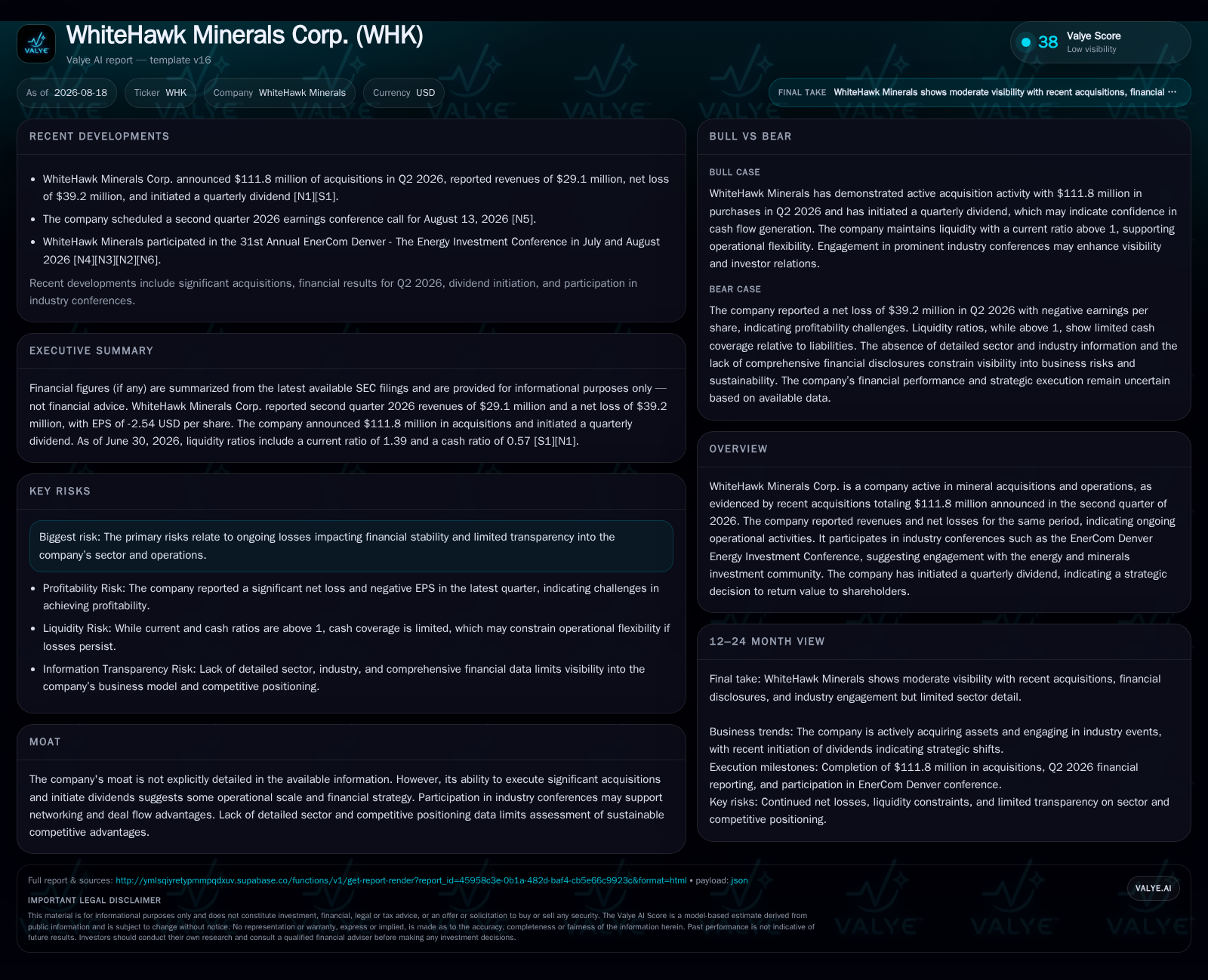
WhiteHawk Minerals Corp. strengthened its position in the mineral rights and royalty interests sector through a $111.8 million acquisition announced in Q2 2026, notably targeting assets in key shale basins such as the Marcellus and Haynesville. While revenue grew to nearly $29.1 million, net losses deepened due to acquisition-related costs and high financing expenses. The company launched a quarterly dividend program reflecting confidence in future cash flows supported by operator activity and commodity price exposure. Concurrently, WhiteHawk arranged a $50 million Series E preferred stock issuance to fund part of its acquisition pipeline, indicating an active capital markets approach to balance growth and leverage.
Recent Operating Update
WhiteHawk Minerals Corp.'s latest quarterly filing dated August 13, 2026 ([S2]) along with a companion material definitive agreement filing on August 12 ([S3], [S18]) underscore pivotal developments shaping the company’s near-term outlook. The firm announced execution of purchase and sale agreements totaling approximately $111.8 million for mineral rights acquisitions predominantly in the Marcellus and Haynesville shale basins — two prolific natural gas regions in the U.S. The transaction framework contemplates acquiring fee mineral interests along with overriding and non-participating royalty interests that entitle WhiteHawk to production royalties from third-party exploration and production operators operating these basins.
Financially, the Q2 2026 top line rose to about $29.1 million [F1], indicating growing operational scale from an expanding asset base. However, net income registered a loss of $39.2 million during the quarter [F1], reflecting upfront acquisition-related expenses, integration costs, elevated financing charges following recent capital raises (detailed below), and general operating costs typical for companies transitioning through aggressive growth phases. Operating losses are not unusual for mineral rights companies rapidly building portfolios before stabilizing mid-cycle production cash flows.
Notably, WhiteHawk has launched its first-ever quarterly dividend program ([N1]). This is significant given the company's historical net losses; initiating dividends suggests management confidence that sustained royalty revenues—augmented by active drilling and favorable commodity pricing—will underpin future positive free cash flow generation critical for dividend sustainability.
Capital strategy updates element into this narrative: On August 12th, WhiteHawk filed multiple disclosures detailing an equity commitment arrangement for a new Series E preferred stock issuance securing up to $50 million from insider investors including CEO Daniel Herz [S7]. The preferred shares carry escalating annual dividend rates starting at 10%, ratcheting up to 14% after two years subject to minimum return conditions. This capital infusion is designated primarily to fund part of the sizeable SJM II Acquisition announced contemporaneously [S3]. The preference structure places Series E shares senior to common stock classes which indicates prioritized dividend pay-outs but also implies higher cost of capital reflective of risk compensation.
Liquidity metrics as of June 30 indicate cash & equivalents at approximately $13.2 million alongside total debt roughly at $68.1 million yielding net debt around $54.8 million [F1]
Revenue generation is driven primarily through production royalties calculated as percentages of production volumes or revenue produced from underlying minerals without bearing direct operational costs or exploration risks.
Key drivers impacting revenue include:
- Operator drilling/completion activity intensity on acquired acreage
- Actual mineral production volumes attributable based on ownership interest types
- Realized commodity prices (primarily natural gas given Marcellus/Haynesville focus)
- Lease terms that govern royalty rates, durations, and potential escalators
The firm's recent acquisitions reflect an intent to deepen portfolio quality across core basins with enduring reserve life prospects enhancing long-term cash flow stability potential.
The dividend initiation reflects shifting shareholder expectations about transforming asset base maturity into distributable cash yields—paralleling peer behaviors observed among other publicly traded mineral rights firms who deploy dividends once steady-state royalty income justifies distributions without impairing reinvestment abilities.
Industry Structure and Competitive Position
Companies like WhiteHawk are situated upstream in the energy value chain concentrating solely on asset ownership & monetization rather than capex-intensive drilling or production activities.
Peers include independent mineral asset acquirers, oil & gas royalty trusts (such as Permian Basin-focused trusts), and natural resource asset managers who compete primarily by sourcing higher-quality or strategically diversified mineral portfolios that can generate stable royalty streams.
Competitive advantages hinge on:
- Ability to identify accretive acquisitions offering long reserve life & attractive royalty rates
- Maintaining relationships with operators ensuring steady drilling activity maximizing throughput on owned acreage
- Accessing flexible capital structures allowing swift deal execution relative to peers
- Portfolio diversification mitigating concentration risk from geographic or commodity exposures
WhiteHawk’s recent moves—executing major acquisitions backed by committed equity capital—demonstrate tactical ability to scale rapidly though overall market share or moat details remain opaque owing to limited disclosed competitive benchmarks.
Growth Drivers
Multiple levers underpin potential growth:
- Strategic acquisitions: Securing accretive mineral rights purchases at attractive valuations broadens revenue base; Q2 acquisitions totaling roughly $111.8 million highlight this priority [N1].
- Operator activity: Increasing rig counts, drilling completions within Marcellus/Haynesville drive higher production volumes enabling royalty income upside.
- Commodity price environment: Sustained or rising natural gas prices enhance realized royalties impacting earnings positively.
- Contractual refinements: Improved lease or overriding royalty terms can boost margin profiles.
- Diversification: Expanding into different basins or adding mineral types reduces single-basin exposure risk.
- Capital market access: Preferred stock issuance signals willingness & capacity to leverage equity markets for growth capital allowing agile deal-making [S7].
Risks and Constraints
Despite promising positioning several risk factors warrant close scrutiny:
- Commodity price volatility directly affects royalty income; sudden price troughs could pressure cash flows used for dividends or debt servicing.
- Operator activity fluctuations: Reduced drilling activity due to macroeconomic downturns or regulatory shifts could curtail production growth affecting revenue trajectories.
- Acquisition execution risks: Closing delays or adverse adjustments could impair expected economic benefits from deals like SJM II Acquisition pending late September closure [S18].
- Financing risk: Dependence on Series E preferred stock proceeds plus revolving credit facility heightens sensitivity to capital market conditions affecting refinancing availability or cost increments.
- Dividend sustainability: While dividends began recently, their continuity depends heavily on stable positive cash flow—a current loss-making profile poses uncertainty around payout durability.
- Regulatory & environmental compliance risks could impose additional operational burdens increasing costs indirectly despite no direct operations currently assumed.
- Concentration risk: Focus on few basins exposes performance sensitivity if those regions encounter adverse developments.
What To Watch Next
Key upcoming milestones include:
- Closing completion of the SJM II Acquisition anticipated around September 25, 2026 [S18], which will materially increase WhiteHawk’s asset portfolio size impacting future royalties.
- Post-acquisition production monitoring particularly operator drilling completion activity levels across newly acquired assets driving actual cash flow contribution realization.
- Performance improvements reflected in sequential quarters where revenue scaling outpaces loss improvement signaling operational leverage progress.
- Progression on Series E preferred stock closing providing funding clarity around capital structure changes [S7].
- Updates regarding dividend declarations including any modifications providing insight into management's confidence in financial health.
Financial Profile Discussion
At Q2 end (June 30), WhiteHawk held cash balances approximating $13.2 million against total debt near $68.1 million resulting in net debt close to $54.8 million [F1]. This leverage magnitude is considerable relative to modest revenue levels indicating reliance on external funding sources for ongoing acquisitions and working capital needs.
A current ratio of approximately 1.39 confirms adequate liquidity coverage over short-term liabilities but suggests cautious financial management required especially if macroeconomic headwinds emerge affecting operator spending or commodity pricing [F1]
Operating losses reported (-$1.34 million) coupled with substantial net loss (-$39.2 million) primarily reflect investment stage dynamics with acquisition-related costs weighing down profitability metrics [F1], consistent with sector peers ramping asset bases through external financing mechanisms such as preferred stocks or credit facilities ([S7]). Managing this transition effectively will be critical for eventual earnings normalization and free cash flow generation necessary for sustaining dividends alongside manageable leverage levels.
--- This analysis synthesizes all publicly available quarterly filings along with contemporaneous event disclosures through mid-August 2026 focused exclusively on verified facts without speculative inference beyond documented evidence sources [F1][N1]
Disclaimer: This is research-only, informational analysis and not investment advice. It may include AI-generated interpretation and general industry context. Always verify important details using primary sources.

Comments