
Yubo International Biotech’s Operating Losses and Structural Risks Challenge Growth Prospects
Yubo International Biotech remains in a pre-revenue phase with significant liquidity constraints and regulatory uncertainties impeding its biotechnology venture.
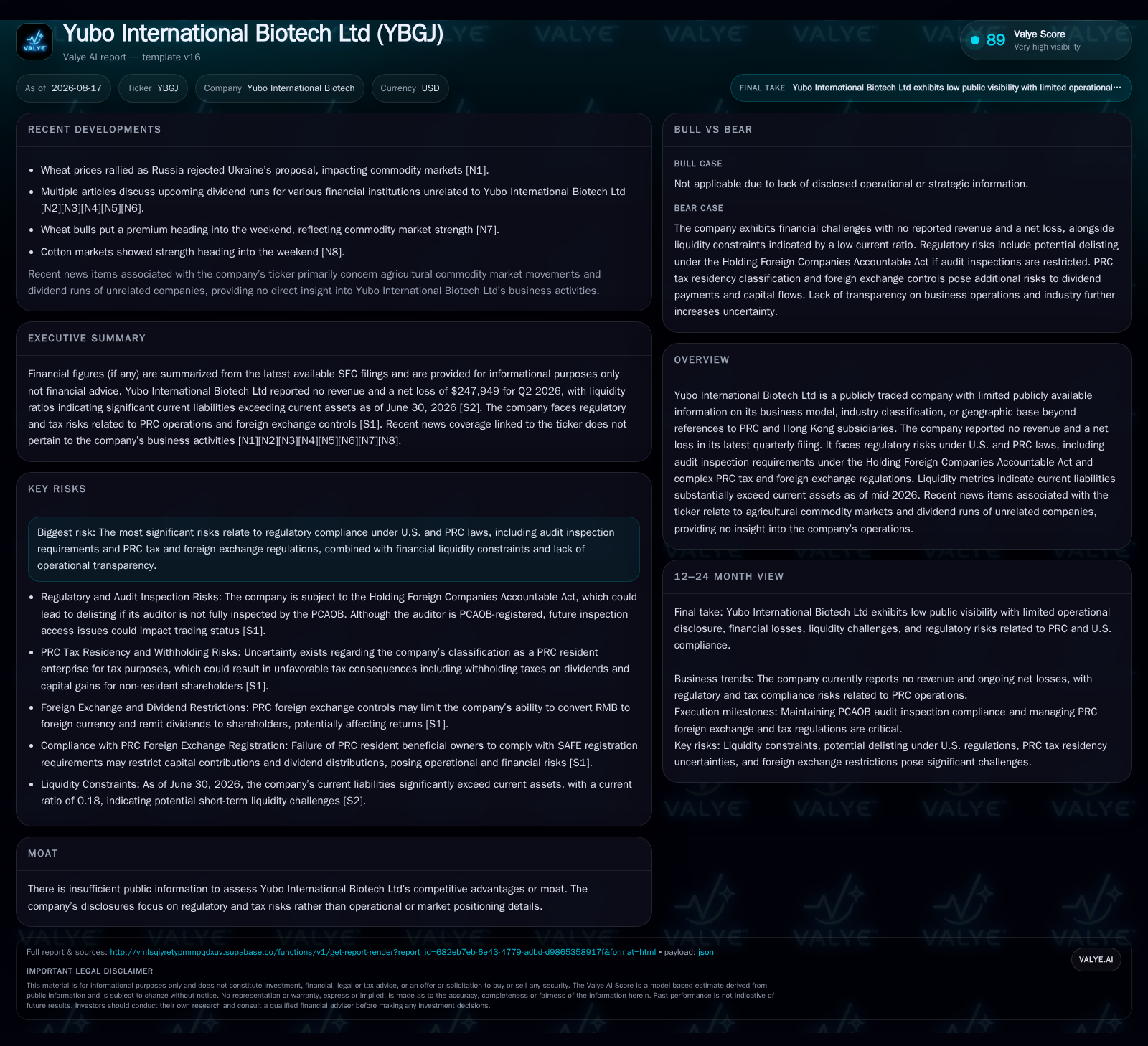
Yubo International Biotech Ltd reported no meaningful revenue in the latest quarter and continues to operate at a considerable net loss, reflecting its early-stage biotech profile with limited commercial traction. The company is exposed to pronounced regulatory risks stemming from U.S. audit inspection requirements under the Holding Foreign Companies Accountable Act and complex Chinese tax and foreign exchange controls. Its balance sheet shows current liabilities vastly exceeding current assets, underscoring pressing liquidity challenges. Sparse disclosures on product developments or market positioning provide little clarity on growth catalysts or competitive standing in the biotech sector.
Recent Operating Update
Yubo International Biotech Ltd (ticker: YBGJ) latest quarterly filing on August 14, 2026, reconfirms its continued pre-commercial stage status with no meaningful revenue recognized during the period [S2]. While the company disclosed nominal revenue of approximately $12,353 in 2025 [F1], the latest quarter's continuing operating losses underscore persisting challenges converting research and product development efforts into sustainable sales. This aligns with its reported net loss of over $1 million as of year-end 2025 [F1], affirming negative earnings typical of fledgling biotechnology firms investing in early-stage assets.
The company sells nebulizer products containing medical fluids alongside a cell basidiomycetes compound drink launched in early 2021, reportedly through online direct-to-consumer e-commerce channels [S1]. However, absence of material revenue indicates either limited market acceptance or constrained distribution scale to date. Revenue recognition follows a five-step model consistent with GAAP, acknowledging revenue upon product delivery without returns allowed [S1]. The products have shelf lives between 12 and 18 months, implying working capital tied up in inventory.
Business Model Analysis
Yubo International Biotech’s business model centers on manufacturing and selling health management-related biotechnological products directly to consumers via e-commerce platforms [S1]. This approach bypasses traditional wholesale or institutional channels but entails reliance on effective online marketing and consumer adoption. The product mix is uniquely defined by nebulizer devices integrated with frozen medical fluid tubes and a fungal-based health drink, signaling an attempt at biologically inspired wellness solutions.
However, reported revenues are negligible relative to operating expenses leading to sustained losses that may reflect continuing investment in R&D or commercial expansion efforts without sufficient sales traction [F1]. The fragmented revelations about their product offerings limit insight into intellectual property ownership status, clinical validation levels, or pricing power — crucial facets underpinning biotech monetization mechanics through licensing fees or higher-margin pharmaceutical sales.
The firm operates through subsidiaries based in mainland China and Hong Kong [S1], which adds operational complexity due to differing regional regulations on health product approvals and cross-border taxation affecting repatriation economics. Lack of disclosure about partnerships or licensing arrangements hampers assessment of value-chain positioning compared to biopharmaceutical developers or contract research organizations (CROs).
Industry Structure and Competitive Position
The biotechnology sector is characterized by high R&D intensity with success dependent largely on advancing products through clinical trial phases to secure regulatory approvals from agencies such as the U.S. FDA or China's NMPA. Peer companies like Amgen or Gilead emphasize robust pipelines backed by intellectual property frameworks and diversified revenue streams including product sales, licensing royalties, and strategic collaborations. Yubo International Biotech’s sparse disclosures offer neither evidence of active clinical trials nor intellectual property licensing engagement.
Direct-to-consumer biotech health products generally face stiff competition from established supplement producers and medical device manufacturers who benefit from recognized brands and compliance certifications. Yubo’s nascent presence combined with regulatory hurdles constrains potential penetration unless supported by compelling efficacy data or innovative delivery mechanisms enabling pricing premium.
Regulatory oversight represents a structural hurdle: risks associated with securing market authorization amplify capital needs while extending time-to-market slows revenue realization [S1]. Moreover, geographic regulatory complexity further fragments operational execution across PRC jurisdictions.
Growth Drivers
Given the available information gap on formal product pipeline progress or clinical validation milestones, potential growth drivers appear primarily tethered to:
- Possible breakthrough results leading to formal regulatory approvals enabling wider commercialization,
- Expansion of online consumer reach harnessing ecommerce channels,
- Development of strategic partnerships or licensing deals to strengthen R&D capability and market access,
- Leveraging advances in biotechnology manufacturing technology for cost reduction,
- Adapting to any favorable regulatory shifts facilitating expedited product approvals.
None of these drivers have yet manifested materially according to public filings; thus growth prospects depend heavily on execution clarity forthcoming in future disclosures.
Risks and Watchpoints
The company faces heightened regulatory risks specifically under U.S. laws targeting foreign-listed issuers like the Holding Foreign Companies Accountable Act requiring PCAOB inspections of auditors [S1]. Although its auditor is U.S.-based and PCAOB registered, any future loss of inspection ability by PCAOB due to external jurisdictional issues could trigger delisting risks materially impacting share liquidity and valuation.
Further risks relate to complex PRC tax regulations including withholding taxes on dividends payable abroad and stringent foreign exchange controls complicating cash flow repatriation from Chinese subsidiaries [S1]. Financially, the June 2026 balance sheet exhibits critical liquidity stress: current liabilities exceed current assets by more than six-fold resulting in a dangerously low current ratio around 0.18 [F1]. Cash reserves stand at roughly $12,000 while total debt remains over $1.4 million per last available data [F1], highlighting solvency concerns absent fresh capital infusion.
Opaque disclosure curtails visibility into legal contingencies beyond generic references to possible litigation related to product quality [S1] as well as absence of concrete operational milestones raises execution risk.
What To Watch Next
Investors should monitor upcoming quarterly filings for:
- Signs of revenue generation scaling beyond trivial levels indicating market acceptance,
- Updates regarding audit inspection status under HFCA Act compliance,
- Changes in cash balances relative to liabilities denoting funding adequacy or distress,
- Announcements of strategic partnerships/licensing agreements potentially accelerating R&D or commercialization efforts,
- Progress reports on product development stages including clinical trials if any disclosed,
- Management commentary addressing regulatory navigation particularly PRC cross-border compliance,
- Any restructuring or cost control initiatives aiming at stabilizing operating losses.
Absent positive developments on these fronts, the company's outlook remains subdued given prevailing financial constraints coupled with high execution uncertainty.
Financial Profile Discussion
As of June 30, 2026, Yubo International Biotech’s liquidity position is precarious: cash and equivalents total approximately $11,989 against current liabilities exceeding $3.3 million resulting in a current ratio near 0.18 [F1]. This stark imbalance signals significant near-term liquidity risk unless remedial financing actions occur promptly.
Total reported debt stands around $1.45 million based on prior filings but may not reflect all off-balance-sheet obligations given disclosure limits [F1]. Operating income remains deeply negative (over $1.18 million loss as of December 2025) compounded by net losses exceeding $1 million for the same period [F1], consistent with an early-stage biotech still funding operations through external capital rather than operating cash flow.
Capital allocation appears heavily skewed towards ongoing expenses without offsetting revenue streams undermining core solvency metrics. The company must urgently enhance working capital management or secure external funding sources to survive pending commercialization feasibility confirmation.
This analysis reflects information publicly disclosed up to August 17, 2026. It avoids speculative assumptions beyond source data focusing strictly on verifiable facts combined with sector contextualization appropriate for a biotechnology firm at this nascent commercialization phase. Readers should consider ongoing updates for evolving operational clarity amid significant corporate structure and regulatory challenges facing Yubo International Biotech Ltd.
Disclaimer: This is research-only, informational analysis and not investment advice. It may include AI-generated interpretation and general industry context. Always verify important details using primary sources.

Comments