
Yunji Inc.: Membership Momentum Meets Regulatory Challenges
Yunji’s latest quarter shows improving cash flow amid shrinking revenue, highlighting tensions between growth ambitions and regulatory limitations in China’s social commerce space.
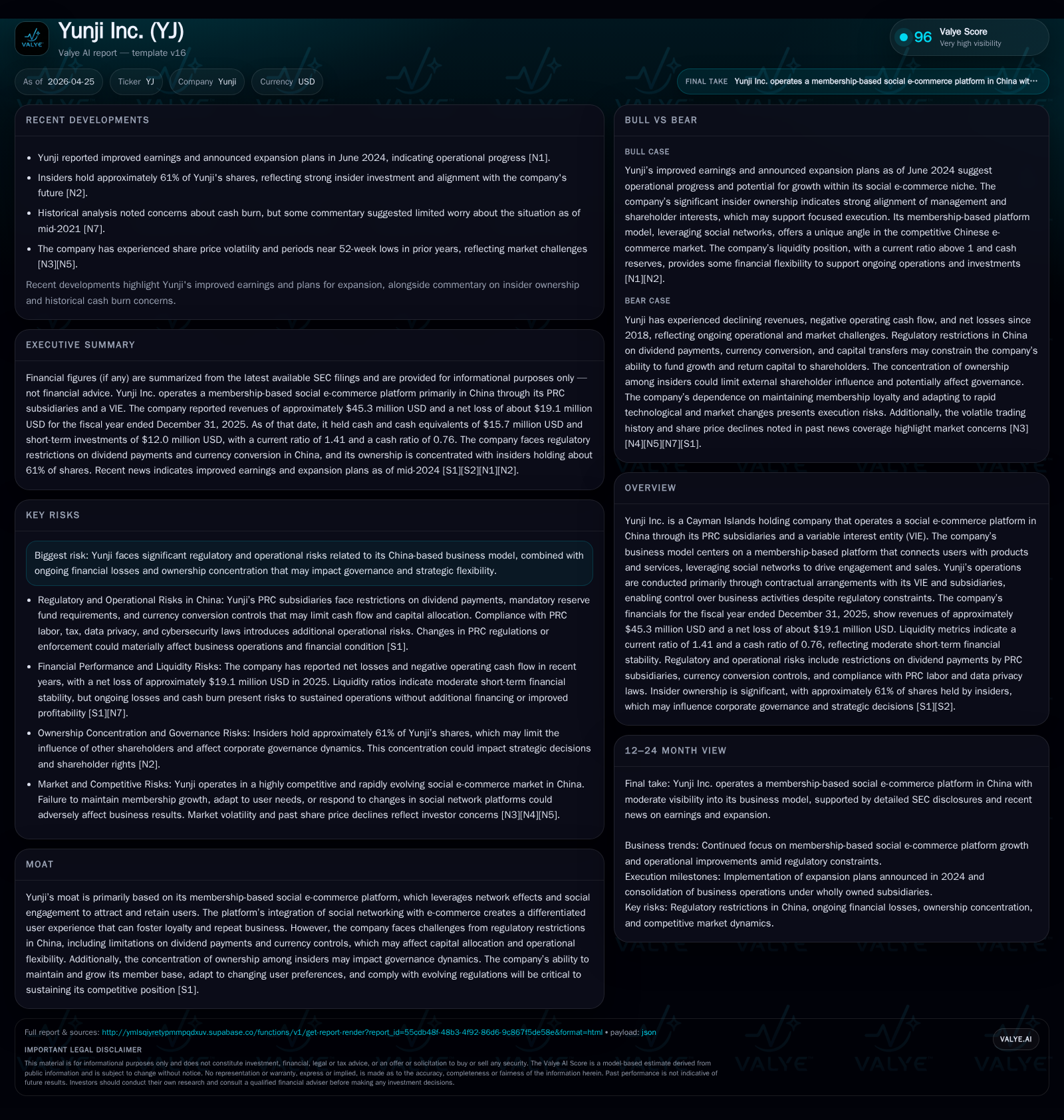
In its March 2026 quarterly disclosure, Yunji reported continued revenue contraction but meaningful progress in reducing operating cash burn, driven by tighter working capital management and modest financing inflows. The company’s membership-based social commerce platform leverages network effects but faces structural headwinds from China’s currency controls and dividend restrictions, which complicate capital flow and operational flexibility. Growth depends on sustaining member engagement and navigating regulatory risks while investing in infrastructure like its Hangzhou headquarters. Financially, Yunji remains loss-making with negative free cash flow, though liquidity ratios are stable and capital expenditures surged reflecting long-term investment.
Latest Quarterly Performance Highlights
The company's most recent filing on March 27, 2026 [S2] disclosed second half and full-year 2025 unaudited financial results indicating a continuation of revenue decline but a significant reduction in operating cash consumption. Specifically, net cash used in operating activities was RMB57.8 million (approximately US$8.3 million) in 2025 compared to a higher net loss of RMB133.3 million (US$19.1 million) in the same period [S2][S3]. This trend suggests tighter working capital management primarily reflected in decreases in accounts receivable balances tied to distribution sales.
Investing activities consumed RMB88.2 million (about US$12.6 million), primarily attributable to construction outlays for a new office building at the Hangzhou Land Parcel—a core infrastructure project aimed at supporting future growth [S2][S13]. Financing activities generated net positive cash flows of RMB38.7 million (around US$5.5 million), mainly from net bank loans, providing incremental liquidity support [S2].
Overall, Yunji demonstrated an operational pivot towards optimizing its cash position despite persistent top-line contraction.
Membership-Centric Social Commerce: Business Model Review
Yunji operates as a Cayman Islands holding company that controls its domestic operations through PRC subsidiaries and a Variable Interest Entity (VIE) structure due to Chinese legal restrictions on foreign ownership in e-commerce platforms [S1]. This contractual setup preserves operational authority over critical business activities while adhering to local regulatory frameworks.
At its core, Yunji runs a membership-based social e-commerce platform leveraging social engagement mechanisms—such as peer sharing and network-driven discovery—to drive product sales and increase customer stickiness [S1]. The model hinges on fostering strong network effects whereby more active members generate communal interaction that encourages repeat patronage and reduces customer acquisition costs relative to traditional marketplaces.
However, the reliance on social networks as a user engagement tool introduces both strategic strength—via differentiated user experience—and vulnerabilities if consumer preferences shift or regulatory scrutiny intensifies around online community commerce practices.
Competitive Positioning Within China’s E-Commerce Ecosystem
Within China’s highly competitive e-commerce market, Yunji distinguishes itself through its hybrid social-commerce membership strategy embedding switching costs connected to social interactions [S1]. This positions it between conventional one-stop online retailers and newer social selling formats gaining traction.
Nonetheless, the company confronts formidable challenges from dominant platforms that command scale advantages and vast logistics networks. Moreover, critical regulatory factors restrict dividend distributions and enforce strict currency controls under PRC foreign exchange regulations [S1][S3]. Specifically, while routine operational foreign exchange transactions can be executed without prior State Administration of Foreign Exchange (SAFE) approval if standard procedures are followed (e.g., profit distributions in foreign currencies), there remain discretionary government abilities to restrict capital outflows [S3].
These constraints impact how efficiently Yunji can allocate capital internationally or reward investors at the holding-company level—circumstances compounded by the VIE framework’s inherent legal ambiguities surrounding offshore control.
Adding to governance complexities is the concentrated ownership stake held by CEO Shanglue Xiao who commands over 90% voting power via Class B shares [S6], ensuring decision-making agility but limiting minority investor influence.
Growth Opportunities Versus Regulatory and Operational Constraints
Yunji's growth thesis rests heavily on expanding its member base and deepening engagement within its social commerce ecosystem; this can generate sustainable network effects driving organic demand [S1][F1]. Yet its persistent losses undermine reinvestment capacity, necessitating judicious resource deployment.
The buildout of corporate headquarters infrastructure signals strategic commitment to scalability but heightens short-term capital expenditure burdens—the 351.9% increase in capex year-over-year evidences this focus [F1]. Simultaneously, macro-level risks loom: evolving PRC regulations could tighten foreign exchange accessibility unexpectedly or introduce further constraints on dividend repatriation [S1][S19].
Operationally, any disruption stemming from heightened compliance requirements or enforcement actions against related-party transactions—as observed industry-wide among U.S.-listed Chinese firms—could create volatility and erode investor confidence [S19].
Therefore, growth trajectories require balancing platform expansion dynamics against an escalating risk backdrop of regulatory oversight and financial losses that impair agility.
Key Near-Term Catalysts and Risks to Monitor
Investors should focus on upcoming developments including detailed disclosures on membership trends beyond Q4 2025 to assess if engagement improvements can reverse declining revenue patterns [S2]. Equally important is progress on capex initiatives such as Hangzhou Land Parcel construction completion timelines which underpin future operational capacity enhancement [S13].
Cash collection efficiency post-quarter end will provide early insight into working capital management improvements crucial for narrowing operating cash deficits [S2]. Given the significance of SAFE processes for cross-border fund transfers noted in filings [S3], any policy changes or administrative delays could materially impact liquidity flows.
Externally, surveillance of Nasdaq listing compliance is key given prior notifications concerning minimum bid price requirements affecting ADS liquidity and valuation stability [S19]. Furthermore, tracking any shifts in PRC trade or currency policies influencing SAFE approvals is essential since these directly affect dividend distribution feasibility.
Financial Overview: Cash Flow, Liquidity, and Capital Structure
Historical performance (annual)
|
| FY | Rev ($mm) | Net ($mm) | CFO ($mm) | OpInc ($mm) | Rev YoY | Net YoY |
|---|---|---|---|---|---|---|
| 2025 | 45 | -19 | -8 | -21 | -20.8% | -13.0% |
| 2024 | 57 | -17 | -17 | -19 | -36.5% | +27.5% |
| 2023 | 90 | -23 | -27 | -11 | -46.1% | -16.1% |
| 2022 | 167 | -20 | -31 | -11 |
Source: SEC companyfacts cache [F1].
Capital returns and efficiency (annual)
|
| FY | Buybacks ($mm) | FCF ($mm) | ROE% |
|---|---|---|---|
| 2025 | -18 | -14.3 | |
| 2024 | -19 | -11.4 | |
| 2023 | 3 | -28 | -13.9 |
| 2022 | 14 | -45 | -10.2 |
Source: SEC companyfacts cache [F1].
Supporting these qualitative findings, Yunji's reported full-year fiscal 2025 revenues totaled roughly $45.3 million USD—a notable contraction of about 20.8% year-over-year from $57.2 million USD in 2024—with operating income declining further into negative territory at -$20.5 million USD compared to -$18.7 million USD previously [F1]. Net losses deepened modestly to -$19.1 million USD from -$16.9 million USD over the same period.
Operating cash flow usage improved substantially by over 50%, registering -$8.26 million USD versus nearly double that figure the prior year (-$17.3M USD), reflecting operational discipline gains likely linked to accounts receivable reductions discussed above [F1][S2]. Capital spending surged nearly fourfold year-over-year to $9.8 million USD aligned with HQ investments.
Balance sheet health remains moderate: total debt stood at roughly $5.7 million USD against $15.7 million USD cash reserves generating an approximate net debt surplus of -$9.9 million USD favoring liquidity comfort as of year-end 2025 [F1].
The firm's sustained negative free cash flow (-$18.1M USD calculated as CFO minus capex) underscores ongoing challenges converting operational improvements into positive returns absent higher revenue or margin expansions.
|
FY | Revenue (USD mln) | Op Income (USD mln) | Net Income (USD mln) | Operating CF (USD mln) | Capex (USD mln) |
| --- | --- |
|---|---|
| --- | --- |
| 2023 | 90.2 |
| 2024 | 57.2 |
| 2025 | 45.3 |
In sum, Yunji's financial trajectory conveys a company wrestling with scaling pressures amid a volatile regulatory environment while attempting to exploit its membership-driven social e-commerce friction advantage.
This analysis references publicly available SEC filings dated March-April 2026 ([S1]–[S26]) and audited financial data ([F1]). It aims solely to provide an informed perspective grounded in disclosed facts without any investment recommendation or opinion regarding stock performance.
Disclaimer: This is research-only, informational analysis and not investment advice. It may include AI-generated interpretation and general industry context. Always verify important details using primary sources.

Comments