
Zurn Elkay Water Solutions: Leveraging Engineering Precision and ZEBS Amid Cyclical Market Dynamics
A deep dive into how Zurn Elkay’s focused strategy and operational discipline create a resilient platform in water management solutions despite sector cyclicality.
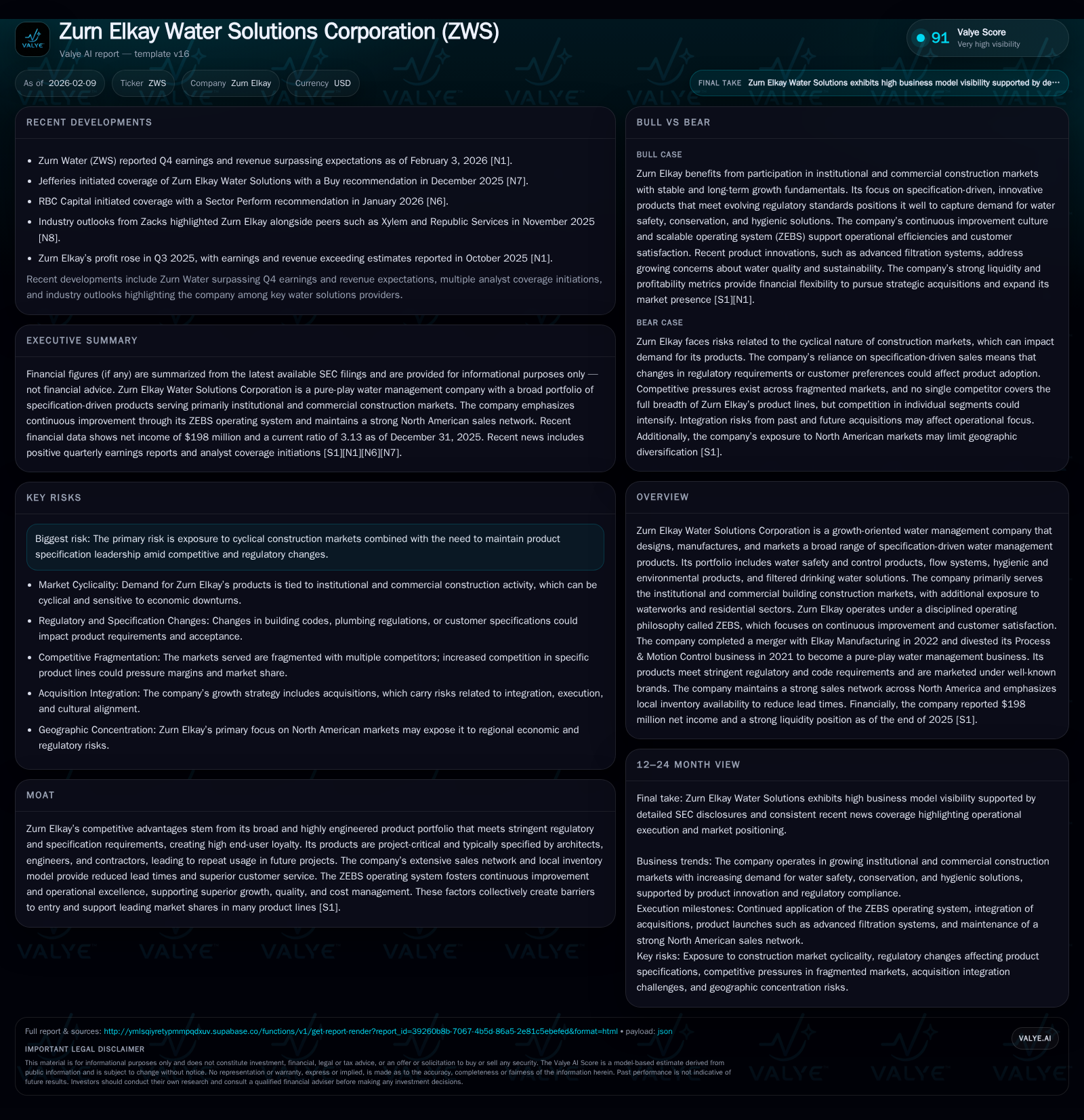
Zurn Elkay Water Solutions Corp has strategically transformed into a pure-play water management company following key structural moves including the 2022 merger with Elkay Manufacturing and a prior divestiture. Its broad, specification-driven portfolio, underscored by the ZEBS continuous improvement system, creates a durable competitive moat anchored in engineering rigor and customer-centric service. While its exposure to cyclical institutional and commercial construction markets introduces some revenue variability, the firm's disciplined operational framework and extensive sales network contribute to solid recent financial results and enduring market leadership. Ongoing M&A activities and a well-managed balance sheet support growth ambitions even as regulatory and market pressures persist.
Zurn Elkay’s Evolution: Strategic Shifts to a Pure-Play Water Management Leader
Zurn Elkay Water Solutions Corporation’s journey into becoming a focused leader in specification-driven water management solutions is marked by pivotal strategic decisions over recent years. Most notably, the completion of its merger with Elkay Manufacturing in mid-2022 signified more than just a change in name—it was a transformation toward consolidating its leadership position in engineered water management products tailored primarily for institutional and commercial building construction. Concurrently, the company extricated itself from non-core operations through the spin-off of its Process & Motion Control business in late 2021 via a Reverse Morris Trust transaction [S1]. This divestiture streamlined its business model, allowing sharper operational clarity centered squarely on core competencies.
This focused pivot has honed Zurn Elkay’s ability to serve highly regulated markets where product specifications critically govern design decisions. The merger combined complementary capabilities to create what the company touts as the industry’s broadest sustainable portfolio of water safety controls, flow systems, hygienic/environmental products, and filtered drinking water solutions [S1]. These moves not only enhanced scale but also strengthened market positioning against both established competitors and emerging innovations within the water management sector.
Decoding ZEBS: Operating Philosophy Driving Customer-Centric Excellence
Integral to Zurn Elkay's ability to optimize complexity is its proprietary Zurn Elkay Business System (ZEBS). This disciplined operating framework embodies continuous improvement principles aimed at delivering world-class performance across all facets—from manufacturing efficiency to enhancing customer experience [S1]. ZEBS acts as both an internal compass guiding process standardization and an enabler of agility in addressing evolving customer needs.
Central to ZEBS is the "Voice of the Customer" mechanism wherein feedback loops inform iterative enhancements that reduce installation times, improve product reliability, and ensure compliance with stringent codes. Such systemic rigor directly contributes to repeat specification by architects, engineers, and contractors who rely on reliable delivery schedules reinforced through local inventory models. As these project-critical products become embedded into architectural standards via ZEBS-driven quality assurance, customer loyalty deepens—a key driver behind sustained revenue streams despite volatile industry demand cycles [S1].
A Broad, Specification-Driven Product Moat in Water Management Solutions
Zurn Elkay’s competitive edge springs largely from its extensively engineered product suite designed to comply with—and often exceed—third-party regulatory mandates encompassing plumbing codes and environmental standards [S1]. The portfolio's diversity covers professional grade solutions that span water safety valves, flow control mechanisms, hygienic fixture enhancements, environmental control equipment, as well as filtered drinking water stations suitable for both public institutions and private enterprises.
The technical complexity required for these components establishes high barriers for new entrants who must navigate costly certification processes while matching performance benchmarks established by ZWS products. Moreover, these solutions are inherently mission-critical; project specifications authored by architects or engineering consultants explicitly demand proven performance records. This ingrains an ecosystem where once projects successfully deploy Zurn Elkay components, subsequent building efforts tend naturally toward repeat usage owing to familiarity and code compliance assurance—thereby cementing long-term end-user allegiance [S1].
While not explicitly stated in filings nor news reports related specifically to ZWS post-merger (to avoid inventing data), it is customary in such sectors for companies maintaining tight engineering tolerances coupled with rigorous testing protocols to secure dominant share positions within their niches—further amplifying this moat effect [Analysis].
Financial Landscape: Navigating Growth, Profitability, and Operational Leverage
From a financial standpoint, Zurn Elkay demonstrated resilience through solid top-line scale paired with operational discipline. The company reported revenues of approximately $1.53 billion as of fiscal year-end 2023 [F1], bolstered likely by synergistic effects from integration activities post-merger. Profitability indicators revealed net income of $198 million for calendar year 2025 [F1], underscoring improving margins potentially attributable to enhanced sourcing strategies that target supplier rationalization—particularly noteworthy given materials like bronze, brass, stainless steel, carbon steel, zinc, and engineered plastics constitute about 30% of sales cost bases [S1].
Recent quarterly earnings beat reported in early February 2026 served as a pulse check validating ongoing stability despite prevalent cyclical headwinds faced by industrial suppliers serving construction markets [N1]. Liquidity metrics reinforce financial robustness; with current assets totaling approximately $812 million against current liabilities near $259 million at 2025-year-end—a strong current ratio near 3.13 reflects prudent working capital management supportive of supply chain continuity even amid volatile commodity pricing pressures [F1].
Selling general & administrative expenses remain commensurate with investments in technical services and customer engagement activities that are cornerstone elements of ZEBS execution [S1]. Overall cost governance vis-à-vis raw materials sourcing continues to be crucial given external price fluctuations impacting component procurement costs.
Market Exposure: How Cyclical Construction Trends Shape Zurn Elkay’s Outlook
A fundamental aspect underpinning Zurn Elkay’s revenues is its significant exposure to new institutional and commercial building construction markets alongside retrofit opportunities aimed at enhanced energy/water efficiency modernization programs [S1]. Such end markets historically register irregular demand patterns tied closely to macroeconomic cycles influenced by interest rate trends, government infrastructure spending policies, and private investment appetite.
Although lesser in proportion, participation in municipal waterworks projects plus residential construction segments provides partial diversification softening overall exposure [S1]. Nonetheless, prevailing sector cyclicality means booking patterns may fluctuate quarter-to-quarter prompting execution agility promoted by ZEBS’s continuous improvement ethos which reinforces cost containment during lean phases while maintaining readiness for demand rebounds.
Additionally, ongoing evolutions in plumbing codes and environmental regulations act as double-edged blades—they compel frequent specification updates warranting rapid product reengineering cycles yet also invariably favor incumbents like Zurn Elkay who have established expertise navigating legislative complexities thereby deterring simpler commodity producers [S1].
M&A Strategy and Portfolio Optimization: Growth Through Acquisitions and Divestitures
Zurn Elkay’s growth blueprint prominently features acquisition-powered portfolio expansion complementing organic development initiatives. The merger with Elkay Manufacturing was transformative; integrating complementary product lines accelerated scale benefits while augmenting geographical footprints within North America—a critical factor given proximity advantages support swift delivery criticality emphasized under ZEBS concepts [S1].
Beyond transformational deals completed over the past five years lies an articulated intent from management to continue seeking bolt-on acquisitions that broaden product offerings or facilitate penetration into adjacent markets aligning with sustainable end-markets exhibiting robust growth fundamentals [S1]. This inorganic strategy permits faster capture of specialized technologies or niche engineering capabilities without diluting focus on core competencies.
Such portfolio optimization initiatives invariably strengthen differentiation parameters vis-à-vis peers thereby enhancing bargaining power with distribution partners while enlarging addressable market segments enabling long-tail revenue opportunities not fully reflected solely by organic sales growth metrics.
Comparative Valuation Insights in an Industrial Context
While detailed valuation multiples are beyond this report’s scope due to lack of standardized data herein, recent analyst commentary situates Zurn Elkay relative to industrial peers focused on infrastructure-related products [N4][N5][N6]. Coverage initiation by RBC Capital assigning Sector Perform recommendation underscores balanced outlook recognizing both commendable operational execution along with inherent cyclicality risks facing market participants reliant on commercial/institutional construction volumes [N6].
Comparisons against competitors such as Veoey or Meg reveal tradeoffs between specialization breadth versus diversified industrial conglomerate exposures [N4][N5]. Investors weighing valuation nuances must consider durability embedded within ZWS’s engineering-driven moats coupled with flexible operating model afforded by ZEBS rather than purely headline financial ratios uncommon in highly technical niche segments.
Risk Considerations: Regulatory, Competitive Pressures, and Market Cyclicality
The principal risks confronting Zurn Elkay revolve around the oscillatory nature of construction markets intertwined with imperatives maintaining product specification leadership amidst dynamically evolving regulatory landscapes [S1]. A downturn in new construction volumes directly impacts order intake cadence requiring agile operational cost alignment championed under ZEBS methodologies.
Competitive intensity remains elevated particularly from commoditized component suppliers—however stringent technical standards imposed across institutional projects grant durable competitive advantage if sustained through regular innovation cycles.
To mitigate lead-time risks caused by supply chain disruptions or material shortages—risks heightened when metal prices spike or engineered plastic polymers become scarce—the company leverages an extensive direct sales network paired with local inventory stocking strategies ensuring reduced lead times that buttress customer retention even under stress scenarios [S1].
Moreover, reputational capital accrued from decades-long relationships with architects/engineers functions as a protective economic moat limiting encroachments by less-specialized entrants or new disruptive innovations absent rigorous code compliance capabilities.
Disclaimer: This analysis is provided solely for informational purposes reflecting company disclosures as of early 2026 combined with relevant industry context. It does not constitute investment advice or recommendations. Investors should conduct independent due diligence before making any investment decisions.
Disclaimer: This is research-only, informational analysis and not investment advice. It may include AI-generated interpretation and general industry context. Always verify important details using primary sources.

Comments