
Arcosa's 2025 Rebound and Transition: Growth Acceleration Coupled with Strategic Divestiture
Arcosa, Inc. delivered robust revenue and profit growth in 2025 alongside a significant divestiture and leadership transition.
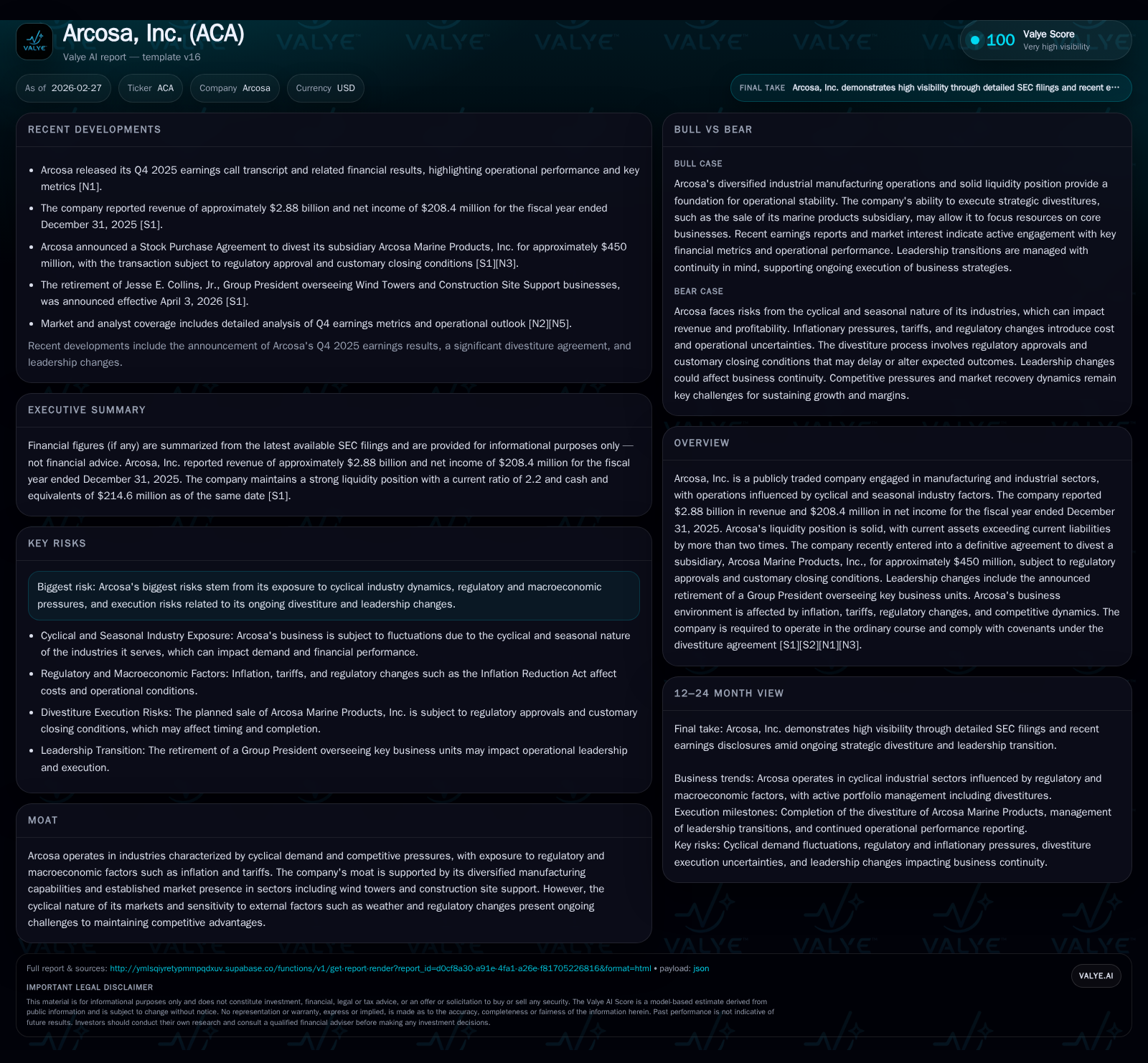
Arcosa posted a marked acceleration in revenue and net income during fiscal 2025, recovering strongly from prior years' pressures. This performance was supported by operational efficiencies and sector demand in industrial manufacturing, despite ongoing cyclical and regulatory challenges. The company’s liquidity remains solid, highlighted by a current ratio of 2.2, enabling it to pursue a strategic divestiture of its Marine Products subsidiary for approximately $450 million. Leadership changes include the planned retirement of a Group President overseeing key business units, indicating a forthcoming management transition amid evolving business priorities.
Company Overview and Market Position
Arcosa, Inc. operates primarily within manufacturing and industrial sectors which are inherently cyclical and influenced by seasonal factors [S1]. The company's portfolio spans wind towers, construction site support equipment, and marine products among others. While Arcosa benefits from diversified manufacturing capabilities and established market presence, it must navigate competitive pressures alongside inflation, tariffs, and evolving regulations as outlined in its recent risk disclosures [S4][S5].
Historical Financial Performance
Arcosa's financial trajectory from FY2022 through FY2025 highlights both volatility characteristic of cyclical industrial players and notable operational improvements in the latest period:
Historical performance (annual)
| FY | Rev ($bn) | Net ($mm) | CFO ($mm) | OpInc ($mm) | Rev YoY | Net YoY |
|---|---|---|---|---|---|---|
| 2025 | 2.9 | 208 | 341 | 342 | +12.2% | +122.4% |
| 2024 | 2.6 | 94 | 502 | 198 | +11.4% | -41.1% |
| 2023 | 2.3 | 159 | 261 | 217 | +2.9% | -35.2% |
| 2022 | 2.2 | 246 | 174 | 349 |
Source: SEC companyfacts cache [F1].
Capital returns and efficiency (annual)
| FY | Div ($mm) | Buybacks ($mm) | FCF ($mm) |
|---|---|---|---|
| 2025 | 10 | 0 | 176 |
| 2024 | 10 | 0 | 312 |
| 2023 | 10 | 14 | 58 |
| 2022 | 10 | 15 | 36 |
Source: SEC companyfacts cache [F1].
Revenue demonstrated consistent growth over the four-year span but with fluctuating profitability and cash flow metrics [F1]. The dramatic jump in operating income (+73%) and net income (+122%) in FY2025 reflects successful margin enhancement initiatives and perhaps favorable pricing or product mix shifts during the year [S2][S4]. Notably, operating cash flow contracted significantly relative to prior periods (-32%), likely impacted by working capital movements common in industrial sectors experiencing ramp-ups or inventory adjustments.
Capex spending declined moderately in FY2025 following prior elevated investments tied possibly to capacity expansions or maintenance upgrades [F1]. Meanwhile, dividends remained steady at approximately $10 million annually with buybacks discontinued since FY2024.
Equity grew steadily across this timeframe reaching $2.64 billion by end-2025, yielding an approximate return on equity of about 7.9%, balancing profit gains against capital increases [F1]. This level is within typical range for industrial manufacturers but signals some room for enhanced capital efficiency.
Recent Developments and Strategic Moves
In February 2026, Arcosa announced entering into a definitive agreement to divest its Arcosa Marine Products subsidiary—a key business unit specializing in hopper, tank, and deck barges—to ACMP Buyer LLC for roughly $450 million [S16][S18][N4]. Completion is anticipated during Q2 2026 pending regulatory approvals under the Hart-Scott-Rodino framework among other customary closing conditions.
This divestiture reflects management’s strategic focus on core segments such as wind towers and construction support equipment where it has higher market penetration or growth potential [N2][N3]. Arcosa has committed to operating the marine products unit in the ordinary course until closing.[S16]
Leadership transitions are underway as Group President Jesse E. Collins Jr., overseeing Wind Towers and Construction Site Support businesses, confirmed retirement effective April 3, 2026 [S24]. Mr. Collins’ exit marks a significant change for these divisions which are critical to Arcosa’s revenue base.
Industry Context and Risks
Arcosa faces ongoing risks inherent in cyclical industrial markets including demand swings influenced by economic conditions and weather-related seasonality [S5]. Inflationary costs impact raw materials input prices while tariffs introduce added complexity into supply chain management—a familiar dynamic seen across U.S.-based heavy industrials post-trade tensions.
Regulatory factors also weigh heavily given exposures from legislation such as the Inflation Reduction Act and infrastructure-related government initiatives that can alter competitive dynamics or product requirements [S9]. Legal proceedings disclosed appear limited without material impact so far [S1][S4].
Execution risks relating to divestiture timing or integration (for counterparties) also pose potential headwinds until completed fully by mid-2026.
Forward-Looking Considerations
While Arcosa did not provide explicit future guidance beyond its divestiture announcement at fiscal year-end reporting [S1], key items warrant watching:
- Post-divestiture revenue composition shifts—likely leaner but more focused segments
- Operating margin trajectory with cost pressures versus efficiency gains
- Capital allocation approach post-sale—whether incremental debt reduction or reinvestment occurs given no buybacks in FY25 [F1]
- Management succession outcomes following Mr. Collins’ retirement impacting wind tower segment strategy [S24]
- Macroeconomic influences including infrastructure spending pace that affect order backlogs across construction equipment lines
Analysts should monitor subsequent quarterly filings for updated commentary on these strategic pivots as well as detailed segment reporting clarifying growth drivers.
Capital Allocation & Returns Analysis
Arcosa’s dividend payments have remained conservative yet stable around $10 million annually over recent years despite earnings fluctuations [F1]. No share repurchases occurred in fiscal 2025 signaling probable prioritization of balance sheet strength or reinvestment strategies amid volatile industrial cycles.
Free cash flow (operating cash flow minus capex) was estimated at approximately $176 million for fiscal 2025—a positive figure but down from elevated levels driven by prior quarter working capital reversals [F1]. This underscores arc-shaped variability typical among capital-intensive manufacturing companies adjusting production footprints.
ROE sits near the mid-to-high single digits (~7.9%), indicative of moderate returns relative to asset bases but with opportunity for improvements via margin expansion or more aggressive capital allocation if cyclical upturns sustain.
Liquidity metrics remain healthy; notably a current ratio exceeding two times evidences ample short-term asset coverage against liabilities at year-end [F1][S7], supporting ongoing operational flexibility through this transition phase including the pending divestiture.
Conclusion
Arcosa demonstrated a pronounced financial rebound in fiscal 2025 characterized by double-digit revenue growth accompanied by sharp improvement in profitability despite softer cash flow conversion metrics typical of an industrial player managing inventory cycles. The company’s strategic plan includes shedding non-core assets such as its Marine Products business for nearly half a billion dollars—sharpening focus on wind towers and construction-related markets which historically offer differentiated opportunities within the company’s footprint. This portfolio pruning aligns with leadership changes signaling refreshed management alignment on priorities ahead. Nonetheless, lingering macroeconomic uncertainties coupled with industry cyclicality mandate prudent monitoring of execution risks and cash generation trends as Arcosa navigates these shifts.
The analysis herein is based solely on publicly available information without any recommendation regarding investment decisions.
Disclaimer: This is research-only, informational analysis and not investment advice. It may include AI-generated interpretation and general industry context. Always verify important details using primary sources.

Comments