
Traeger, Inc. Reports Wider Losses While Implementing Project Gravity Restructuring in 2025
The wood pellet grill pioneer faces increased operating losses despite positive cash flow as it restructures operations and sales channels to address low market penetration and refinancing risks.
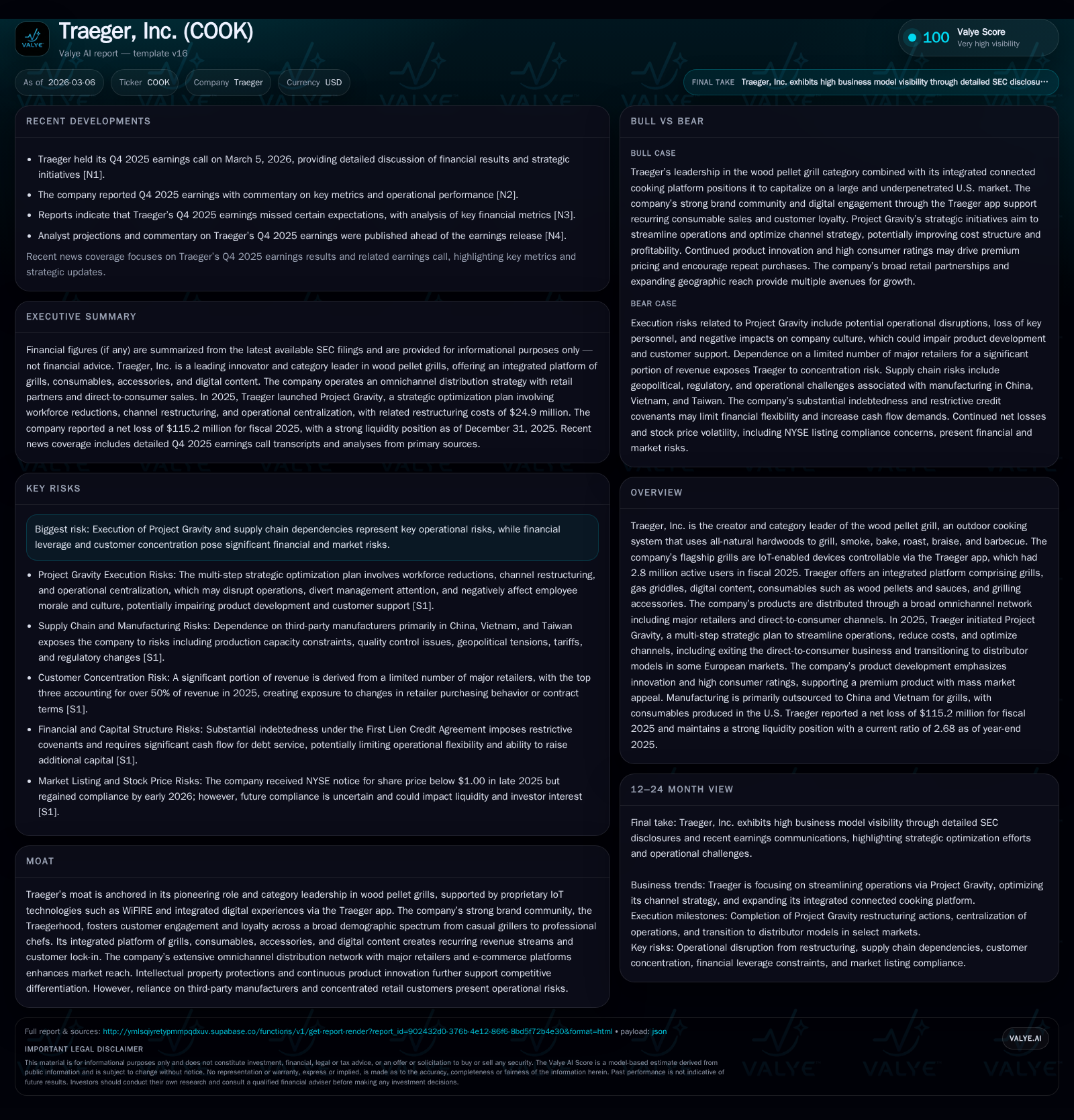
Traeger, Inc., the pioneer in wood pellet grills with an integrated IoT cooking platform, reported deepening operating and net losses in fiscal 2025 despite positive operating cash flows. The company launched Project Gravity in mid-2025 to streamline operations, reduce costs, and optimize sales channels, recording $24.9 million in restructuring charges during the year. Traeger’s addressable U.S. grilling market remains large but penetration is low at approximately 3.4%. Liquidity is supported by a strong current ratio, though debt maturities and restrictive covenants pose refinancing risks. Execution of restructuring initiatives and supply chain dependencies remain key near-term risks as Traeger seeks to restore profitability and maintain its competitive position [F1], [S1], [S4], [S6].
Innovation Leadership and Brand Ecosystem
Traeger, Inc. pioneered the wood pellet grill category in 1987 and remains its dominant player with a versatile outdoor cooking system that uses all-natural hardwood pellets for grilling, smoking, baking, roasting, braising, and barbecuing [S1]. The company's integrated IoT platform enables remote grill control via the Traeger app, which had approximately 2.8 million active users during fiscal year ending December 31, 2025 [S1].
This technology fosters a vibrant community known as the "Traegerhood," comprising casual grillers to professional chefs who drive brand loyalty. Traeger's product ecosystem extends beyond grills to consumables like wood pellets and sauces that support recurring revenue streams, complemented by accessories and proprietary digital content including recipes and cooking classes [S16].
Distribution follows an omnichannel approach with major retail partners such as Ace Hardware, The Home Depot, Amazon, and Best Buy. Direct-to-consumer sales through Traeger.com are being phased out under Project Gravity to streamline operations while maintaining consumer access through retail channels [S1], [S16].
Historical Financial Performance Overview
Traeger's recent financial performance reflects persistent operating challenges amid investments in innovation and brand development:
Historical performance (annual)
| FY | Net ($mm) | CFO ($mm) | OpInc ($mm) | Capex ($mm) | Net YoY |
|---|---|---|---|---|---|
| 2025 | -115 | 21 | -98 | 7 | -238.7% |
| 2024 | -34 | 24 | -3 | 12 | +59.7% |
| 2023 | -84 | 64 | -55 | 20 | +77.9% |
| 2022 | -382 | 5 | -346 | 18 |
Source: SEC companyfacts cache [F1].
Capital returns and efficiency (annual)
| FY | FCF ($mm) | ROE% |
|---|---|---|
| 2025 | 14 | -67.4 |
| 2024 | 12 | -12.3 |
| 2023 | 44 | -29.0 |
| 2022 | -13 | -114.1 |
Source: SEC companyfacts cache [F1].
(Data sourced from SEC filings companyfacts snapshot covering fiscal years ended December 31, 2022–25) [F1]
In FY2025 operating losses surged sharply to approximately $97.7 million from a modest loss of $2.9 million the prior year—a negative swing exceeding 3200%. Net losses similarly escalated to $115 million alongside a reduction in equity capital to roughly $171 million by year-end reflecting accumulated deficits [F1].
Despite these earnings headwinds, operating cash flow remained positive at about $20 million though down by approximately 14% year-over-year amid significant reductions (>40%) in capital expenditures signaling disciplined spending aligned with liquidity preservation efforts during restructuring [F1]. The calculated return on equity for FY2025 stands near -67%, underscoring ongoing challenges converting invested capital into profits.
Project Gravity: Operational Realignment
Launched in May 2025, Project Gravity is a comprehensive strategic initiative aimed at optimizing Traeger's cost structure and operational footprint to improve profitability and cash flow generation [S1]. Key components include:
- Workforce reductions to lower fixed costs.
- Centralizing MEATER business operations into Salt Lake City.
- Discontinuation of Costco roadshow programs.
- Exiting direct-to-consumer online sales by redirecting customers to retail partners.
- Transitioning certain European markets from direct sales to distributor models.
- Pellet mill consolidation.
The company recorded approximately $24.9 million in restructuring charges related to these initiatives during fiscal year 2025 with expectations for substantial completion by end of FY2026 [S1].
While designed for long-term benefit, these changes introduce execution risks including temporary supply chain disruption, potential lapses in customer service quality, loss of institutional knowledge due to workforce cuts affecting innovation capacity, morale impacts on corporate culture critical for product development, and operational complexities during transition periods—all factors that could adversely affect revenue and margins if not managed effectively [S1].
Market Opportunity and Growth Outlook
Traeger estimates about 78 million U.S households own grills representing its total addressable market; estimated penetration stands at approximately 3.4% based on cumulative unit sales exceeding 2.7 million from 2020 through mid-2025—indicating significant room for growth within this established segment [S1].
The company's IoT-enabled platform combined with proprietary digital content positions it uniquely within an evolving outdoor cooking landscape increasingly valuing connected experiences beyond traditional charcoal or gas grills [N1]. Internationally, channel optimization efforts aim to balance overhead reduction with market access efficiency via distributor models though short-term revenue visibility may fluctuate due to transitional impacts [S1].
Competitive pressures from established regional manufacturers emphasizing pricing strategies or alternative heat sources require continued focus on product innovation and quality differentiation as highlighted by management commentary around competitive dynamics [N3], [S1].
Explicit forward-looking financial guidance has not been disclosed beyond Project Gravity’s anticipated completion timeline (FY2026). Key indicators for monitoring will be unit sales trends relative to industry benchmarks across retail partnerships alongside digital engagement metrics which reflect consumer retention critical for sustained growth absent direct forecasts ([N4]).
Capital Structure and Liquidity Position
As of December 31, 2025, Traeger held approximately $19.6 million in cash and equivalents supporting working capital needs alongside current assets totaling about $215 million against current liabilities near $80 million yielding a robust current ratio of roughly 2.68x—a positive liquidity indicator despite ongoing operational losses [F1].
Debt maturities include revolving credit facility tranches maturing June 2026 ($30 million) and December 2027 ($82.5 million), plus a first lien term loan due June 2028 emphasizing refinancing necessity within two years amid uncertain profitability outlooks presenting refinancing risk under potentially adverse terms [S4], [F1]. Restrictive covenants embedded within credit agreements impose constraints on incurring additional indebtedness or making restricted payments thereby limiting financial flexibility needed for strategic initiatives or weathering downturns [S10].
No dividends or share repurchases were declared reflecting constrained free cash flow generation despite positive operating cash flows combined with reduced capital expenditures producing an estimated free cash flow of approximately $13.6 million for FY2025 indicating internal cash discipline aligned with restructuring objectives without reliance on external capital infusions ([F1]).
Key Risks: Execution Challenges and Operational Dependencies
Principal risks include uncertainties around successful execution of Project Gravity’s multi-faceted initiatives where failure or delays could exacerbate financial weaknesses through lost revenues or elevated costs; workforce reductions may also result in loss of critical institutional knowledge impacting product development velocity and customer support responsiveness vital for brand reputation preservation [S1].
Manufacturing heavily depends on third-party suppliers predominantly based overseas—approximately eighty percent of grills are manufactured in China—exposing Traeger to geopolitical risks heightened by trade policies including tariffs necessitating renegotiations within Project Gravity scope though residual supply chain vulnerabilities remain potentially affecting costs or delivery timelines unpredictably [S6], [S11].
Customer concentration risk is material with the top three retailers accounting collectively for over half of revenues (29%,14%,8%) increasing dependence on their retail presence decisions which could materially affect sales volumes absent long-term contractual protections [S23].
Digital platform reliance on third-party operating system providers such as Apple iOS and Android introduces exposure to policy changes or fee adjustments that could impair app availability or user experience thereby impacting engagement critical for monetization models tied to software services integral to future growth strategies [S7].
Additional legal-compliance risks arise from labor law exposure linked with workforce reductions potentially triggering litigation or regulatory actions imposing financial penalties or distracting management focus amid aggressive restructuring phases already reflected in financial results ([S17]).
Conclusion
Traeger's status as the original innovator coupled with a strong brand community creates a defensible market position characterized by high switching costs through interconnected hardware-software-consumable synergies supported by broad distribution networks. Nonetheless, restoring profitability hinges critically on adeptly navigating complex restructuring efforts while managing supply chain dependencies amidst shifting macroeconomic headwinds.
Disclaimer: This is research-only, informational analysis and not investment advice. It may include AI-generated interpretation and general industry context. Always verify important details using primary sources.

Comments