
Arch Capital Group Delivers Steady Profitability Amid Cyclical Industry Challenges and Regulatory Complexity
Arch Capital leverages its specialty insurance expertise and technology investments to sustain growth in a volatile reinsurance environment.
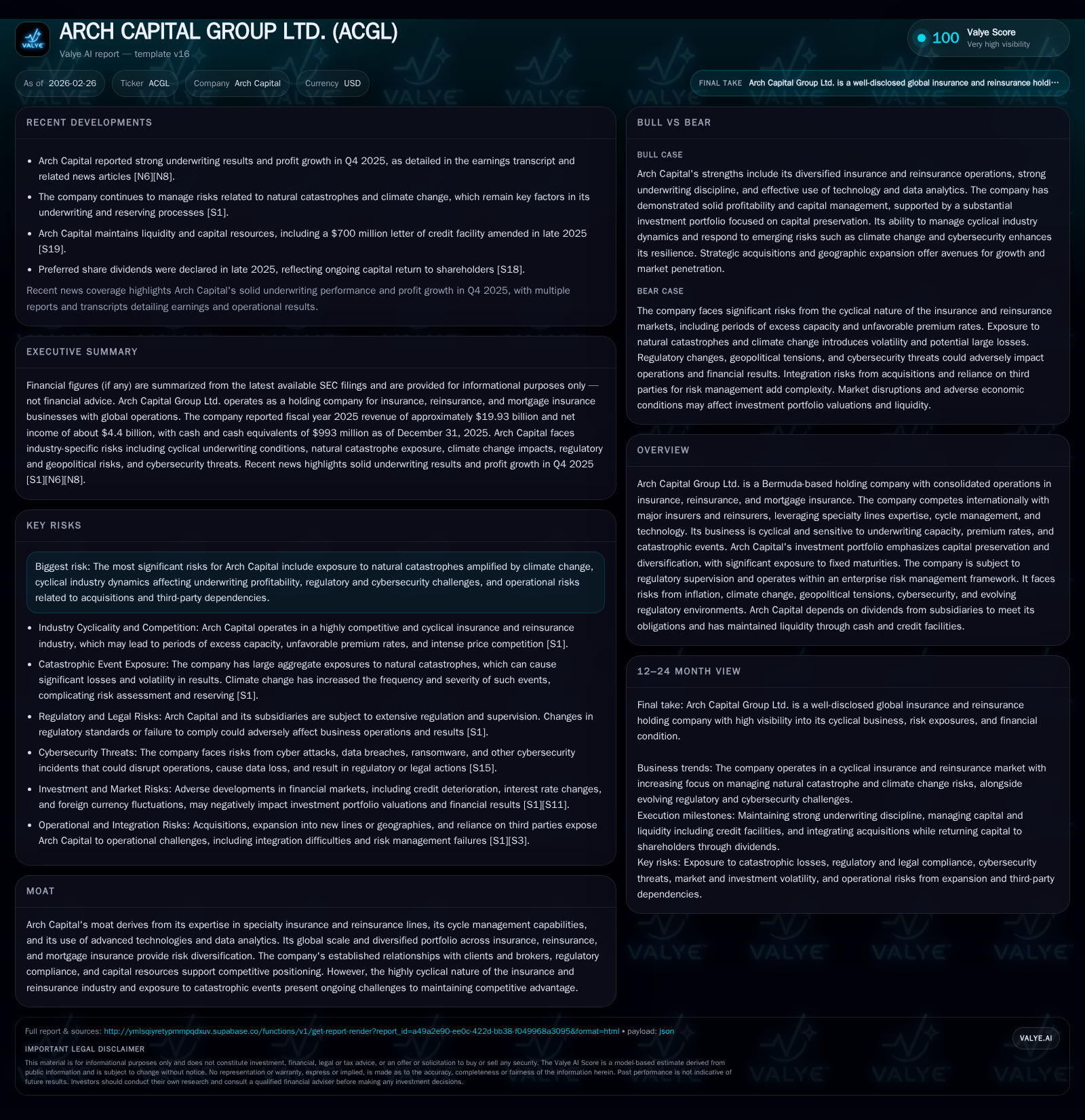
Arch Capital Group Ltd. reported robust revenue growth of 14.3% in FY2025, reaching $19.9 billion, driven by strong underwriting performance across its international insurance, reinsurance, and mortgage insurance segments [F1]. Despite the cyclical nature of the industry and exposure to catastrophic risk amplified by climate change, Arch has maintained disciplined cycle management and capital preservation strategies [S1][S4]. The company’s approximately 18.2% return on equity reflects effective capital allocation supported by share repurchases totaling nearly $1.9 billion in FY2025 [F1][S29]. Looking ahead, regulatory shifts including Basel III revisions and evolving climate-related requirements pose ongoing risks but also opportunities for strategic adaptation [S20][S25].
Introduction
Arch Capital Group Ltd., a Bermuda-based holding company, operates diversified insurance-related businesses internationally covering insurance, reinsurance, and mortgage insurance. As of its latest fiscal year ending December 31, 2025, Arch reported strong financial performance driven by specialty line underwriting expertise and rigorous cycle management during a challenging market environment characterized by inflationary pressures and elevated catastrophic event risk.
This report reviews Arch’s historical financial results, evaluates future growth prospects given industry dynamics and regulatory developments, assesses key risks inherent in its business model, and summarizes recent strategic capital allocation activity based on latest SEC filings [F1].
Historical Performance
Arch Capital demonstrated notable revenue expansion over the past four years as it scaled premium volume while managing underwriting profitability carefully across its specialties.
Historical performance (annual)
| FY | Rev ($bn) | Net ($bn) | CFO ($bn) | Capex ($mm) | Rev YoY | Net YoY |
|---|---|---|---|---|---|---|
| 2025 | 19.9 | 4.4 | 6.2 | 44 | +14.3% | +2.0% |
| 2024 | 17.4 | 4.3 | 6.7 | 51 | +27.9% | -2.9% |
| 2023 | 13.6 | 4.4 | 5.7 | 52 | +41.8% | +200.8% |
| 2022 | 9.6 | 1.5 | 3.8 | 52 |
Source: SEC companyfacts cache [F1].
Capital returns and efficiency (annual)
| FY | Buybacks ($mm) | FCF ($bn) | ROE% |
|---|---|---|---|
| 2025 | 1889 | 6.1 | 18.2 |
| 2024 | 24 | 6.6 | 20.7 |
| 2023 | 0 | 5.7 | 24.2 |
| 2022 | 586 | 3.8 | 11.4 |
Source: SEC companyfacts cache [F1].
(Figures in billions USD except Capex)
Revenue surged from under $10 billion in FY2022 to nearly $20 billion by FY2025 reflecting both organic growth and acquisition integration benefits highlighted by the MCE acquisition noted in filings [S5][S16]. Net income grew substantially post-2022 driven partly by easing pandemic-related claims volatility followed by stabilization at around $4.3-$4.4 billion levels.
Operating cash flow remained strong though it declined modestly in FY2025 relative to prior year as policyholder claims costs normalized amidst inflationary headwinds.
Capital expenditures remained low given Arch’s business model focused on underwriting rather than heavy physical assets.
Share repurchases dramatically accelerated again in FY2025 following near dormancy during earlier pandemic years—underscoring management confidence in sustainable cash generation capacity.
Drivers of Historical Growth
Underlying growth was powered by:
- Leveraging specialty lines: Arch focuses on niche sectors such as excess casualty and professional liability where advanced underwriting analytics offer competitive differentiation .
- Cycle management: Disciplined premium rate setting aligned with market capacity conditions helped preserve margins despite industry cyclicality and periodic rate softness [S1].
- Geographic diversification: International footprint spreads catastrophe and economic risks across multiple regions.
- Mortgage insurance segment resilience: Despite regulatory uncertainties, the mortgage business maintained premium volumes backed by proprietary risk models simulating severe housing market downturns [S15].
- Strategic acquisitions: The MCE acquisition expanded product scope and enhanced scale for operating efficiencies [S5][S16].
Future Growth Prospects
Looking ahead several drivers could support continued expansion:
- Growing demand for specialty insurance products driven by increasing complexity of commercial risks globally.
- Continued cycle discipline enabling selective premium rate increases when market hardening occurs.
- Expansion into new geographic markets leveraging existing underwriting platforms.
- Mortgage insurance growth contingent on favorable regulatory outcomes from GSE eligibility criteria revisions and Basel III implementation modifications announced for reproposal aiming at more industry-friendly terms [S20].
- Technology adoption including AI/data analytics enhancements aimed at accelerating underwriting precision and customer responsiveness.
However, constraints include:
- Industry cyclicality: Periodic softening due to excess capacity or pricing competition remains a challenge.
- Catastrophe loss volatility: Large-scale natural disaster events influenced increasingly by climate change can materially impact underwriting results unexpectedly [S6][S15].
- Regulatory pressures: Enhanced supervision as an IAIG coupled with evolving sustainability disclosure demands could increase compliance costs or limit certain product offerings [S12][S25].
- Geopolitical tensions and sanctions: Ongoing Russia-Ukraine conflict sanctions have already impacted marine and energy lines with uncertain future ramifications [S26].
- Mortgage insurance demand risks if government policies shift toward reduced private sector participation or tighter capital requirements under revised banking regulation frameworks manifest more onerously than anticipated [S20].
Forecasts / Milestones / Expectations
While Arch has not provided explicit earnings guidance within available disclosures through February 2026 [N5][N7], investor commentary asserts expectations to monitor:
- Rate environment trends through upcoming quarters influencing top-line premium yields.
- Loss ratios influenced by catastrophe frequency/severity especially related to climate risk exposures.
- Regulatory updates regarding mortgage insurer eligibility with U.S. GSEs plus Basel III reproposal outcomes that could reshape capital demands on primary mortgage risk insurers.
- Share buyback program execution levels as signals of confidence in free cash flow sustainability.
Continued assessment of enterprise risk management effectiveness will remain integral due to the dynamic risk landscape described below.
Returns / Capital Allocation Analysis
Arch’s capital allocation strategy balances reinvestment in operations with significant shareholder returns via buybacks supported by strong cash flows:
- Approximate Return on Equity stood near an attractive ~18% based on FY2025 net income relative to equity base—a sign of effective profit generation leveraging shareholder capital [F1].
- Free cash flow approximated at $6.13 billion (operating cash flow minus capex), provides robust internal funding for both operations and distributions [F1].
- Substantial increase in share repurchases during FY2025 (~$1.89 billion) boosted capital returns after subdued activity previously reflecting pandemic uncertainty; no dividend payout data was explicitly disclosed but prior communications emphasize balanced returns policy consistent with prudent capital management objectives [F1][S29].
- Cash & equivalents totaled approximately $993 million end-FY2025 supporting liquidity alongside credit facilities evidenced through amendments extending letter of credit availability through May 2026 enhancing financial flexibility [S10][S28].
Risk Profile & Industry Considerations
Cyclicality & Catastrophic Exposure
The re/insurance sector is inherently cyclical—premium rates fluctuate with capacity shifts—impacting underwriting profitability often unpredictably over short cycles [S1][S27]. Large insured losses from natural catastrophes are exacerbated by climate change trends requiring continuous refinement of catastrophe models; Arch employs these while also relying on retrocessional arrangements though availability may tighten limiting loss mitigation efficacy [S6][S22][S27].
Regulatory & Legal Environment
Arch is regulated globally with intensified scrutiny post-designation as an Internationally Active Insurance Group (IAIG), incurring higher compliance burdens including EU/UK sustainability reporting obligations that are evolving rapidly adding complexity and cost [S12][S25]. Changes in capital adequacy rules from Basel III reforms could affect mortgage insurer business volumes depending on final implementation details currently pending revisal [S20]. Ongoing litigation risks exist though management reports no material cases threatening firm condition presently [S4].
Cybersecurity & Operational Risks
Technological reliance opens exposures to cyber attacks including ‘silent cyber’ losses unpriced within traditional policies; third-party dependency further complicates risk controls requiring continuous investment in system resilience while adopting AI tools poses challenges balancing innovation with security oversight adequacy [S16][S17]. Empirical evidence highlights increasing sophistication of threat actors necessitating vigorous defense postures.
Geopolitical & Sanctions Risks
Russia/Ukraine conflict introduces uncertainty affecting sectors insured especially marine/energy lines; divergences among U.S., UK & EU sanction regimes add complexity for compliance impacting global underwriting activities requiring agile adjustment mechanisms to mitigate emerging geopolitical instability impacts [S26].[
Mortgage Market Specific Risks
The private mortgage insurance segment faces demand variability tied closely to macroeconomic trends in housing affordability plus regulatory eligibility tied to GSE policies; changes reducing reliance on private mortgage insurance could diminish premium bases requiring strategic adjustments including pricing innovations or product diversification timelines yet uncertain given governmental rulemaking fluxes expected through early-mid 2026 period per Federal Reserve indications[S15][S20].[
Competitive Positioning & Strategic Moat
Arch’s moat rests firmly on deep domain expertise across specialty insurance lines blending actuarial rigor with data-driven underwriting technology that few competitors fully replicate; this underpins superior cycle management capability preserving disciplined premium rates where others might cede margin for share.[ Global scale affords diversification benefits reducing concentration risk while established client/broker relationships create distribution strengths difficult to displace. Nevertheless persistent pressure from larger multinational incumbents with greater resource pools underscores the need for continuous innovation/storage efficiency enhancements/specialty niche refinement.[S1]
Summary
Arch Capital Group Ltd.’s financial trajectory reflects well-executed strategy navigating the highly cyclical, capital-intensive property-casualty insurance/reinsurance markets through disciplined underwriting combined with steady adoption of advanced technology tools supporting market differentiation.[F1] Despite intensifying regulatory requirements and multi-dimensional risk exposures—including climate-driven catastrophic events, cybersecurity threats, geopolitical uncertainties—management continues prudent cycle navigation emphasizing sustainability paired with meaningful capital returns via share repurchases.[S29] Upcoming regulatory milestones such as Basel III Endgame finalizations and GSE reforms loom as potential inflection points shaping mortgage insurance demand cadence.[S20] While short-term earnings may experience volatility linked to loss incidence frequency/severity variability typical for this sector,[S27] Arch’s diversified operational footprint cushioned by granular loss mitigation programs ensures resilience bolstered by strong liquidity buffers.[S10] Institutional investors should watch these evolving external mandates alongside management’s ability to maintain competitive underwriting margin disciplines for cues regarding medium-term profitability stability.
This analysis is intended solely for informational purposes to assist understanding of ARCH CAPITAL GROUP LTD.’s operational context within its industry sector without constituting investment advice or recommendation.
Disclaimer: This is research-only, informational analysis and not investment advice. It may include AI-generated interpretation and general industry context. Always verify important details using primary sources.

Comments