
AUTOMATIC DATA PROCESSING INC: Navigating Human Capital Management with Scale and Innovation
ADP leverages its global footprint and integrated HCM platform to address workforce complexities amid evolving technology and regulatory challenges.
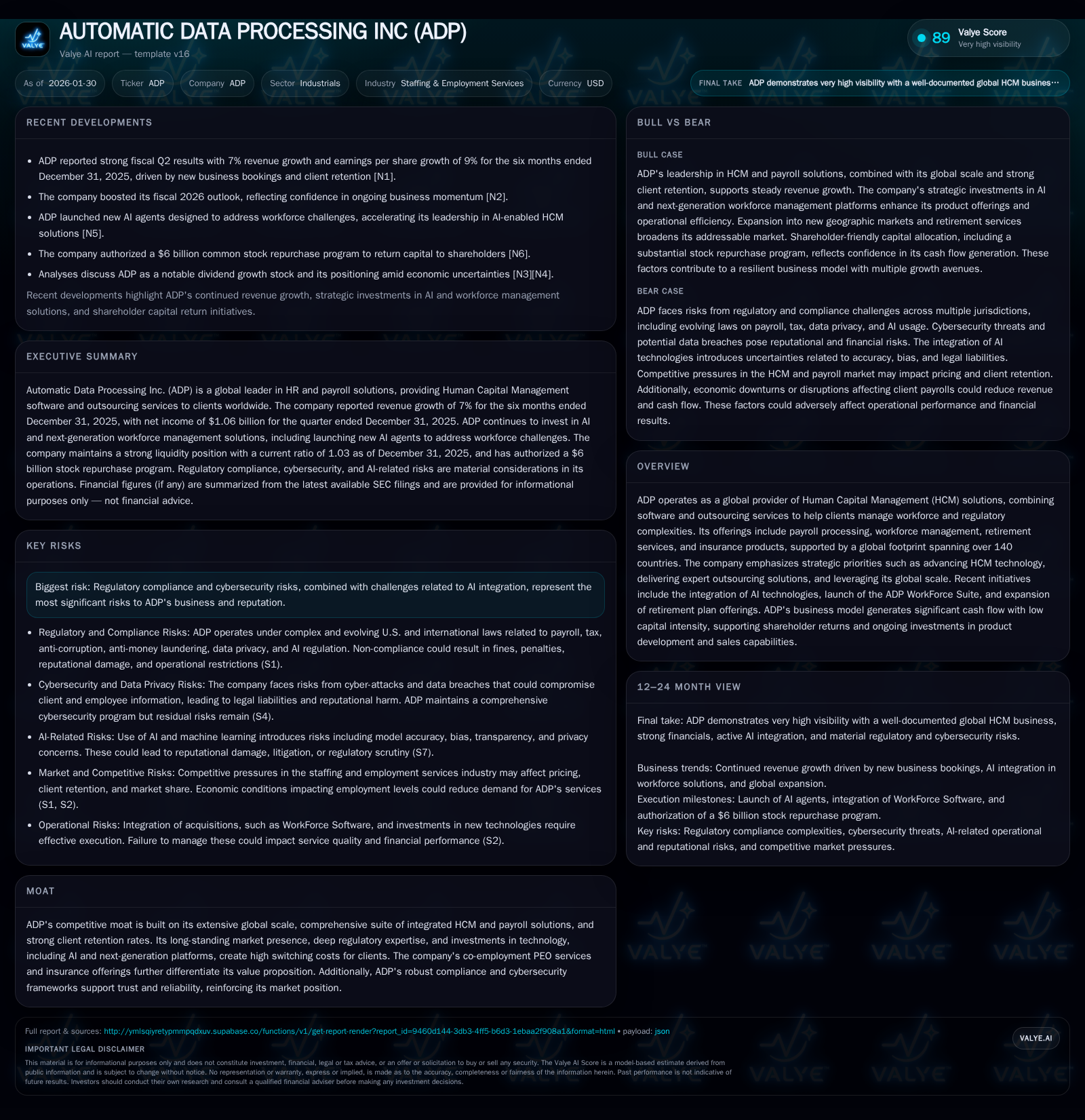
Automatic Data Processing Inc (ADP) remains a dominant player in the human capital management (HCM) space, combining payroll services, workforce management, and outsourcing solutions on a global scale. Recent acceleration in AI integration, including new AI agents targeting workforce challenges, aligns with its strategic priorities to lead in technology and expertise. The company’s robust recurring revenue and strong client retention underpin its financial performance, although regulatory and cybersecurity risks persist. ADP’s continued investments in next-generation platforms and acquisitions like WorkForce Software position it well within a competitive landscape marked by increasing digitization and compliance complexity.
What Changed Recently
ADP accelerated its AI leadership with the launch of new AI agents designed to solve workforce challenges, announced on January 28, 2026. These AI tools aim to enhance the client and associate experience by automating and optimizing workforce management tasks, aligning with ADP’s strategic priority of leading with best-in-class HCM technology [N1, S1]. Shortly after, the company reported Q2 FY26 earnings with a 7% revenue growth and raised its full-year guidance, supported by strong Employer Services performance and solid new business momentum, demonstrating operational strength amid a complex macroeconomic backdrop [N2, N3]. Additionally, ADP authorized a $6 billion share repurchase program, signaling confidence in its cash generation and capital allocation strategy [N7].
Business Model as a System
ADP operates as a global provider of integrated Human Capital Management solutions, combining technology-driven payroll processing, workforce management, retirement plan services, insurance offerings, and Professional Employer Organization (PEO) services. Its business model is structured around recurring revenue streams from Employer Services (ES) and PEO segments, supported by a global client base spanning more than 140 countries [S1, S2].
The system functions through three strategic priorities:
- Leading with advanced HCM technology, embedding AI to improve automation and client outcomes;
- Delivering expert outsourcing and compliance solutions to alleviate workforce regulatory burdens;
- Leveraging global scale to serve diverse markets with localized expertise and integrated payroll offerings [S1].
ADP’s client retention rates remain high (~92% in Employer Services), driven by deeply embedded payroll systems, high switching costs due to complex integration, and continuous product enhancements including AI capabilities [S2]. The PEO business, which co-employs client workers, provides additional revenue streams but is sensitive to labor-related costs and insurance risks [S6, S9]. The company’s technology platforms like ADP WorkForce Suite and ADP Lyric HCM are central to expanding wallet share and attracting mid-market and enterprise clients [S1].
Industry Map & Competitive Battlefield
The HCM and payroll services industry is characterized by network effects, regulatory complexity, and technology-driven disruption. Key competitors include SAP SuccessFactors, Workday, Paychex, and regional payroll providers. ADP’s competitive advantage stems from its scale, breadth of services, and ability to serve multinational organizations with localized compliance expertise.
Emerging trends reshaping the battlefield include:
- AI and automation adoption for workforce analytics, recruitment, and compliance;
- Increasing demand for integrated platforms combining payroll, benefits, and workforce management;
- Heightened regulatory scrutiny and data privacy requirements, necessitating robust cybersecurity and compliance frameworks;
- Growing interest in PEO and co-employment models as companies seek to outsource complex HR functions.
ADP’s acquisition of WorkForce Software and expansion in markets like Japan and Saudi Arabia reflect its strategy to deepen its product portfolio and geographical reach, positioning it favorably against competitors with less global footprint or service breadth [S2].
Where the Economics Become Real
ADP’s economics pivot on scale efficiencies, recurring revenue, and client retention. Employer Services revenue grew 7% year-over-year to $20.56 billion in fiscal 2025, with organic constant currency growth at 7% and EPS growth near 10% [S2]. The pays per control metric, indicating payroll employees managed, increased modestly, underscoring steady client base growth.
PEO services contribute meaningfully to revenues ($6.69 billion in fiscal 2025) but margins are compressed by rising workers’ compensation, state unemployment insurance costs, and zero-margin benefit pass-throughs. ADP mitigates insurance exposure via indemnity arrangements and reinsurance agreements with Chubb, capping losses per occurrence and aggregate exposures [S6, S9, S10].
Operating leverage is evident in rising R&D spend (nearly $1 billion in fiscal 2025), focusing on next-gen platform development and AI integration, coupled with increased selling and marketing expenses to sustain growth [S16, S17]. Liquidity remains strong with $2.4 billion in cash and equivalents and access to $10.6 billion in committed credit facilities, supporting capital expenditures, acquisitions, and shareholder returns including dividends and buybacks [S11, S12, S13, SEC XBRL].
Client funds management and short-term funding involve substantial commercial paper issuances and reverse repurchase agreements, reflecting the large scale of payroll disbursement and related cash flows [S13, S14].
Diligence Questions / Disconfirming Signals
- How effectively can ADP integrate AI capabilities without disrupting core client workflows or increasing operational risks?
- To what extent could rising workers’ compensation and unemployment insurance costs erode PEO margins in an inflationary or regulatory tightening environment?
- Are emerging competitors or cloud-native HCM platforms materially eroding ADP’s market share in the small to mid-market segment?
- How resilient is ADP’s global compliance framework against fast-changing labor laws, data privacy regulations, and geopolitical risks?
- What is the exposure and preparedness regarding cybersecurity threats given increased attack vectors targeting payroll and personal data?
- Could regulatory changes or enforcement actions around co-employment and PEO arrangements impact revenue recognition or cost structures?
- How sustainable is growth in new business bookings given macroeconomic volatility and client budget constraints?
- What is the impact of ongoing share repurchases on balance sheet flexibility and investment capacity?
Conclusion
Automatic Data Processing stands as a formidable incumbent in the HR and payroll services sector, underpinned by a comprehensive product ecosystem and global scale. Its recent AI initiatives and technology investments signal a commitment to innovation while maintaining a focus on regulatory compliance and outsourcing expertise. The company’s financial metrics highlight steady growth and robust cash generation, although margin pressures in PEO services and regulatory risks warrant close monitoring. ADP’s ability to navigate evolving market dynamics, integrate acquisitions, and defend its competitive moat will be critical to its ongoing operational success.
This analysis is based on publicly available information and does not constitute investment advice. It aims to provide a comprehensive understanding of Automatic Data Processing Inc’s business and industry context as of early 2026.
Disclaimer: This is research-only, informational analysis and not investment advice. It may include AI-generated interpretation and general industry context. Always verify important details using primary sources.

Comments