
Argan's Q1 Surge: Backlog, Margins, and Market Position in Power EPC
Argan’s latest quarterly 10-Q reveals a robust backlog above $2.7 billion and margin expansion, reinforcing its foothold in the evolving U.S. power generation market.
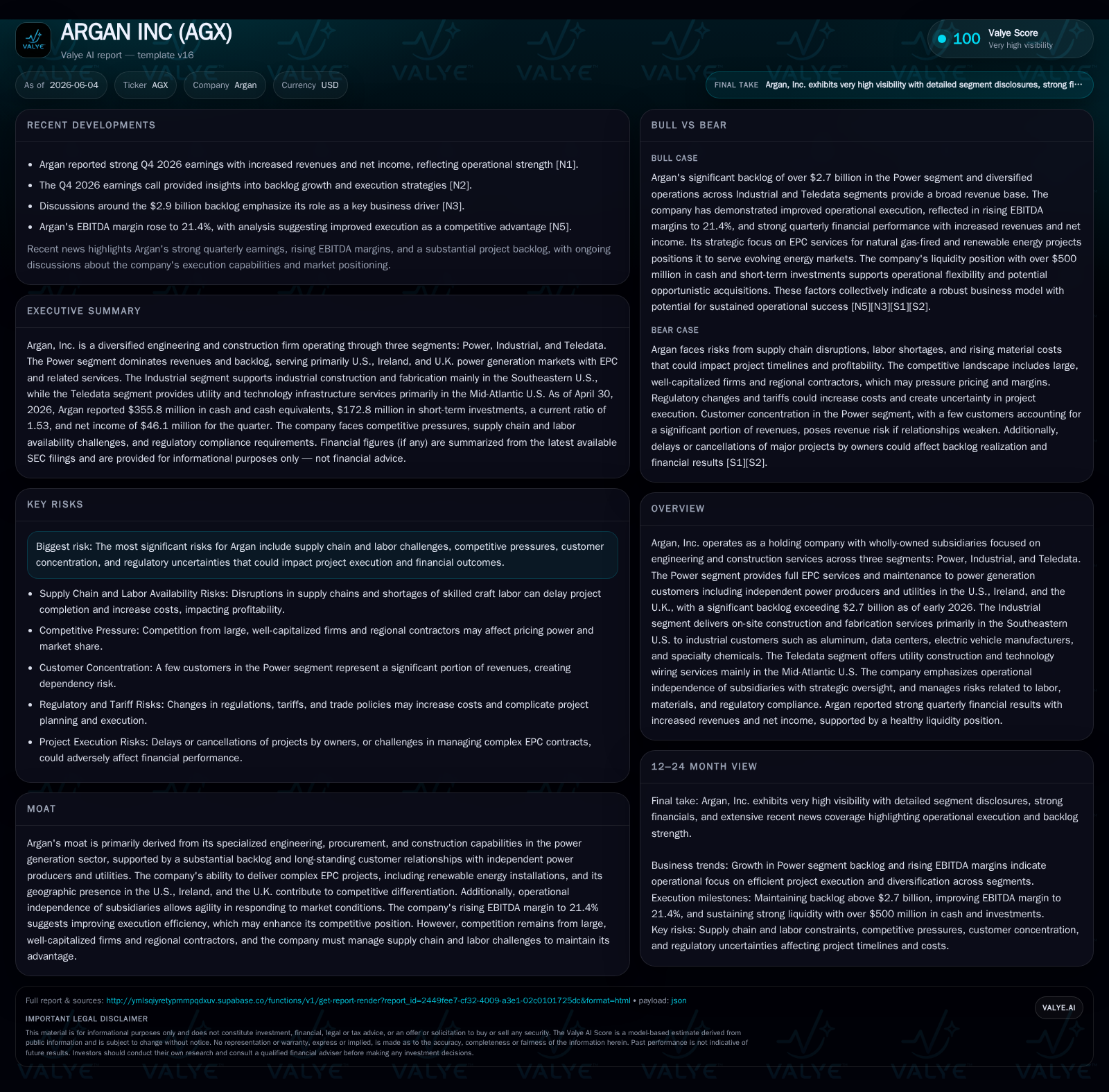
In its Q1 2026 filing, Argan reports a significant backlog exceeding $2.7 billion alongside an EBITDA margin increase to 21.4%, driven largely by its Power segment focused on natural gas-fired and renewable EPC projects across the U.S., Ireland, and the U.K. The company’s holding structure enables operational agility across its three segments—Power, Industrial, and Teledata. Increasing retirements of conventional power plants in the U.S. underpin demand for dispatchable, reliable power infrastructure—a core focus of Argan’s business. Despite labor and supply chain headwinds, Argan’s strategic positioning and backlog provide a strong foundation for growth, supported by prudent liquidity management and a credit facility in place.
Q1 Operational Highlights: Backlog and Margin Momentum
Argan Inc’s Q1 2026 SEC filings spotlight substantial operational progress anchoring its leadership in the engineering, procurement, and construction (EPC) domain for power generation facilities. The company reported a backlog exceeding $2.7 billion, underscoring sustained contract awards predominantly tied to natural gas-fired plants and renewable energy installations in critical U.S., Irish, and U.K. markets [S2]. This backlog scale is notably aligned with growing grid operator concerns regarding electricity supply shortages amid accelerated retirement of traditional fossil fuel power plants across the U.S. Electric grid operators cite the imperative for additional dispatchable capacity to maintain system stability during peak demand episodes or renewable intermittency [S2].
Coupled with backlog strength is Argan’s rising EBITDA margin reaching 21.4% [N5], an indicator of enhanced execution efficiency amidst technically challenging project scopes characteristic of combined-cycle and simple-cycle natural gas projects along with solar field EPC efforts. This margin improvement signals operational discipline gains potentially translating into competitive advantage over larger diversified contractors constrained by less specialized focus.
The company continues its track record of steady dividend payments sitting at $0.50 per share for Q1 reflecting confidence in cash flow stability despite project phasing variability inherent in multi-year EPC contracts [S2]
EPC Business Model: Contracts, Customers, and Subsidiary Structure
Argan operates as a holding company overseeing wholly-owned subsidiaries segmented chiefly into Power, Industrial, and Teledata businesses [S1]. The Power segment accounts for more than 80% of revenues and specializes in full scope EPC services targeting independent power producers (IPPs), utilities, power plant OEMs, and commercial entities with substantial electricity needs across the U.S., Ireland, and the U.K. [S1][S18]. Revenue recognition practices hinge on milestone progression measured via costs incurred, reflecting long-dated contract cycles often sensitive to receipt of formal notices-to-proceed from customers—a key determinant of revenue timing [S1].
The Industrial segment delivers onsite fabrication and field construction services primarily within the Southeastern U.S., catering to industries such as aluminum production, electric vehicle manufacturing facilities, data centers, specialty chemicals plants, water treatment facilities, among others [S22]. Its business model emphasizes flexibility augmenting permanent labor with temporary trades when needed to meet project timelines
Teledata focuses on utility-scale infrastructure wiring, installation, maintenance services within Mid-Atlantic states serving commercial to government clients [S1]. The corporate structure deliberately delegates operational autonomy to subsidiaries enhancing localized decision-making agility while central management imposes strategic oversight ensuring capital discipline, risk management, and standardization where beneficial.
Such decentralized subsidiary operation coupled with diversified end-markets mitigates reliance on any single customer or geography although Power segment customer concentration remains notable—with several large accounts comprising significant revenue portions [S18]
Industry Context: Power Construction Market and Competitive Set
The prevailing industry backdrop presents both opportunities and formidable competition for Argan’s specialized EPC offerings. As older coal-fired and less efficient fossil baseload generators exit service under tightening environmental regulations or economic obsolescence, grid regions increasingly demand new reliable capacity able to integrate renewable sources while guaranteeing firm dispatchability—a niche where combined-cycle gas technology excels due to superior heat rates versus peaking turbines or reciprocating engines [S2][N9]
In addition to natural gas projects, utility-scale solar fields constructing massive PV arrays contribute meaningfully to Argan’s pipeline evidenced by orders within its backlog [S1]. However, these markets also attract sizable well-capitalized competitors spanning global engineering conglomerates to nimble regional contractors capable of winning smaller field service engagements or specific utility contracts.
Argan differentiates itself through proven expertise managing complex integrated projects that blend cutting-edge thermal generation with renewables backed by longstanding relationships in power generation circles. Nonetheless exposure to supply chain volatility—especially critical equipment lead times—and persistently tight craft labor markets challenge schedule adherence nationwide [S27][N9]. Regulatory uncertainties around permitting cycles further add execution risk layers.
Drivers of Growth: Infrastructure Demand and Project Execution Efficiency
Structural drivers boosting Argan’s growth stem from accelerating infrastructure replacement cycles amid increasing grid decentralization. Rising electricity demand coupled with declining baseload capacity primes utility-scale natural gas plants as flexible resources enabling coexistence alongside intermittent wind/solar systems that require firming support during low-generation intervals [S2][N5]. Public policy emphases on cleaner energy transitions reinforce investments in high-efficiency combined-cycle units alongside battery storage integration opportunities potentially opening future EPC avenues.
Execution excellence constitutes expanding moat potential signaled by recently elevated EBITDA margins [N5], conveying improved project cost control alongside better subcontractor coordination reducing wasteful spending overruns common in construction-intensive sectors. Sustained workforce retention initiatives including training programs enhance operational continuity enabling delivery timeline compression despite macro labor scarcity trends [S21].
Nevertheless revenue recognition remains dependent on project commencements contingent upon customer approvals—delays or postponements disrupt cash flow timing warranting close monitoring of notice-to-proceed issuance patterns accompanying new contract awards [S1][N3]
Risks and Execution Challenges: Supply Chain, Labor, Customer Concentration
Key risks involve episodic project delays triggered by deferred customer funding or regulatory approvals restraining revenue visibility despite secured contracts [S18][S27]. High customer concentration within the Power segment elevates exposure should major IPPs or utilities alter CapEx priorities or enforce stringent contract renegotiations
Labor shortages exacerbate schedule pressures especially given specialized skill demands inherent to large thermal plant components requiring certified craftspeople—supplemented but not easily replaced through subcontractors without quality or safety compromises [S27]. Material price inflation spikes remain potential headwinds affecting fixed-price EPC margins.
While overseas litigation involving subsidiary contracts arose recently in the U.K., management affirms no material adverse financial impact at present though illustrates inherent contractual risks tied to complex multinational engagements [S29]. Procurement bottlenecks on critical equipment items remain monitored due to their outsized influence on project milestone adherence.
Outlook and What to Watch: Upcoming Contracts and Guidance
Market participants should track award announcements of major utility-scale gas-fired plants plus renewable EPC deals as near-term catalysts signaling backlog replenishment pace beyond current ground already secured over $2.7 billion [S3][N3]. Receipt timing for notices-to-proceed drives revenue cadence influencing quarterly results substantially given project size variability.
Management commentary during recent earnings events underscores emphasis on improving execution speed while cautiously navigating supply chain constraints without overextending operational capacity [N2]. Monitoring competitively bid contract wins against peers provides insight into pricing environment elasticity amid aggressive bidding climates.
Margins trajectory offers timely readout whether recent gains prove sustainable normalization versus cyclical uplift underpinned by backlog mix shift toward renewables integration projects commanding higher premium pricing relative to traditional thermal builds.
Liquidity and Financial Health Snapshot
Financially Argan maintains solid liquidity with approximately $356 million in cash & equivalents as of April 30, 2026 alongside total current assets exceeding $1.2 billion against current liabilities near $795 million yielding a comfortable current ratio of about 1.53 supporting operating flexibility without reliance on short-term debt draws [F1]
The company enjoys an unsecured revolving credit facility totaling $35 million base commitment plus an accordion feature expandable by an additional $30 million subject to conditions extending through May 31, 2027 [S2]
This financial positioning affords capacity for opportunistic investments or cushioning against working capital volatility emerging from large fiscal period-to-period project cash flow swings characteristic of EPC contracting workloads.
This analysis integrates SEC disclosures through Q1 2026 filings combined with recent industry reporting to provide an informed perspective on Argan Inc.'s operational progress within the evolving power infrastructure sector without offering investment advice or research views.
Disclaimer: This is research-only, informational analysis and not investment advice. It may include AI-generated interpretation and general industry context. Always verify important details using primary sources.

Comments