
Applied Industrial Technologies Strengthens Technical Solutions Amid Operating Stability
Latest quarterly disclosures highlight disciplined working capital management reinforcing Applied Industrial’s value proposition in industrial distribution.
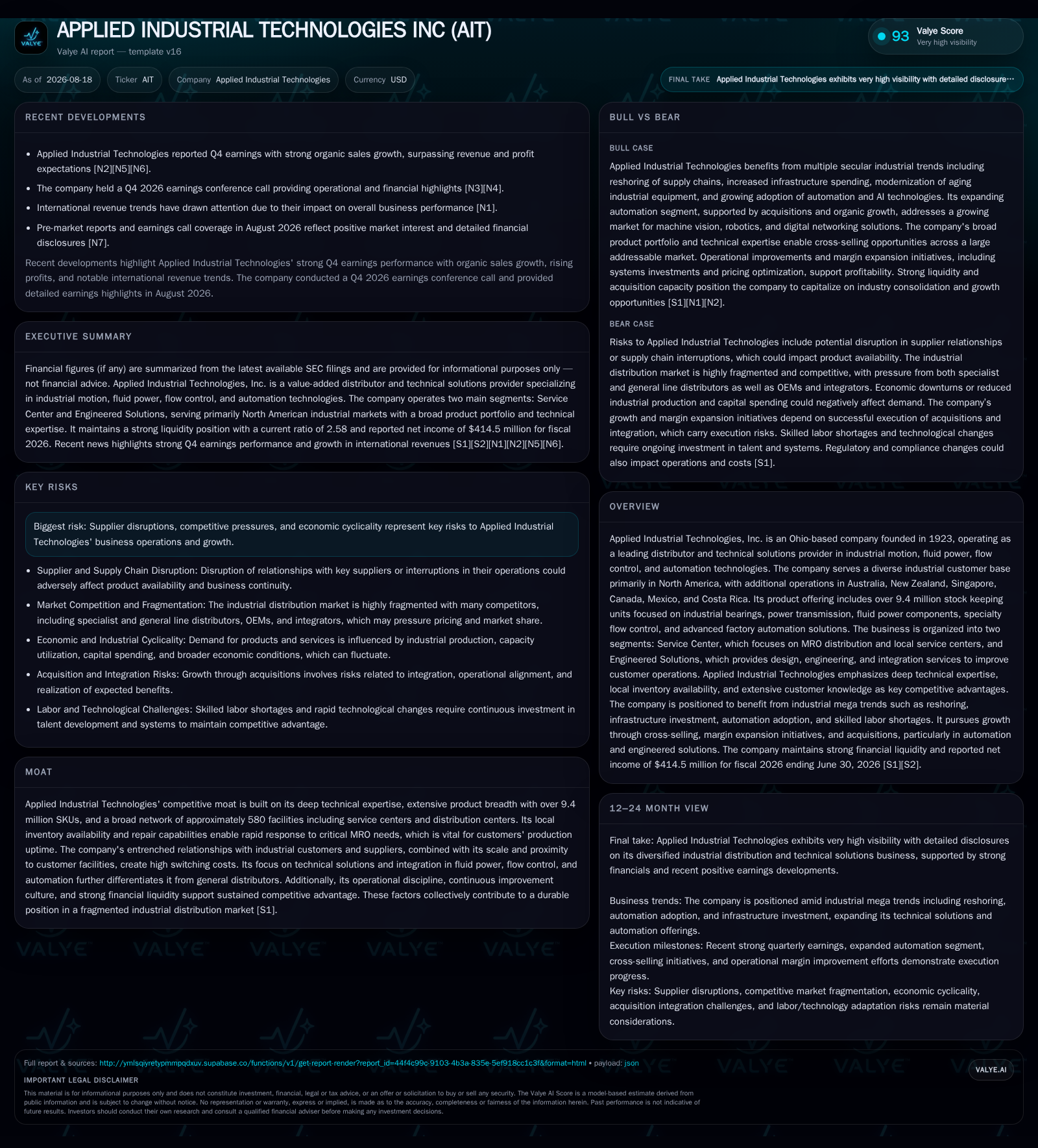
Applied Industrial Technologies reported steady operating performance in its latest quarter, with stable Days Sales Outstanding (DSO) near 57 days and a notable reduction in accounts receivable past due beyond 90 days to 1.2% from 2.1% the prior year. Its inventory turnover ratio improved modestly to 4.4x, signaling enhanced inventory efficiency aligned with its Service Center segment’s focus on rapid MRO responsiveness. The company continues leveraging its dual-segment model—value-added distribution through extensive SKU breadth and technical engineering integration—to differentiate itself in a cyclical industrial market. Key risks include supply chain disruptions and cyclical demand variability, but the firm’s broad network, technical expertise, and conservative financial profile underpin resilience.
Quarterly Receivables Health Signals Operational Resilience during Economic Cycles
Applied Industrial Technologies’ Q3 fiscal 2026 filing reveals stable working capital metrics essential for operational continuity during cyclical industrial demand [S2]. The company’s Days Sales Outstanding (DSO) remained steady at approximately 57 days as of March 31, 2026. More notably, accounts receivable balances overdue beyond 90 days declined significantly to about 1.2%, down from 2.1% the previous year-end. This improvement reflects stricter credit risk management within the U.S.-focused Service Center segment and enhances cash flow reliability.
Inventory Management: Incremental Turnover Gains Support Service Center Efficiency
Inventory turnover—a pivotal metric balancing cost control with service responsiveness—rose modestly to an annualized rate of approximately 4.4x through March 31, 2026 from 4.3x a year earlier [S2]. This indicates ongoing enhancements in inventory management that reduce carrying costs while maintaining adequate local stock levels critical for rapid Maintenance, Repair & Operations (MRO) fulfillment.
Applied’s broad network of around 580 facilities—including service centers and distribution hubs primarily across North America with select international operations—underpins this balance between SKU breadth exceeding nine million items and turnover efficiency [S1]. The company uses average cost-based calculations rather than LIFO valuations for turnover analysis to better reflect operational realities.
Improved inventory efficiency supports margin preservation in a competitive market environment where pricing pressures are common among industrial distributors.
Dual Segment Model Leverages Scale and Technical Depth to Mitigate Pricing Pressures
Applied’s business model integrates two complementary segments: the Service Center segment delivering value-added distribution focused on MRO consumables and repair services; and the Engineered Solutions segment providing specialized design engineering and system integration for OEM capital projects [S1].
The Service Center segment supplies critical components such as industrial bearings, power transmission products, fluid power parts, and specialty flow control devices—products essential for minimizing customer downtime across diverse manufacturing sectors. Its extensive local footprint enables rapid break-fix support that differentiates Applied from less technically oriented distributors.
Engineered Solutions caters to increasingly complex automation needs driven by electrification transitions and datacenter expansions shaping growth markets. This segment’s engineering expertise embeds higher switching costs by delivering tailored solutions beyond commodity sales.
Competitive Differentiation Anchored in Local Inventory Availability and Engineering Expertise
Applied’s competitive advantage arises from its scale—over nine million SKUs—and one of the industry’s largest networks of technically skilled service centers staffed with engineers and sales associates [S1]. This combination surpasses peers focused mainly on high-volume commodity distribution by providing integrated repair services coupled with broad product availability.
Local inventory availability is a crucial value driver given customers’ imperative to minimize downtime; integrated repair shops further enhance uptime beyond parts supply alone. Competitors such as W.W. Grainger or Fastenal operate broadly in MRO but typically lack Applied’s depth in engineered solutions akin to Motion Industries’ hybrid model.
Geographically diversified operations across North America plus select Asia-Pacific markets position Applied well to serve end markets benefiting from energy transition projects requiring sophisticated fluid conveyance products alongside semiconductor infrastructure growth driving specialty flow control demand.
Growth Drivers: Automation Expansion and Energy Transition Open New Markets
Applied benefits from macro trends accelerating demand for technical solutions including factory automation modernization and electrification of machinery among OEM customers [S1]. These shifts require close collaboration with suppliers capable of engineering complex component assemblies—a natural extension of Applied’s capabilities.
Infrastructure buildouts like datacenters and semiconductor fabs expand addressable markets for high-spec fluid power systems combining precise flow regulation with reliability—a segment commanding premium margins relative to commoditized parts.
Investments in talent acquisition for technical sales associates and engineers reinforce Applied’s positioning as a solution provider rather than a transactional distributor amid labor market constraints impacting skilled personnel availability industry-wide.
Risks: Economic Cyclicality, Supply Chain Disruptions, Credit Exposure Remain Key Concerns
Applied faces typical sector risks including sensitivity to economic cycles that influence customer production levels leading to volume swings or pricing pressure [S1]. Supply chain volatility—from transportation bottlenecks to raw material shortages—poses challenges in product availability or cost inflation potentially compressing margins.
Credit risk is salient given Applied extends unsecured trade credit broadly; deterioration in customer financial health during downturns could elevate bad debt expense despite recent improvements noted this quarter [S1],[S2]. Additionally, consolidation among customers or suppliers may shift negotiation leverage adversely impacting pricing dynamics.
Technological advances require continuous portfolio refreshment and compliance adherence imposing ongoing investment demands while geopolitical factors can disrupt global supply chains introducing execution risks.
What to Watch Next: Working Capital Trends and Execution on Growth Initiatives
Near-term indicators include monitoring DSO stability or improvement alongside sustained low provisions signaling continued receivables quality enhancements supporting cash conversion cycle optimization vital for distributor liquidity.
Further gains in inventory turnover will reflect progress balancing customer service requirements against cost containment objectives amid competitive pressures.
Execution success in scaling the technical workforce and deepening penetration into automation-driven OEM segments will validate strategic efforts diversifying revenue streams beyond core MRO offerings.
Supply chain normalization commentary or changes in cost pass-through ability will materially influence margin outlook given persistent inflationary pressures across logistics and inputs affecting the sector broadly.
Financial Profile Discussion
As of June 30, 2026, Applied Industrial Technologies sustains a strong financial position with a current ratio of approximately 2.58 reflecting current assets near $1.58 billion against liabilities around $612 million [F1]. Cash and equivalents exceed $418 million versus total debt approximating $262 million resulting in net cash positive leverage around $156 million—a conservative structure enabling operational flexibility amid economic uncertainties [F1].
This balance sheet strength underpins ongoing investments in workforce development for technical personnel alongside capital expenditures supporting digital transformation efforts integrating physical service centers with multi-channel sales capabilities [F1]. Operating income reported near $549 million evidences steady profitability facilitating reinvestment potential alongside shareholder returns if pursued within typical capital allocation frameworks observed in specialized industrial distributors
Disclaimer: This analysis is based solely on publicly available information without offering investment advice or research views regarding securities transactions.
Disclaimer: This is research-only, informational analysis and not investment advice. It may include AI-generated interpretation and general industry context. Always verify important details using primary sources.

Comments