
Alkami Technology’s Growth Levers Constrained by Rising Debt and Persistent Losses
Alkami’s cloud-based SaaS platform expands client base and product suite amid financial and operational challenges.
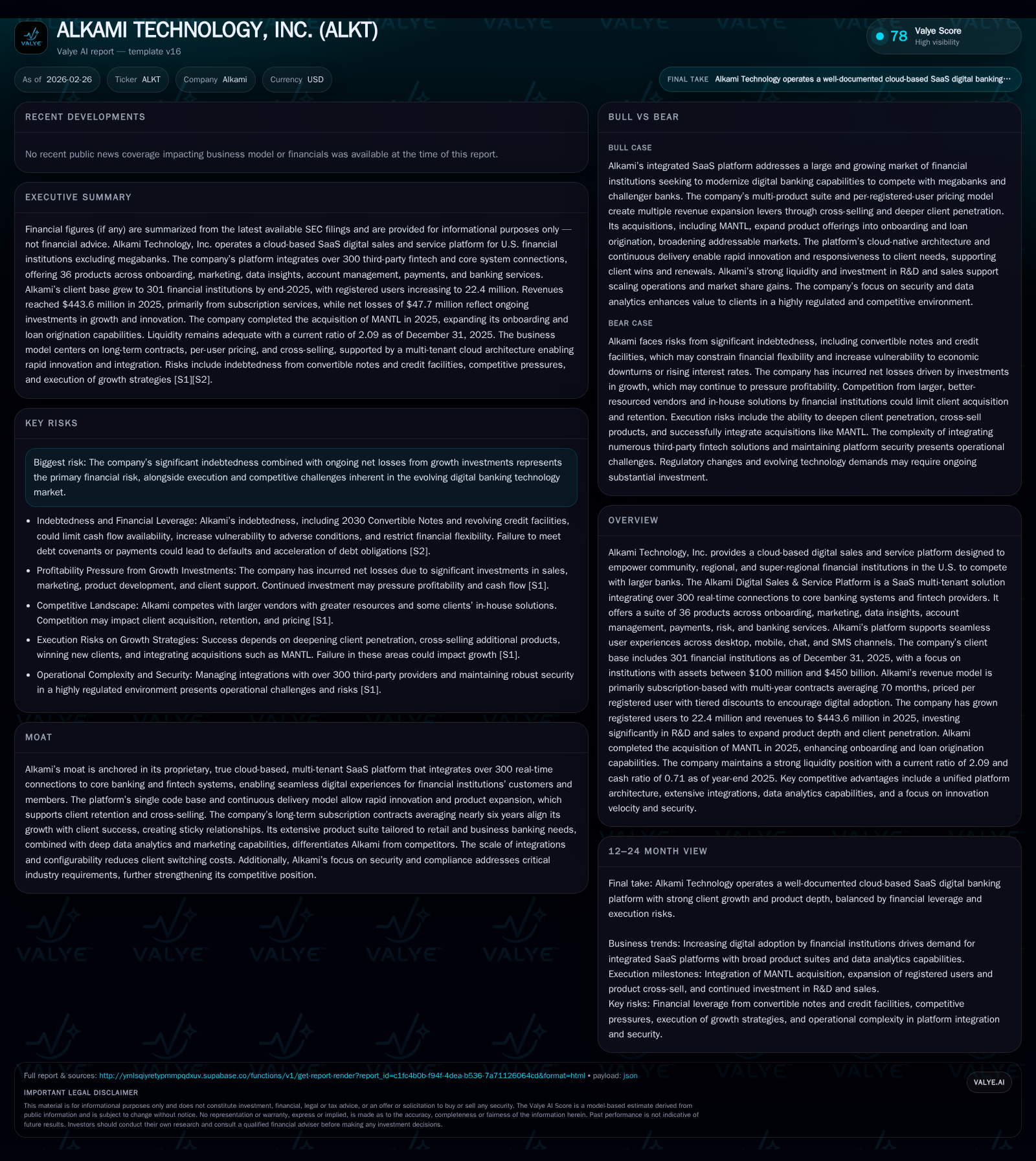
Alkami Technology, Inc. has established a strong foothold in digital banking for community to super-regional financial institutions through its multi-tenant SaaS platform, integrating over 300 third-party connections. The company has delivered robust revenue growth driven by long-term subscription contracts, expanding product depth, and strategic acquisitions like MANTL. However, ongoing net losses and significant indebtedness weigh on its financial health, with operating expenses rising due to investments in sales, R&D, and infrastructure. Near-term growth will depend on client acquisition momentum, deepening digital penetration among users, and successful integration of acquired technologies—while capital structure risks and competition remain key headwinds.
Historical Growth and Performance
Alkami Technology has demonstrated robust top-line expansion during the recent cycle. Revenue advanced from $264.8 million in 2023 to $333.8 million in 2024 (+26.1%), then accelerated to $443.6 million in 2025 (+32.9%), underscoring strong demand for its Alkami Digital Sales & Service Platform [S9]. This uplift was driven primarily by the platform’s subscription-based revenue model built on long-term contracts averaging approximately 70 months (nearly six years), providing predictable recurring revenue streams [S1][S12].
Client expansion remains central to Alkami’s growth strategy. The company served 301 financial institutions (FIs) via its core digital banking platform as of December 31, 2025—a meaningful increase that contributes to network effects given the integrations across over 300 third-party fintech providers [S8][S10]. Including distinct clients from recent acquisitions like ACH Alert, Segmint, and MANTL pushes the unique FI client count past 960 [S9].
Despite the impressive growth trajectory, Alkami continued to post net losses—$62.9 million in 2023 narrowed to $40.8 million in 2024 but widened again to $47.7 million in 2025 [F1]. Operating income remained negative throughout this period due to sustained investment spending supporting R&D, sales expansion, product implementation teams, and general administrative costs necessary for scaling [F1][S14]. Importantly, operating cash flow turned positive in 2024 ($18.6 million) and almost doubled again in 2025 ($42.9 million), signaling improving cash generation efficiency amid growth [F1]. Capital expenditures stayed modest relative to revenues but increased slightly in line with scaling needs.
Historical performance (annual)
| FY | Net ($mm) | CFO ($mm) | OpInc ($mm) | Capex ($) | Net YoY |
|---|---|---|---|---|---|
| 2025 | -48 | 43 | -54 | 1542000 | -16.7% |
| 2024 | -41 | 19 | -45 | 1195000 | +35.1% |
| 2023 | -63 | -18 | -64 | 1058000 | -7.4% |
| 2022 | -59 | -38 | -58 | 1057000 |
Source: SEC companyfacts cache [F1].
Capital returns and efficiency (annual)
| FY | Div | Buybacks | FCF ($mm) |
|---|---|---|---|
| 2025 | 41 | ||
| 2024 | 17 | ||
| 2023 | 0 | 0 | -19 |
| 2022 | 0 | 0 | -39 |
Source: SEC companyfacts cache [F1].
Revenue growth reflects an accelerated adoption of Alkami's platform solutions by FIs alongside expansion of product suites through internal development and strategic acquisitions.
Future Growth Drivers and Constraints
Alkami’s future top-line expansion will hinge on three interrelated levers: acquiring new clients within its target segment of community to super-regional banks and credit unions; increasing product adoption depth within existing clients’ customer/member bases; and expanding digital penetration among account holders through enhanced engagement features [S1][S8].
The company has fueled addressable market expansion via targeted acquisitions—ACH Alert’s fraud prevention tools (October 2020), Segmint’s behavioral data analytics capabilities (April 2022), and MANTL’s onboarding/account opening plus loan origination solutions (March 2025) [S1][S13]. MANTL notably broadens Alkami’s footprint into commercial banking account acquisition and loan products for various deposit types, deepening cross-selling opportunities across retail/business segments [S8][S16].
Given a typical sales cycle of three to twelve months followed by implementation periods ranging six to twelve months depending on integration complexity, pipeline-to-revenue conversion is relatively lengthy—introducing uncertainty around short-term inflows [S12]. Growth scaling also depends on managing increasing operational complexities such as customization requests related to workflow familiarity or regulatory compliance enhancements [S11][S19].
Risks exist around competitive pressures as well—Alkami faces legacy digital banking vendors with more extensive resources plus new entrants developing in-house platforms within FIs themselves [S5]. Retention could be challenged if these competitors offer lower pricing or faster innovation cycles.
Financially, high leverage constrains flexibility: the issuance of $345 million principal amount of convertible notes in March 2025 elevated debt service demands notably through interest payments ($9.5 million total interest expense for FY25 including amortization costs) alongside obligations under revolving credit facilities totaling $15 million borrowings outstanding as of end-2025 [S6][F1]. Covenants embedded in financing agreements restrict dividend payouts (none declared since FY21), share repurchases (none since FY22), asset disposals, capital expenditures above thresholds without consent, new lines of business initiation, among other constraints that could limit aggressive growth initiatives or agility [S7][S17].
Forecasts & Key Milestones To Watch
While no explicit forward guidance was provided for fiscal years beyond December 31, 2025 within the disclosed documents, several indicators are important:
- Client count growth: Monitoring quarterly additions beyond the baseline >300 FIs onboarded could signal acceleration or stalling.
- Cross-sell penetration: Expansion of active registered users per FI client alongside uptake rates for recently acquired products like MANTL's onboarding solutions.
- Revenue mix shifts: Tracking SaaS subscription versus professional services contribution clarifies margin sustainability.
- Operating cash flow trends: Continued improvement would validate operational leverage despite negative net income.
- Debt covenant compliance: Any indications of covenant breaches require scrutiny given potential liquidity impacts.
- Integration efficacy: Speed and cost-effectiveness related to MANTL and other acquisitions’ assimilation could materially affect cost structure.
These milestones collectively speak to Alkami’s ability to maintain competitive differentiation through technological velocity while managing increases in complexity across a growing client base [S1][S28].
Capital Allocation & Financial Returns
Alkami has prioritized reinvestment into technology development (R&D), sales force expansion including client success teams, implementation specialists, and infrastructure build-out associated with cloud hosting service scale-up [F1][S14]. This has resulted in deliberate tolerance for net losses during this investment phase.
The company reported negative equity returns reflecting net losses against equity capital — approximately -13% ROE based on last fiscal year figures (-$47.7M net income vs $362M equity at end-2025) [F1]. This negative figure aligns with typical SaaS scale-up dynamics where upfront acquisition/development costs precede profitability.
Cash flow management shows more encouraging signs: free cash flow estimated at ~$41 million for fiscal year ended December 31, 2025 marks a recovery from negative cash flow earlier years as recurring revenue scales effectively above incremental costs [F1]. Modest capital expenditures relative to total cash flows reflect emphasis on software-enabled service delivery rather than fixed asset intensity.
The company has not declared dividends nor undertaken share buybacks since fiscal year ended December 31, 2022 — consistent with a strategy focused on capital preservation amid heavy debt servicing needs and reinvestment priorities [F1]. Liquidity remains adequate with combined cash & equivalents plus marketable securities totaling approximately $99 million at year-end although leveraged balance sheet warrants continued caution [F1][S23].
Platform Strengths & Market Positioning
At the heart of Alkami’s value proposition is its true cloud-based multi-tenant SaaS platform architecture integrating more than three hundred real-time connections across diverse back-office systems and fintech partners that enable seamless user experiences spanning desktop browsers through mobile apps to chat/SMS channels [S8][S20]. This extensibility facilitates rapid product additions without costly bespoke reengineering.
The single code base updated via continuous software delivery expedites innovation velocity—helpful given rising expectations for modern UI/UX coupled with enhanced security/compliance layers essential for digital banking platforms exposed to numerous cyber risks [S15][S16]. Deep data capabilities powered partially by Segmint’s AI-driven analytics enable tailored client marketing segmentation driving higher engagement and monetization potential within existing customer bases.
Furthermore, long-duration contracts averaging nearly six years align commercial success with client outcomes thus enhancing stickiness—switching costs are heightened through configurability complexity combined with profound embeddedness into FI workflows particularly across both retail and increasingly business banking verticals [S1][S22][S28].
Risks & Challenges Summary
Key risks center on managing rapid growth while balancing execution quality across sales cycles that can span up to a year; retaining clients against competitors including large vendors with deeper pockets; navigating technology evolution especially with AI integration mandates; protecting highly sensitive personal data amid tightening privacy regulations internationally; ensuring uninterrupted uptime/security despite reliance on third-party data centers; maintaining skilled workforce amid competitive labor markets; plus managing substantial leverage that limits strategic options [S11][S19][S24][S27].
This constellation underscores why profitability remains elusive despite accelerating revenues—capital intensive scaling combined with significant research/driving technology upgrades continue constraining earnings improvement near-term.
Conclusion
Alkami Technology has constructed a sophisticated digital sales & service ecosystem tailored for midsized U.S.-based financial institutions competing against megabanks' technological advantages by providing integrated fintech-rich SaaS solutions spanning onboarding through payments/security/risk layers coupled with actionable data insights produced by AI-enabled analytics acquired incrementally via strategic bolt-on companies like MANTL.
While top-line momentum remains healthy supported by a broadening FI footprint exceeding three hundred core clients plus ancillary subscription users surpassing nine hundred total relationships inclusive of acquired units, simultaneous sustained net losses combined with a sizable debt load represent cautionary constraints on financial flexibility.
Navigating future success will require executing efficiently against prolonged sales/implementation timelines while advancing product-market fit amidst severe competition—including internal FI developments—and balancing investment demands against eventual profitability aspirations within a tightly regulated environment demanding continual innovation alongside bulletproof cybersecurity frameworks.
Disclaimer: This analysis is based solely on public filings as of February 26, 2026 ([F1], ) without any predictive judgments or investment recommendations offered or implied herein.
Disclaimer: This is research-only, informational analysis and not investment advice. It may include AI-generated interpretation and general industry context. Always verify important details using primary sources.

Comments