
AstroNova Resolves MTEX Dispute While Managing Leverage and Trade Risks
AstroNova's recent settlement ends arbitration over MTEX acquisition amid ongoing credit covenant vigilance and exposure to trade tariffs.
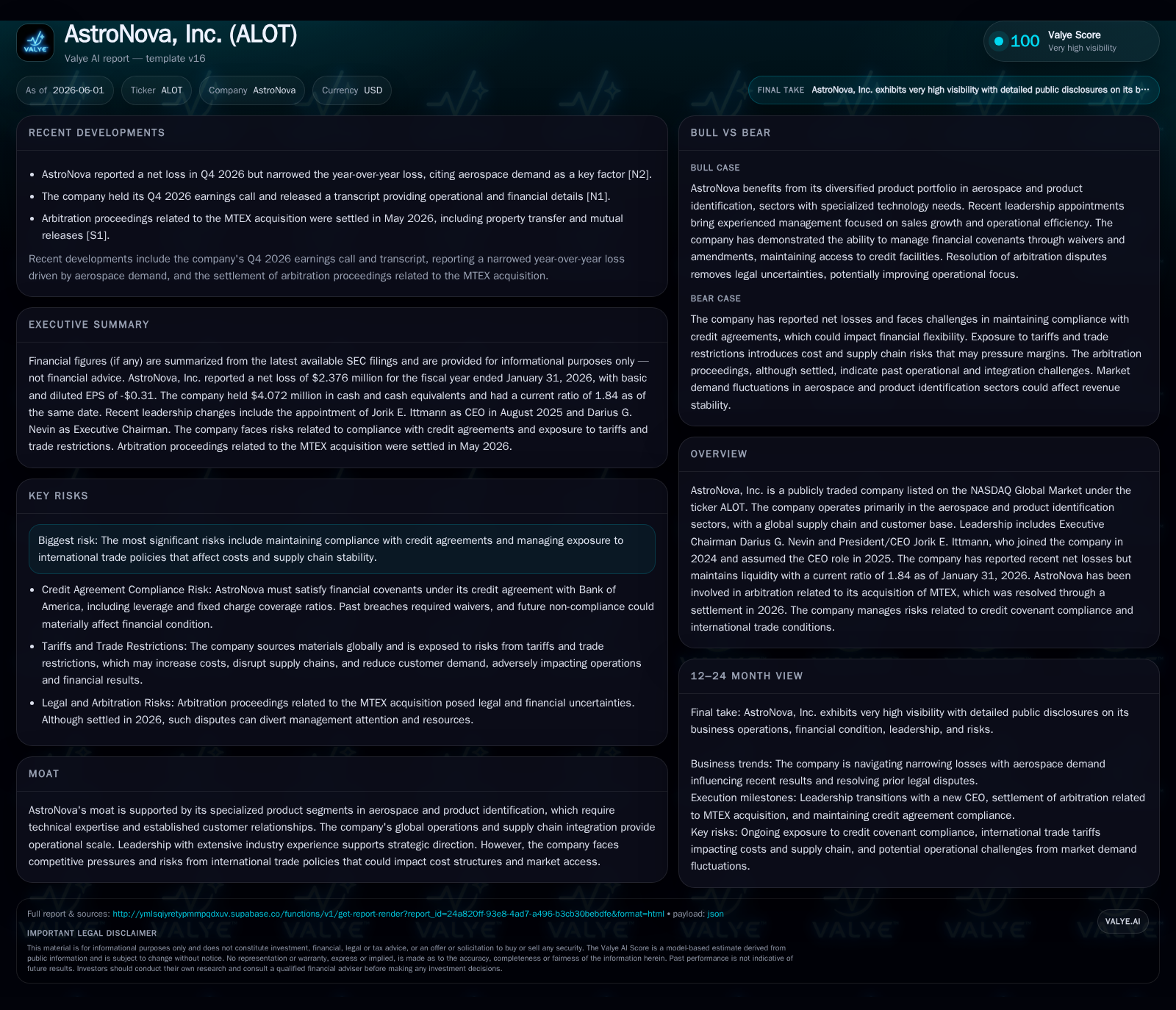
AstroNova, a specialized aerospace and product identification company, recently settled a significant arbitration related to its 2024 acquisition of MTEX, removing a key legal overhang. Despite net losses reported in the fiscal year ending January 2026, the firm maintains solid liquidity with a current ratio of 1.84. However, AstroNova remains exposed to risks from credit agreement compliance and international trade tensions that could pressure margins and operating results. The company’s niche technical offerings and integrated global supply chain underpin its competitive moat, but growth depends on navigating supply cost inflation, commercial aerospace cycles, and stable access in international markets.
Recent Operating Update
AstroNova reported its latest quarterly results via the Form 10-Q filed December 10, 2025 [S2], followed by a material event filing on May 18, 2026 [S3], which disclosed the resolution of arbitration proceedings connected to the May 2024 acquisition of MTEX. The settlement includes the transfer of an industrial property located in Porto, Portugal valued at €2.5 million to AstroNova Portugal (a subsidiary), waiver of lease-related claims by the lessor Atlantiprestigio, and release of personal guarantees previously extended by Mr. Ferreira associated with MTEX loans [S9][S25]. This legal closure removes uncertainty surrounding MTEX’s integration and associated liabilities.
Financially, the fiscal year ended January 31, 2026 [S1][F1] reflected a modest operating income of approximately $1.2 million but culminated in a net loss of $2.4 million. The loss appears influenced by operational headwinds including integration expenses from MTEX and macroeconomic pressures discussed below. Liquidity remains sufficient with cash balances at $4.07 million against total debt slightly above $21 million yielding a current ratio near 1.84 [F1], supporting near-term funding requirements despite prior covenant breaches addressed through lender waivers [S7].
Business Model Analysis
AstroNova operates in two primary segments: aerospace components manufacturing and product identification solutions. The aerospace segment hinges on designing and producing custom instruments, labels, and identification products meeting stringent regulatory standards and quality expectations typical for aerospace OEMs and aftermarket suppliers. The product identification segment spans labeling systems used across industrial sectors requiring traceability and compliance capabilities.
Revenue generation is driven by contract manufacturing orders largely under long-term agreements or framework contracts with OEMs or end-users who prioritize reliability, certifications, and traceability compliance. Pricing power varies; while aerospace products demand premium pricing due to technical complexity and certification requirements, product identification sales face more competitive market pressures.
Cost structure depends heavily on raw materials subject to global commodity fluctuations—as evidenced by tariff risks—and operational execution across a geographically dispersed supply chain that requires coordination among subsidiaries like AstroNova Portugal and acquired units such as MTEX [S1]. The company’s ability to pass through material cost increases is limited by customer contract terms but aided partially through incremental price adjustments when tariffs or trade restrictions apply [S16].
Industry Structure & Competitive Position
AstroNova occupies a specialized niche combining aerospace-grade manufactured components with technologically intricate product identification solutions globally. This intersection creates barriers for new entrants given industry certifications required for aerospace products alongside technical expertise in labeling systems integration.
Its major competitors include diversified industrial conglomerates with aerospace divisions as well as dedicated product identification technology providers; however, few players bridge both sectors as effectively as AstroNova does. The company’s global footprint—spanning North America, Europe (notably Portugal), and parts of Asia—allows proximity to key customers and regional diversification mitigating country-specific risks.
Competitive advantage stems from established customer relationships in aerospace OEMs requiring high-certification levels plus integrated service offerings enhancing switching costs. However, persistent external pressures such as international trade tariffs can erode manufacturing margin robustness compared with larger peers able to absorb cost shocks or relocate production more flexibly.
Growth Drivers
Growth potential is grounded in several interlinked drivers:
- Aftermarket service expansion: Leveraging installed base products for maintenance replacement cycles provides recurring revenue potential less sensitive to new build cycles.
- Operational scale-up post-MTEX acquisition: Completion of integration unlocks cross-selling opportunities within Europe while potentially enhancing manufacturing capacity utilization.
- Supply-chain resilience improvements: Streamlining vendor networks mitigates raw material input volatility particularly amid ongoing trade tariff uncertainties.
- Innovation in product identification technologies: Development of advanced labeling solutions addressing evolving regulatory demands can differentiate offerings.
- Aerospace sector demand: Despite cyclical characteristics inherent in aerospace programs tied to aircraft production rates; longer-term structural trends toward fleet modernization sustain underlying demand.
Risks & Constraints
Key risk vectors include:
- Credit covenant compliance: Historical covenant breaches resulting in reliance on waivers indicate financial leverage constraints that could limit strategic flexibility or raise refinancing risks [S7].
- Trade policy volatility: Exposure to tariffs imposed by the U.S. or other governments increases input costs which may only be imperfectly recoverable through pricing adjustments risking margin pressure [S16].
- Legal contingencies: Although resolved recently regarding MTEX arbitration [S25], prior disputes illustrate ongoing governance risks tied to acquisitions requiring management attention.
- Customer concentration: Aerospace customers often account for significant revenue portions making AstroNova vulnerable to program delays or cancellations common in the sector.
- Supply chain disruptions: Global sourcing dependencies expose production schedules to geopolitical tensions or logistics bottlenecks prevalent in industrial manufacturing.
What to Watch Next
Future monitoring should focus on:
- Execution post-MTEX settlement including asset deployment efficiency measured via facility utilization updates or capacity additions.
- Quarterly updates on sales order backlog composition from both Aerospace OEM programs’ status and aftermarket uptake.
- Developments around credit facility negotiations ensuring sustainable covenant adherence amidst prevailing leverage levels.
- Impact assessment of any new tariffs or trade policy shifts affecting procurement costs or customer pricing power.
- Progress in product innovation pipelines particularly within product identification technologies responding to dynamic regulatory frameworks.
Financial Profile Summary
As of January 31, 2026 (fiscal year-end), AstroNova maintained $4.07 million in cash against total debt near $21.44 million implying net debt around $17.36 million [F1]. Current assets approximately stand at $70.7 million versus current liabilities around $38.4 million supporting a current ratio above 1.8 which suggests reasonable short-term liquidity buffers despite recent operating losses [F1]. Operating income was marginally positive at just over $1 million but net income remained negative near $2.4 million reflecting integration costs plus macroeconomic challenges during FY2026 [F1].
This analysis is based on publicly filed SEC documents up to June 1, 2026, including Form 10-K/A for fiscal year-end data and recent Form 8-K event disclosures resolving litigation related to MTEX acquisition as well as quarterly filings covering liquidity position through late 2025 into early 2026. It excludes forward-looking investment guidance or research views.
Financial position in context
As of 2026-01-31, companyfacts shows $4mm in cash and equivalents and $21mm of total debt [F1]. The same snapshot implies net debt of roughly $17mm, keeping balance-sheet context relevant but secondary to the operating story [F1]. Current assets of $71mm and current liabilities of $38mm imply a current ratio near 1.84x for 2026-01-31 [F1].
Disclaimer: This is research-only, informational analysis and not investment advice. It may include AI-generated interpretation and general industry context. Always verify important details using primary sources.

Comments