
Alpha Compute Corp’s Put Option Trigger Highlights Risks in AI Infrastructure Capital Strategy
June 2026 put option exercises and lease disputes underscore capital and operational challenges amid Alpha Compute’s strategic shift toward AI infrastructure.
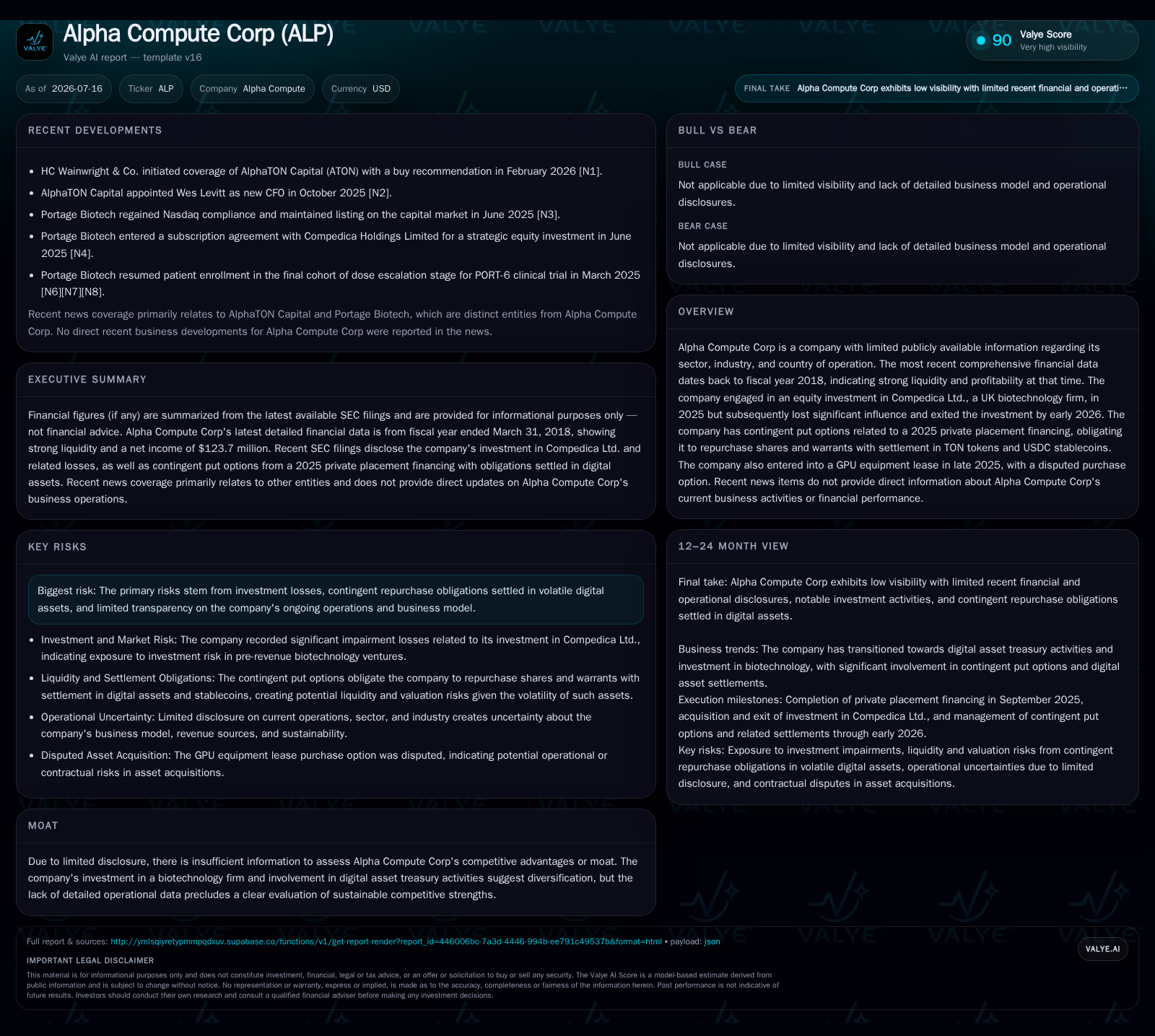
Alpha Compute Corp recently faced a significant liquidity drain after investors exercised put options tied to its September 2025 private placement, requiring the repurchase of shares via transfers of TON tokens and USDC stablecoins. This event highlights structural capital risks inherent in funding a capital-intensive AI infrastructure business that also maintains a volatile digital asset treasury. Concurrently, Alpha Compute contends with contested GPU equipment lease-to-own terms, reflecting the depreciation burden and asset obsolescence pressures typical in this fast-evolving sector. The company remains in early revenue generation stages, absorbing substantial operating losses as it pivots from biotechnology toward GPU compute leasing and digital assets. Its competitive position is challenged by deep-pocketed hyperscale cloud providers and specialist GPU operators, necessitating careful navigation of customer contracts, capital raises, and volatile token valuations.
Alpha Compute Corp’s Put Option Exercise Exposes Capital and Operational Risks in AI Infrastructure Pivot
Alpha Compute Corp recently faced a significant liquidity event when, on June 22, 2026, two investors exercised put options tied to the company's September 2025 private placement financing. This triggered an obligation for Alpha Compute to repurchase approximately 1.2 million ordinary shares and 633,931 pre-funded warrants by transferring over 2.1 million TON tokens and more than 5.1 million USDC stablecoins to the investors, reflecting the original consideration without any adjustment for token value fluctuations [S2]. This mechanism, embedded in side letter agreements granting irrevocable repurchase rights exercisable between six and twelve months post-financing, highlights a structural capital risk unique to hybrid financings involving volatile digital assets [S2]. The non-cash nature of the repurchase—settled in digital tokens rather than fiat currency—exposes the company to balance sheet volatility and liquidity management challenges amid fluctuating crypto markets.
The put options represent a recurring liquidity risk, as further exercises by remaining holders could intensify token outflows, complicating treasury operations. This is particularly significant given Alpha Compute’s digital asset treasury strategy, which balances holdings between TON tokens—subject to high market volatility—and USDC stablecoins, which provide relative liquidity stability [S1], [S5]. The company’s digital asset portfolio has experienced impairments and realized losses exceeding $4.8 million in fiscal 2026, underscoring the earnings volatility and cash flow uncertainty introduced by its crypto exposure [S1]. This dual exposure to capital-intensive AI infrastructure and volatile digital assets requires careful risk management to maintain operational flexibility.
Concurrently, Alpha Compute is navigating operational uncertainties related to its GPU infrastructure. Since late 2025, the company has been engaged in a lease-to-own agreement for clusters of NVIDIA B200 GPUs to scale its compute capacity for AI workloads [S1]. However, disputes over the enforceability and terms of the purchase option embedded in these leases have introduced ambiguity in asset ownership and balance sheet valuation. This reflects a broader sector challenge where rapid GPU technology cycles accelerate depreciation burdens and complicate lease-versus-own decisions. Leasing can mitigate upfront capital expenditure (capex) but increases operating leverage through recurring rental expenses, while ownership entails higher depreciation risk amid fast obsolescence. For Alpha Compute, unresolved lease disputes cloud cost structure visibility and may hinder efficient hardware refreshes critical to maintaining competitive GPU utilization rates and service-level agreements (SLAs).
Alpha Compute’s business model centers on monetizing leased high-performance GPU clusters primarily for AI model training workloads, alongside managing a digital asset treasury. The company reported limited revenues of approximately $97,000 for fiscal 2026, marking an early-stage commercial launch [S1], [S7]. This modest revenue contrasts sharply with operating expenses nearing $23.2 million, driven predominantly by general and administrative costs ($20.4 million) and research and development ($2.8 million) as the company scales its workforce and infrastructure [S1]. The capital intensity of GPU infrastructure—characterized by high capex requirements, power density, and cooling infrastructure costs—combined with low utilization rates typical of a nascent provider, contribute to ongoing operating losses and negative operating leverage.
Revenue generation depends on securing long-term contracts with AI developers or enterprises requiring scalable compute capacity. Key operating KPIs include GPU utilization rates, contract duration and renewal rates, and customer concentration ratios, which remain undisclosed but are critical to Alpha Compute’s path to profitability. The company’s ability to maximize GPU utilization and minimize idle capacity will directly influence gross margins and cash flow sustainability. However, the current competitive landscape presents significant headwinds.
Alpha Compute operates in a highly competitive AI infrastructure ecosystem dominated by hyperscale cloud providers such as Amazon Web Services (AWS), Microsoft Azure, and Google Cloud Platform. These hyperscalers leverage vast capital resources to secure preferential GPU supply from manufacturers like NVIDIA and AMD, operate geographically diversified data centers with optimized power and cooling efficiencies, and offer integrated AI compute services bundled with software platforms. Specialist GPU cloud providers like CoreWeave and Lambda Labs compete by targeting niche segments requiring flexible burst capacity but face capacity constraints due to smaller hardware footprints.
Against this backdrop, Alpha Compute’s smaller scale and capital constraints expose it to higher per-unit capex and operating costs. Its hybrid business model, combining GPU leasing with digital asset treasury management, adds complexity compared to peers focused solely on compute infrastructure. The unsettled GPU lease purchase disputes further exacerbate operational risk, potentially limiting the company’s agility in hardware upgrades and contract negotiations.
Growth prospects hinge on expanding AI compute demand driven by increased adoption of AI model training and inference workloads across industries. However, Alpha Compute faces several growth constraints: sustained operating losses exceeding $38 million annually reflect the capital-intensive buildout phase and impede positive free cash flow generation [S1]; the need for substantial additional capital raises beyond potential at-the-market (ATM) proceeds introduces dilution and leverage risks; customer concentration typical of emerging providers limits revenue visibility; and regulatory uncertainties surrounding digital asset holdings may impose operational costs or force deleveraging [S1], [S5].
Key watchpoints for Alpha Compute include the resolution of GPU lease purchase disputes, which would clarify asset ownership and improve balance sheet transparency. Monitoring further put option exercises is critical, as these could trigger additional outbound transfers of volatile TON tokens, tightening liquidity unless offset by successful equity or debt financings [S2], [S3]. Regulatory developments affecting digital asset classification or trading restrictions represent another material risk factor impacting treasury valuation and operational flexibility.
Incremental progress in scaling revenue beyond the initial $97,000 milestone would provide tangible validation of the company’s core GPU leasing business viability. Achieving higher GPU utilization rates and securing longer contract durations are essential to improving operating leverage and competing effectively against hyperscale and specialist providers. Meanwhile, managing the depreciation burden amid rapid GPU technology refresh cycles and optimizing power and cooling infrastructure will be critical operational levers.
In summary, Alpha Compute Corp’s recent put option exercises and lease disputes underscore the multifaceted capital and operational challenges inherent in its strategic pivot toward AI infrastructure. The company must navigate volatile digital asset exposures, capital-intensive GPU infrastructure investments, and a competitive market landscape dominated by well-capitalized peers. Success will depend on resolving contractual uncertainties, securing stable customer contracts, managing liquidity prudently, and scaling GPU utilization efficiently.
Disclaimer: This is research-only, informational analysis and not investment advice. It may include AI-generated interpretation and general industry context. Always verify important details using primary sources.

Comments