
Norris Industries’ Niche Texas E&P Strategy Encounters Persistent Liquidity Constraints
NRIS leverages underexplored leaseholds and enhanced recovery techniques in Texas but remains challenged by capital access amid volatile oil markets.
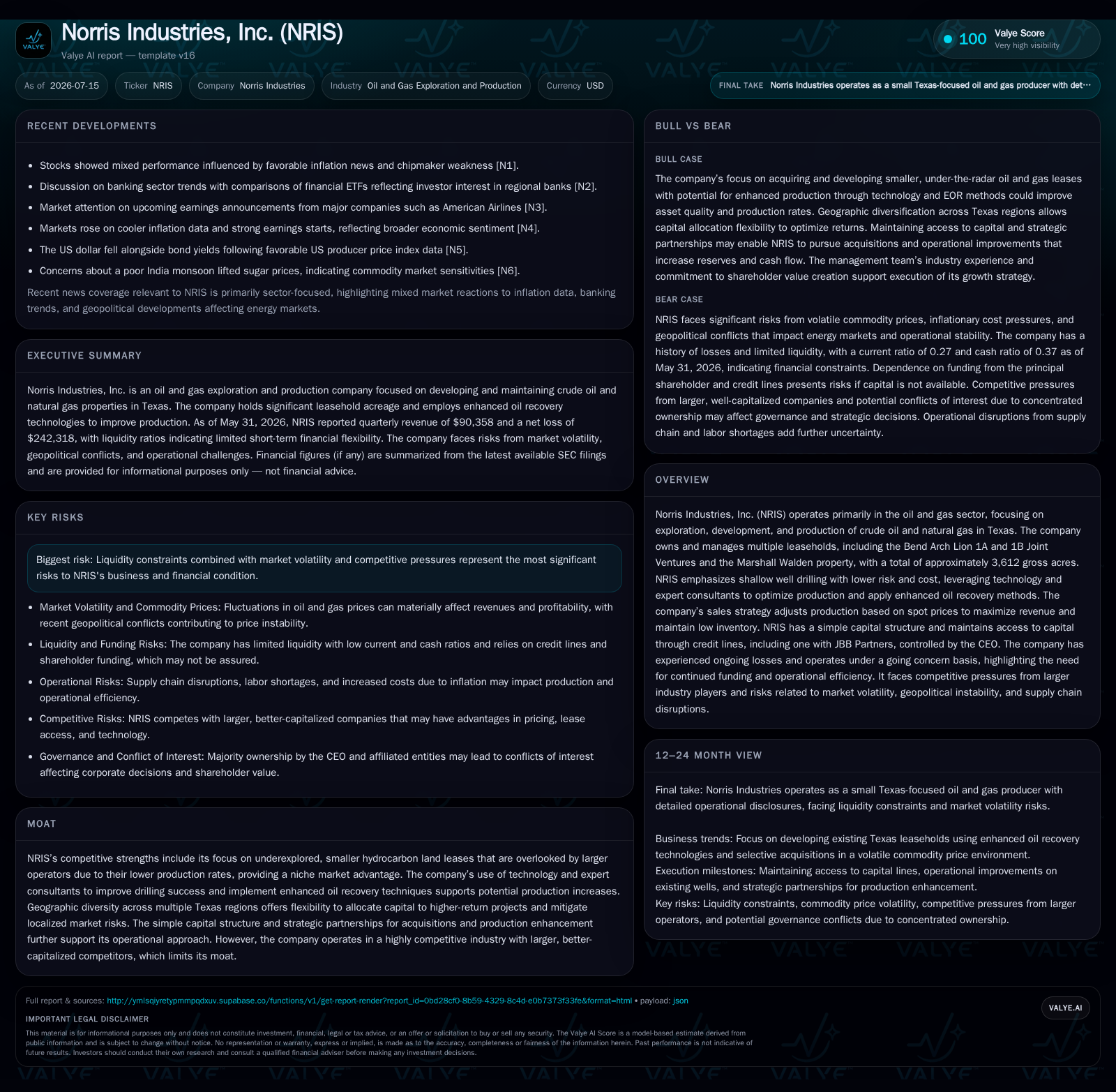
Norris Industries, Inc. (NRIS) operates as a small independent exploration and production company focused on shallow well drilling and development of niche hydrocarbon leases primarily in Texas. Its recent quarterly update underscores ongoing production assessment and work-over activities while maintaining a strategy of flexible production rates aligned with spot pricing. Despite leveraging technology and expert partnerships to optimize output, NRIS continues facing significant liquidity challenges, reflected in recurring operating losses and a constrained current ratio. The company’s competitive edge lies in targeting overlooked small fields unsuitable for larger producers, though its modest scale and capital structure limit growth amid an unpredictable commodity price environment.
Recent Operating Update: Assessment Phase Amid Market Volatility
In its latest quarterly 10-Q report filed July 15, 2026, Norris Industries disclosed that fiscal 2026 has featured a strategic focus on assessing and performing work-overs on existing wells rather than aggressive expansion through new drilling [S2]. This signals a cautious approach reflecting both the volatile market environment shaped by residual effects from COVID-19 lockdowns and geopolitical tensions affecting oil prices and demand [S1]. NRIS’s operations in the first quarter have been marked by flexibility – curtailing production during periods of low spot pricing while increasing output when prices are more favorable [S1]. This dynamic production management aims to optimize revenues while maintaining minimal crude inventory levels to reduce holding costs [S1]. The company continues active relationships with tier-1 buyers such as BML, Lion Oil Trading & Transportation, and WTG Jameson to facilitate sales logistics via existing pipeline connections [S1].
Business Model: Focused Niche E&P Operations in Texas with Technology-Enabled Production Optimization
Norris Industries operates as a small-cap independent upstream oil and gas producer focusing on exploration, development, and production of crude oil and natural gas primarily across approximately 3,600 gross acres of leaseholds dispersed throughout North Central and Northeast Texas [S5][F1]. Key assets include the Bend Arch Lion 1A/1B Joint Ventures in Coleman County with multiple wells on about 777 leased acres and full control of the Marshall-Walden property where NRIS owns 100% of the working interest with a net revenue interest (NRI) of about 75% [S5].
The company’s strategy targets "under the radar" assets—smaller mature fields with daily well production typically below the threshold considered viable for major independents that require at least 300 barrels per day per well to meet their cost structures [S7]. This niche approach allows NRIS to acquire producing properties at relatively low cost but imposes constraints related to scale economies, ultimately limiting margin expansion.
NRIS distinguishes itself by focusing on shallow drilling targets—typically less than 5,000 feet deep—to mitigate geological risk and reduce capital expenditure per barrel equivalent produced [S13]. By leveraging external expert consultants specializing in geology, petrophysics, reservoir engineering, fracture mapping technologies, and enhanced oil recovery (EOR) methods, the company seeks to increase drilling success rates and extract additional reserves from existing or newly acquired fields more cost-effectively [S13][S19]. These EOR initiatives represent an attempt to boost reserves replacement ratios within capital limitations.
Revenue generation derives primarily from oil and gas sales directly routed through contractual agreements with regional midstream operators or traders who handle transportation to refineries or natural gas pipelines [S19]. Pricing is tied to current spot market values for crude (WTI-based) or Henry Hub natural gas benchmarks. Flexible scheduling of production volumes enables NRIS to modulate cash flow exposure amidst volatile commodity prices—a crucial tactical element given ongoing global market uncertainties
Industry Structure and Competitive Position
Within the upstream oil and gas sector's value chain, Norris Industries operates at the exploration and production stage serving primarily regional midstream entities as buyers. As an independent operator focused on smaller leaseholds versus larger integrated majors or even sizable independents like Pioneer Natural Resources or Concho Resources active in Texas shale basins such as Permian or Eagle Ford, NRIS occupies a niche underexplored sub-market segment.
Competition is intense for exploration acreage acquisition as numerous firms vie for proven reserves capable of commercial extraction. However, NRIS benefits from its management's intimate knowledge of local geology and use of technology-driven analytics to identify leases overlooked due to small scale or lower initial well outputs. Geographic diversification across multiple Texas counties helps manage localized political or regulatory risks while supporting selective capital allocation decisions among projects [S7]. Nonetheless, this positioning comes with inherent risks: limited operational scale restricts negotiating power with suppliers/service providers leading to higher operating costs per barrel compared to larger peers; financial capacity constraints hamper sizeable investment in new acreage or deep exploration; liquidity issues expose the firm to market shocks.
Growth Drivers
NRIS's near-term growth depends largely on optimizing production from existing leases via work-overs combined with incremental gains from applying enhanced recovery methods that can increase ultimate reserves without large upfront CapEx commitments [S8][S13]. Success here could improve site-level economics and cash flow generation.
Strategically pursuing acquisitions of similar mature smaller fields with upside potential remains a core objective. Such acquisitions rely heavily on timely access to financing—either through equity injections or debt facilities—to capitalize on opportunities priced attractively due to broad sector volatility [S6]. Moreover, advancements in subsurface imaging technology contribute to better identification of producible zones enhancing drilling success rates relative to historical industry norms.
External factors such as sustained elevated oil prices driven by heightened geopolitical risk or supply disruptions (e.g., Middle East conflicts constricting pipeline access at Hormuz Strait) could materially enhance project economics enabling more aggressive expansion or operational continuity at healthier margins [S15][S28]. Updated environmental regulations favoring domestic energy supply also create supportive policy tailwinds at the federal level.
Risks, Constraints, and Watchpoints
The company reported fiscal year 2026 net losses of approximately $661k alongside negative operating income indicative of strained profitability dynamics [F1][S22]. Commodity price volatility directly impacts revenue streams since production timing is strategically adjusted around spot prices; extended periods of depressed prices would reduce funds available for maintenance CapEx thereby risking production declines or shut-in wells [S19][S22]. Inflationary pressures increasing input costs alongside supply chain disruptions widen operating margins negatively.
From an operational standpoint, dependence on limited personnel expertise—with only key executives dedicating substantial time—and lack of an independent audit committee create governance weaknesses potentially affecting financial reporting accuracy or strategic oversight [S25][S27]. Additionally, limited insurance coverage exposes NRIS to unforeseen liabilities which could materially affect financial reserves if invoked adversely [S21].
Geopolitical tensions—including Middle East conflicts impacting global energy security—add unpredictability both in raw material costs and potential regulatory responses that could constrain operational flexibility [S1][S26]. The pandemic aftermath continues introducing demand uncertainty despite improvements since initial outbreaks.
What To Watch Next
Key upcoming milestones will include monitoring future quarterly disclosures for changes in production volumes measured in barrels of oil equivalent per day (BOE/day), demonstration of reserve replacement improvements via successful EOR implementations, shifts in operating cost per BOE reflecting efficiency gains or setbacks, plus any announcements related to new capital raises either through equity markets or debt financing.
Additionally, tracking commodity price trends relative to average realized barrel prices is crucial since sustained price increases may unlock further developmental activity whereas prolonged weakness could force additional operational curtailments. Management’s ability to secure strategic partnerships beyond JBB Partners will signal improved funding prospects vital for growth initiatives.
Finally, observe any changes in governance arrangements addressing internal control weaknesses as such developments affect investor confidence over financial stewardship.
Financial Profile Discussion
At the end of May 2026 fiscal period reported via recent filings, Norris Industries displayed strained liquidity metrics reflective of its ongoing struggle transitioning from losses toward sustainable operations. The current assets ($61.4k) cover only a fraction of current liabilities ($227.5k) resulting in a suboptimal current ratio near 0.27 suggesting imminent working capital challenges if not addressed swiftly [F1]. Total debt figures remain unresolved in more recent filings but historical best estimates placed it around $750k netted against minimal cash balances signaling meaningful leverage though firm has not publicly updated this metric recently [F1].
Cash flow from operations has been negative ($440k loss reported FY26) requiring frequent reliance on intra-group financing which while supportive is contingent upon shareholder willingness without any legal commitment for refinancing future deficits [S22]. Continued losses ($661k net loss FY26) emphasize need for revenue growth sharpened expense control or external capital influx if NRIS is to avoid curtailment scenarios detailed previously.
Capital expenditures are carefully managed given constrained resources focusing primarily on work-over activities instead of costly new well drills minimizing immediate cash outflows though limiting potential reserve additions absent successful EOR deployment clarified as core longer-term value drivers [S8][S13][S19]
Overall financial posture underscores typical small independent upstream profile challenged by high fixed costs relative to scale but tempered by conservative spending cultures oriented towards risk mitigation amidst volatile commodity backdrop.
This analysis presents facts strictly drawn from public SEC filings up to July 2026 combined with industry-contextual insights without providing investment advice or valuation judgments.
Disclaimer: This is research-only, informational analysis and not investment advice. It may include AI-generated interpretation and general industry context. Always verify important details using primary sources.

Comments