
CDT Equity Inc. Advances AI-Powered Drug Asset Repositioning Under Liquidity Pressure
The July 2026 quarterly filing reveals CDT Equity’s innovation-driven biotech model faces pressing liquidity constraints amid ongoing pipeline and AI partnership developments.
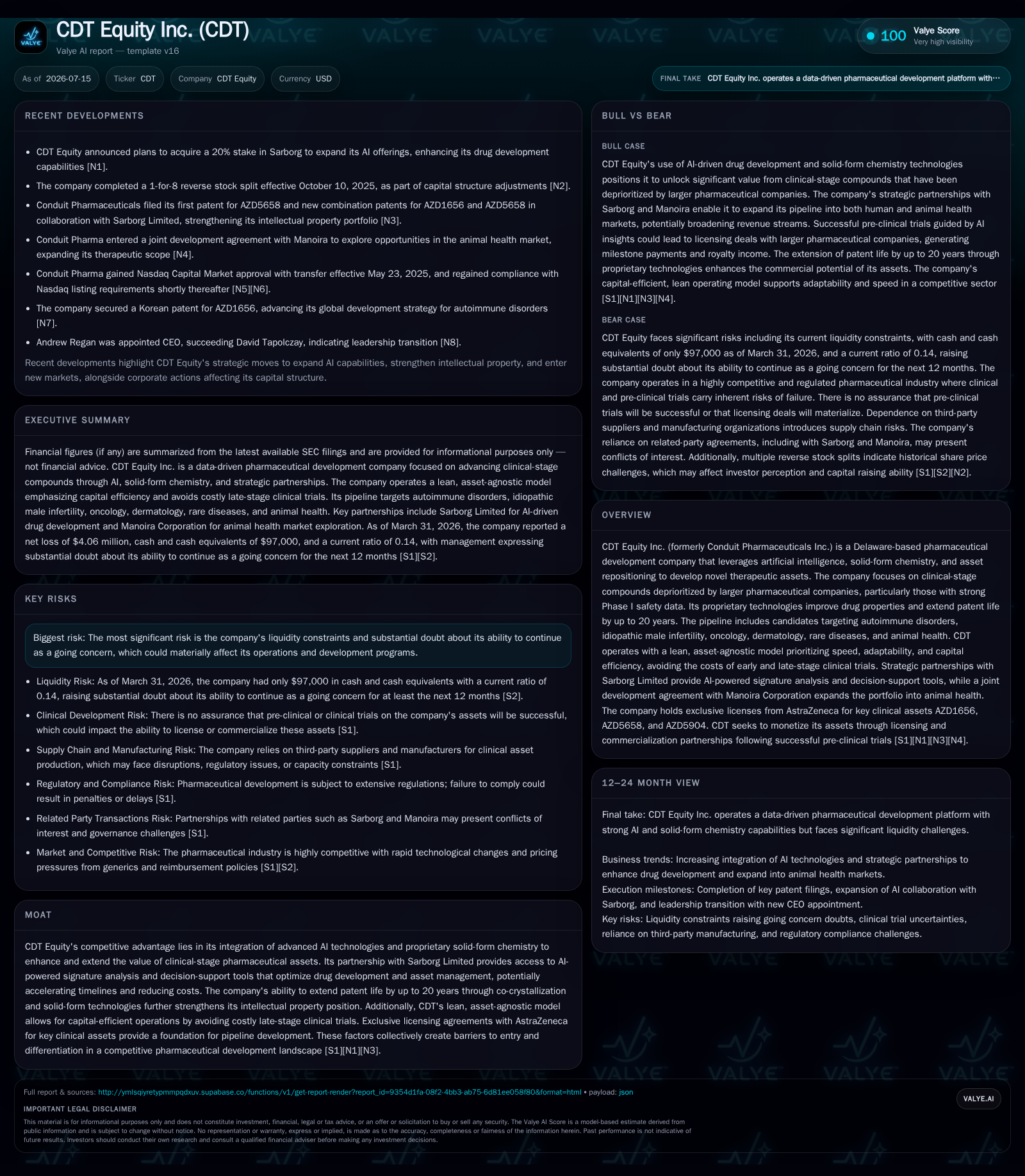
CDT Equity Inc., a clinical-stage pharmaceutical developer focusing on AI-enhanced asset repositioning and solid-form chemistry to extend drug patent life, reported a critical cash depletion to $97,000 as of March 2026, raising substantial doubt about its ability to continue as a going concern. The company leverages strategic partnerships, including exclusive licenses with AstraZeneca and a technological collaboration with Sarborg Limited, to accelerate development and licensing of deprioritized Phase I compounds. Despite operational advances in its autoimmune, rare disease, and veterinary asset pipeline, CDT's capital efficiency remains under threat by mounting accrued litigation liabilities and low current assets relative to liabilities. Monitoring milestone acquisitions, licensing deals, and capital raises will be key to evaluating CDT’s path forward.
July Quarterly Update Highlights Critical Liquidity Constraints Amid Pipeline Development
In its latest 10-Q filing dated July 15, 2026, CDT Equity Inc. disclosed a sharp decline in liquidity, reporting cash and cash equivalents of only $97,000 as of March 31, 2026, down from $1.5 million at the end of 2025 [S2][F1]. This liquidity contraction occurs alongside accrued litigation liabilities totaling approximately $9.6 million related to a dispute with Strand Hanson Limited over advisory fees predating CDT’s business combination [S24]. The company’s current liabilities exceed $21.6 million compared to current assets of roughly $3 million, resulting in a current ratio of approximately 0.14, underscoring significant short-term financial stress [F1][S2]. This constrained liquidity profile raises substantial doubt about CDT’s ability to sustain operations without near-term capital raises or milestone-driven licensing revenues.
AI-Driven Asset Repositioning: Accelerating Clinical-Stage Compound Development
CDT Equity operates an asset-light, innovation-driven biotech platform focused on repositioning deprioritized clinical-stage compounds that have cleared Phase I safety data but require enhanced therapeutic validation and intellectual property (IP) augmentation [S1][S16]. Central to this strategy is a multi-phase services agreement with Sarborg Limited, whose AI-powered signature analysis platform provides advanced computational tools to identify novel therapeutic applications and optimize compound selection [S13][S16]. Sarborg’s cybernetic technology reduces human error in decision-making and accelerates hypothesis generation for in vitro and in vivo studies, enabling CDT to efficiently prioritize assets for out-licensing.
This AI integration allows CDT to bypass costly late-stage clinical trials by focusing on generating robust preclinical data packages that support licensing agreements. This approach aligns with emerging trends in AI-driven drug discovery exemplified by companies like Recursion Pharmaceuticals but is uniquely combined with solid-form chemistry innovations to extend patent life and create new IP barriers.
Solid-Form Chemistry: Enhancing Patent Life and Competitive Positioning
Complementing its AI capabilities, CDT has developed proprietary co-crystallization solid-form chemistry technologies that modify physical drug properties such as bioavailability and stability, potentially extending patent protection by up to 20 years [S1][S16]. The AZD1656 co-crystal glucokinase activator, targeting autoimmune diseases, exemplifies this approach.
This patent life extension strategy positions CDT alongside pharmaceutical leaders like Pfizer and Novartis, who leverage solid-state chemistry for lifecycle management. However, CDT’s focus on deprioritized assets allows it to create new IP on established compounds, supporting future licensing fees and royalty streams while mitigating the risks and costs associated with novel drug discovery.
Business Model and Industry Context: Asset-Light Licensing Focus
CDT’s business model centers on acquiring and enhancing clinical-stage assets through AI and solid-form chemistry, then out-licensing these assets to third parties for further clinical development, regulatory approval, and commercialization [S1][S15]. Revenue generation is expected primarily from milestone payments, licensing fees, and royalties rather than direct product sales.
This model parallels asset-light biotech firms such as Ligand Pharmaceuticals, which focus on capital-efficient licensing strategies to avoid the high costs of Phase II/III trials. Key operating metrics for CDT include the number of assets progressing through preclinical validation, time to IND filing, and successful execution of licensing deals [S2][F1][S19]. However, the company’s current financial strain, including a quarterly net loss near $4 million and operating expenses around $3.7 million, highlights the challenges of sustaining R&D and administrative functions without immediate revenue inflows
Pipeline Diversification and Veterinary Market Expansion
CDT’s pipeline targets autoimmune disorders, idiopathic male infertility (AZD5904), oncology, dermatology, and rare diseases, with ongoing in vitro and in vivo studies designed to support licensing [S1][S5]. Notably, the company has expanded into the veterinary pharmaceutical market through a collaboration with Manoira Corporation, enabling cost-efficient exploration of animal health applications while retaining full ownership of human-related data [S1][S15].
This cross-sector strategy leverages growing demand in veterinary pharmaceuticals driven by increased pet ownership and animal care spending. It also diversifies potential revenue streams and mitigates risk by spreading R&D investments across multiple species and indications. Regulatory incentives for orphan and rare diseases further enhance the attractiveness of CDT’s pipeline assets for licensing partners.
Financial and Legal Challenges Impacting Operational Flexibility
Despite strategic partnerships, including exclusive licenses with AstraZeneca, CDT faces mounting financial pressures. The company reported a net operating cash outflow of approximately $1.9 million in Q1 2026 and sustained net losses around $4 million per quarter [S2][F1]. The accrued litigation liability of $9.6 million related to Strand Hanson further constrains financial flexibility, despite efforts to isolate this risk through subsidiary sales and settlement negotiations [S24].
The company’s modest total debt of approximately $200,000 and net debt near $103,000 as of late 2024 indicate limited leverage but do not offset the acute liquidity shortage [F1]. Additionally, regulatory risks such as potential FDA requirements for additional clinical trials or delays in marketing approvals could extend timelines before licensing revenues materialize, compounding cash flow challenges [S6][S7][S9].
Key Performance Indicators and Upcoming Catalysts to Monitor
Investors and stakeholders should closely watch several near-term indicators that will influence CDT’s trajectory:
- Progression of pipeline assets through preclinical and IND filing milestones, validating therapeutic hypotheses and enabling licensing discussions [S2][S5].
- Completion and advancement of Sarborg AI service phases, including new therapeutic target identifications and optimization of compound portfolios [S13][S16].
- Execution of licensing agreements or royalty arrangements that convert pipeline progress into milestone payments and recurring revenue streams [S1][S5].
- Expansion and results from veterinary collaborations, which may unlock additional revenue opportunities and diversify risk [S1][S15].
- Resolution or settlement of ongoing litigation to reduce accrued liabilities and improve balance sheet strength [S24].
- Capital raising activities, including equity offerings or convertible note issuances, to replenish cash reserves and extend operational runway [S2][S3][S5].
- Impact of recent reverse stock splits on share structure and investor base composition, potentially facilitating institutional participation [S5].
Summary: Balancing Innovation with Financial Viability
CDT Equity’s integration of AI-driven drug repositioning and solid-form chemistry presents a differentiated approach within the biotechnology sector, targeting efficient development and patent extension of clinical-stage compounds. The company’s asset-light licensing model aligns with industry trends favoring capital efficiency and risk mitigation by avoiding costly late-stage trials.
However, the severe liquidity constraints evidenced by a cash balance of $97,000 against substantial current liabilities and accrued litigation obligations pose significant operational risks [F1][S2][S24]. The company’s ability to convert its innovative pipeline and strategic partnerships into licensing revenues or secure additional financing will be critical to sustaining development momentum and achieving commercial viability.
Financial Snapshot as of March 31, 2026
- Cash and cash equivalents: $97,000 [F1]
- Current assets: $3.05 million [F1]
- Current liabilities: $21.6 million [F1]
- Current ratio: ~0.14 [F1]
- Accrued litigation liability: ~$9.6 million [S24]
- Total debt (as of October 2024): ~$200,000 [F1]
- Quarterly net loss: approximately $4 million [S2][F1]
Disclaimer: This analysis is for informational purposes only and does not constitute investment advice. All financial and operational data are sourced from CDT Equity Inc.’s SEC filings as of July 15, 2026.
Disclaimer: This is research-only, informational analysis and not investment advice. It may include AI-generated interpretation and general industry context. Always verify important details using primary sources.

Comments