
Elevance Health’s Q2 Sees Mixed Signals: Strong Liquidity and Guidance Offset Health Benefits Pressure
Elevance Health posted better-than-expected Q2 results, raising full-year outlook despite ongoing challenges in its health benefits segment.
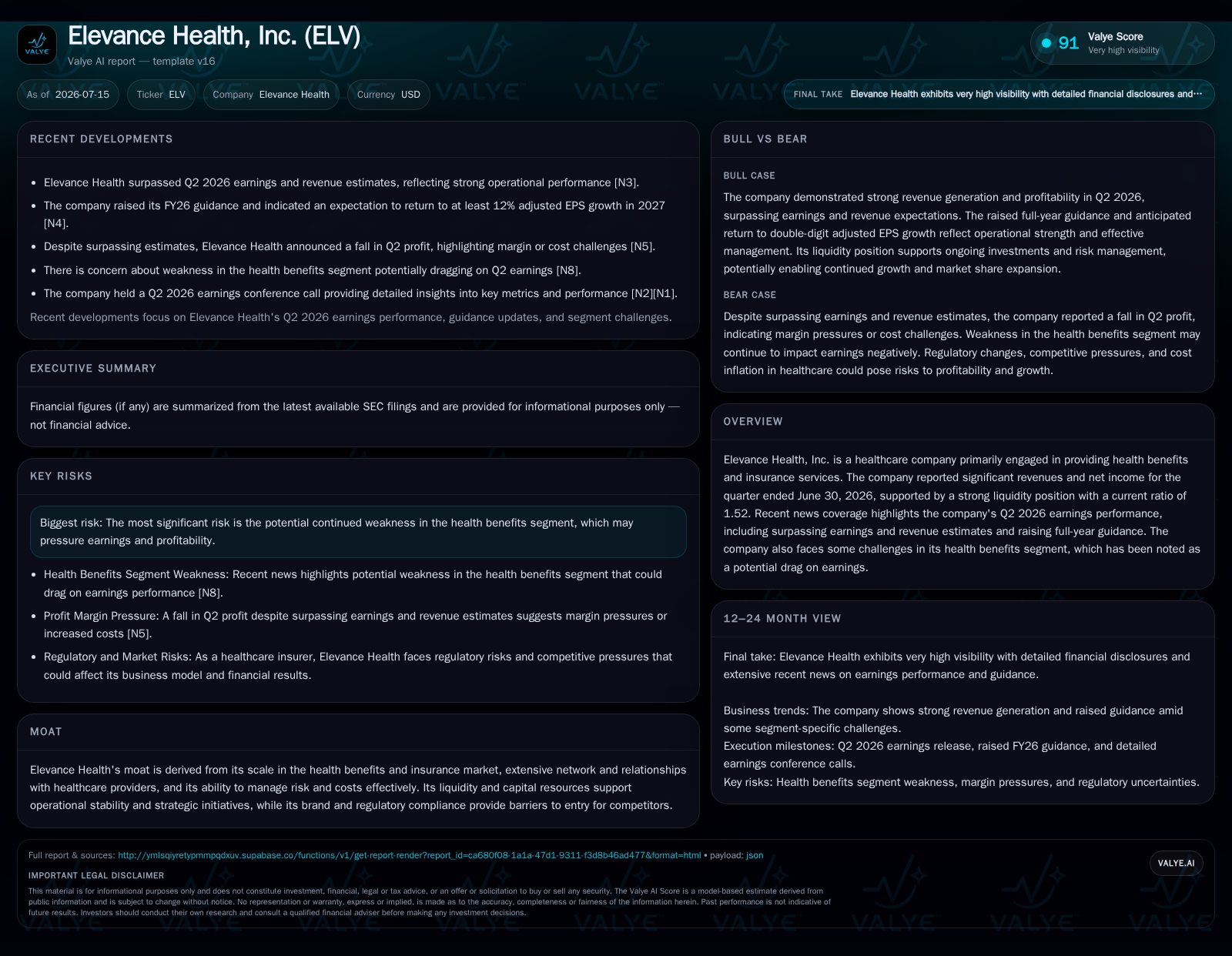
In its latest quarter ended June 30, 2026, Elevance Health demonstrated resilience with earnings and revenue surpassing estimates, prompting an upward revision to full-year guidance. This performance was supported by robust underwriting and investment income, alongside a healthy liquidity position evidenced by a current ratio of 1.52. However, the company’s health benefits segment continued to exert pressure on profitability, highlighting segment-specific risks. The firm’s scale, provider network strength, and disciplined risk management underpin its competitive moat in the healthcare insurance sector amid evolving cost dynamics.
Recent Operating Update
Elevance Health, Inc. reported a stronger-than-expected financial performance for the quarter ended June 30, 2026, with both earnings and revenues surpassing consensus estimates. This robust performance prompted the company to raise its full-year guidance, reflecting management’s confidence in its operational trajectory despite persistent challenges in the health benefits segment [S2][N3][N4]. The quarter’s results were driven by effective premium pricing strategies, disciplined claims management, and favorable net investment income, which together supported underwriting profitability.
However, the health benefits segment continued to weigh on overall profitability due to elevated medical loss ratios (MLR) stemming from higher-than-anticipated healthcare utilization and claims costs [S2][N7]. This segment’s pressure highlights the ongoing volatility in managing healthcare cost inflation and utilization trends. Management is actively addressing these headwinds through enhanced cost containment initiatives, including renegotiating provider contracts and leveraging advanced claims analytics to improve claims management effectiveness.
Business Model Overview
Elevance Health operates primarily as a healthcare insurance and health benefits provider, generating revenue predominantly through premium collections from individuals, employer groups, and government-sponsored programs such as Medicare and Medicaid [S1]. The company’s business model centers on underwriting risk pools, administering health benefits plans, managing claims payments, and negotiating contracts with a broad network of healthcare providers.
Revenue generation depends on balancing premium growth with underwriting profitability, which is closely monitored through key operating metrics such as the medical loss ratio (MLR), which measures claims costs as a percentage of premium revenue, and retention rates of insured members [S1][S2]. Administrative services income, derived from third-party administration (TPA) contracts, supplements premium revenue and contributes to operational cash flow stability. Additionally, investment income from a diversified portfolio of fixed maturity securities and equity investments provides an important earnings buffer, especially in periods of underwriting margin pressure.
Critical operating levers include member enrollment growth (covered lives), average premium per member influenced by risk adjustment mechanisms, claims incidence rates reflecting healthcare utilization, and administrative expense efficiency. Elevated claims frequency or rising healthcare costs can adversely affect the combined ratio and compress underwriting margins, underscoring the importance of effective claims management and provider network contracting.
Industry Structure and Competitive Position
The healthcare insurance industry is heavily regulated, requiring companies like Elevance Health to maintain compliance with federal and state mandates while managing actuarial risks associated with unpredictable medical cost inflation. Elevance competes with major managed care organizations such as UnitedHealth Group, Centene Corporation, Anthem, Cigna, and Humana, all of which operate extensive provider networks and offer a range of managed care products including Medicaid and Medicare Advantage plans.
Elevance’s competitive moat is supported by its scale, which enables more effective risk pooling across a diverse member base, improving underwriting outcomes relative to smaller competitors. Its extensive provider network facilitates negotiation of capitation arrangements and fee-for-service contracts that help control cost escalation. The company also invests in sophisticated claims management systems and employs reinsurance and stop-loss insurance strategically to mitigate exposure to catastrophic claims [S1]
Brand recognition and regulatory certifications required for participation in government programs further strengthen client retention and create switching costs embedded in network access arrangements. These factors collectively underpin Elevance’s ability to sustain underwriting profitability amid evolving healthcare cost dynamics.
Growth Drivers
Several structural factors support demand growth for Elevance’s health insurance offerings. Expanding insured populations, driven by employer-sponsored coverage and government program enrollments, provide a growing base for premium revenue expansion. Demographic trends such as an aging population increase healthcare utilization, enhancing the relevance of managed care solutions.
Regulatory reforms favoring managed care adoption, combined with technological innovations like digital health platforms and care coordination tools, contribute to cost containment and improved member engagement. Specialty insurance products addressing niche healthcare needs complement core offerings and diversify revenue streams.
Strategic acquisitions targeting regional operators or complementary service providers offer pathways to scale enhancement and market expansion, supporting long-term growth objectives.
Risks and Constraints
The health benefits segment remains the primary risk area, with elevated medical loss ratios posing a threat to underwriting margins if healthcare utilization outpaces premium adjustments. Regulatory changes affecting pricing controls, risk adjustment methodologies, or benefit mandates could further constrain underwriting flexibility.
Claims reserve misestimation or unexpected surges in high-cost claimants introduce volatility in earnings. Competitive pricing pressures require careful premium setting to balance member retention against adverse selection risks.
Operational risks include potential provider network disruptions and reimbursement rate volatility, which can impact cost structures. Economic downturns may reduce employer-sponsored coverage enrollment, affecting premium revenue growth.
Technology risks, including cybersecurity threats, could compromise data integrity essential for accurate underwriting and claims processing.
What to Watch Next
Key indicators to monitor include quarterly trends in medical loss ratios, particularly within the health benefits segment, to assess whether cost pressures are stabilizing. Member enrollment growth and retention metrics across commercial and government segments will provide insight into competitive positioning and market share dynamics.
Administrative expense ratios will offer signals on operational efficiency improvements amid scale expansion. Updates on provider network contracting and expansions will be important to evaluate cost control effectiveness.
Investment income trends remain relevant, especially in the context of fluctuating interest rates affecting fixed income portfolio yields. Capital allocation decisions, including share repurchases versus reinvestment in growth initiatives, will reflect management’s confidence in future prospects.
Financial Profile Discussion
Elevance Health maintains a strong liquidity position, with current assets totaling approximately $67.18 billion against $44.25 billion in current liabilities as of June 30, 2026, resulting in a current ratio of 1.52, indicative of solid short-term financial flexibility to meet claim obligations during periods of utilization variability [F1][S2]
Cash and cash equivalents stood at $10.23 billion, while total debt was approximately $13.12 billion, yielding a net debt position near $2.89 billion [F1]. This moderate leverage level supports strategic investments and potential acquisitions while preserving credit quality consistent with leading healthcare insurers.
Earnings are generated from multiple streams, including underwriting profit, which is influenced by medical loss ratio fluctuations, and net investment income primarily from fixed maturity securities [S2]. The company’s investment portfolio is managed prudently amid recent interest rate volatility to sustain income stability
Overall operating income remains robust, supported by diversified revenue sources and disciplined expense management, which together sustain margin resilience despite segment-specific headwinds [S1][N3]
This analysis provides an informed perspective based on publicly available filings and industry context for Elevance Health as of July 2026.
Disclaimer: This is research-only, informational analysis and not investment advice. It may include AI-generated interpretation and general industry context. Always verify important details using primary sources.

Comments