
ARTS WAY Manufacturing Strengthens Dealer Reach and Innovation Amid Supply Chain Challenges
Latest quarter highlights mixed demand signals in agricultural machinery and growing modular building backlog amid supply headwinds.
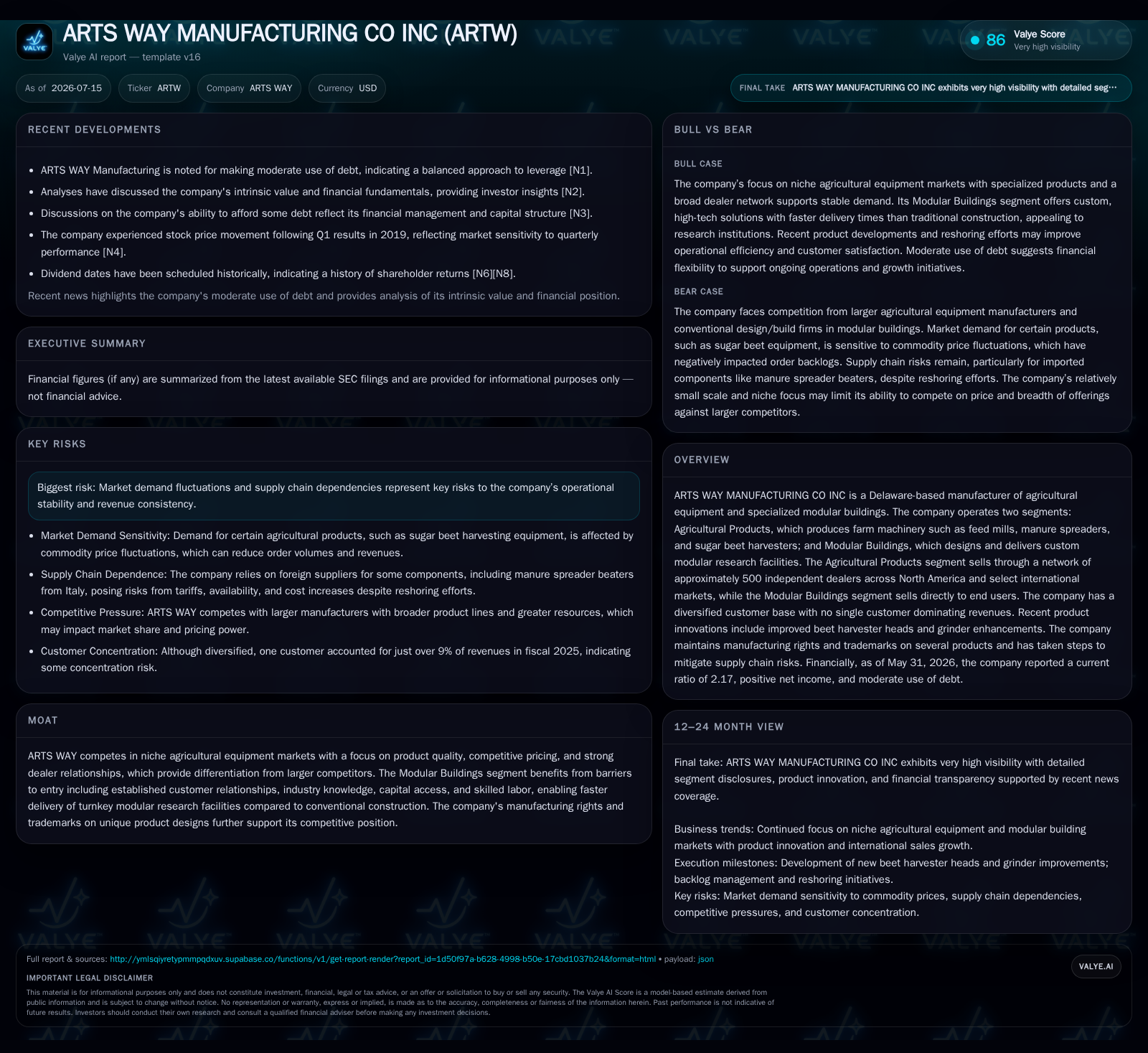
Art's-Way Manufacturing Co. reported in its July 2026 quarterly filing ongoing pressure from supply chain disruptions impacting manufacturing lead times and dealer shipments across its dual segments. The Agricultural Products division, relying on a broad North American and international dealer network, saw persistent backlog accompanied by cautious dealer order timing influenced by commodity price fluctuations. Meanwhile, the Modular Buildings segment continued to build a sizeable project backlog due to its turnkey laboratory solutions delivered faster than traditional construction. Product innovations in beet harvesters and grinders underpin competitive differentiation amid niche market specialization. Art's-Way’s financial position remains stable with adequate working capital relative to liabilities supporting strategic flexibility during operational cycles.
Quarterly Operating Shifts Reveal Mixed Signals on Demand and Supply Constraints
Art’s-Way Manufacturing’s latest quarterly report for the period ended May 31, 2026 underscores a nuanced operational landscape shaped by persistent supply chain challenges juxtaposed against steady underlying demand. The Agricultural Products segment is experiencing ongoing constraints due to longer lead times for critical components — a common theme in specialized ag equipment manufacturing — which tempers shipment volumes despite a stable order backlog reported earlier in the year [S2][S3]. This dynamic suggests that while farmer demand remains present, the pace at which orders convert into deliveries is affected by external supply risks. Such bottlenecks typically depress near-term revenue recognition but may set the stage for deferred sales upside.
Simultaneously, the Modular Buildings segment continues expanding its sizable order backlog as it benefits from being differentiated by speed-to-market advantages compared with conventional design/build firms. With modules delivered in as little as six months versus years for traditional construction, Art's-Way secures extended project pipelines particularly from academic and government research customers [S1]. Yet this growth is contingent on efficient manufacturing capacity utilization during labor and materials availability challenges.
These factors combined produce a mixed operational signal: healthy long-term demand evidenced by backlog accumulation offset partially by near-term shipment cadence disruptions linked largely to supply chain volatility.
Dual-Track Business Model: Dealer-Driven Machinery Versus Direct Modular Solutions
Art’s-Way operates two distinct yet complementary segments: Agricultural Products generating approximately 55.5% of net revenue through an extensive network of roughly 500 independent dealers predominantly across North America plus select international markets; and Modular Buildings delivering custom-designed research facilities directly to end users accounting for around 44.5% of net revenues [S1]
The agricultural business model depends heavily on dealership relationships that extend reach into regional farm markets with products including feed mills, manure spreaders, sugar beet harvesters, forage equipment, bale processors, and dirt work tools. Revenue here derives primarily from unit sales of capital equipment supplemented by aftermarket parts servicing — an important margin contributor given parts service contracts tend to have higher predictability and margins [S1]. Dealer incentives, product availability dictate volume variability along seasonality lines.
Conversely, the Modular Buildings segment pursues direct sales contracts for highly customized turnkey projects requiring design adaptability and responsive installation services tailored to government labs or animal containment applications. This channel limits dependence on intermediaries while facilitating premium pricing due to customization requirements and tight project timelines [S1]. The value proposition thus hinges on engineering expertise combined with rapid delivery capabilities rarely matched by traditional construction providers.
The bifurcation creates inherently different scaling dynamics: dealership expansion broadens geographic penetration incrementally over time whereas modular projects scale via larger contract wins subject to bid competition yet protected by high entry barriers such as capital intensity and skilled labor access.
Competitive Moats Rooted in Product Innovation, Manufacturing Rights, and Dealer Networks
Art’s-Way leverages specialized manufacturing rights protecting unique design elements embodied in several product lines enabling competitive insulation within targeted niches [S21]. Trademarks further enhance brand recognition critical in agricultural markets where buyer trust ties closely to perceived reliability.
Notably, recent upgrades like the clear-view head for the 12-row beet harvester not only improve operator visibility but also maintain backward compatibility with older machines — a strategic innovation expanding addressable install base without forcing full equipment replacement [S26]. Similarly, incremental improvements in grinder mechanics aim at reducing downtime — a key buyer criterion — thereby reinforcing customer loyalty.
Dealer relationships function as crucial moats since brand loyalty intertwines with service support availability; this setup mirrors approaches taken by larger ag OEMs but with emphasis on niche product breadth rather than extensive generalist offerings [S23]. The combination of IP protections alongside dealer dependency creates switching costs that disincentivize migration to competitors for both dealers and farmers.
The Modular Buildings division enjoys moats driven by industry knowledge depth, established customer ties within regulated sectors (like education and health), and access to qualified labor pools — factors limiting entrant threats particularly when coupled with capital requirements necessary for fabrication facilities [S1].
Industry Positioning: Peer Benchmarks Highlight Channel and Delivery Advantages
While Art's-Way remains smaller than major agricultural machinery manufacturers like Deere & Company or AGCO Corporation, its concentrated dealer network strategy shares parallels allowing effective regional market coverage without necessitating sprawling direct sales infrastructure. Deere’s model exploits brand loyalty via entrenched dealerships similarly focused on performance reliability alongside widespread parts support.
In modular buildings, Art's-Way competes within niche custom research facility markets where players such as CIMC Modular Building Systems emphasize rapid delivery turnkey solutions—a space where speed compresses traditional construction timelines from multiple years down to under one year [S1]. Art’s-Way's ability to deliver complex laboratories quickly strengthens its relative advantage given heightened client sensitivity around project lead times in regulated scientific environments.
Supply chain management challenges typify peer experiences across agricultural capital equipment manufacturers globally. Industry leaders deploy multi-source procurement strategies combined with aggressive inventory buffering; Art's-Way has adopted reshoring initiatives especially around critical inputs such as manure spreader beaters previously imported from Italy [S22], indicating proactive risk mitigation efforts essential for sustaining throughput consistency.
Growth Pathways: Replacement Cycles, Dealer Network Expansion, Technological Adoption
Growth impulses stem firstly from cyclical farm machinery replacement triggered by aging fleets compounded by fluctuating commodity prices influencing farmer CAPEX decisions; improved macro conditions such as lower interest rates can accelerate these cycles enhancing dealer order flow [S20]. Integration of product innovations (e.g., enhanced beet heads) offers upsell potential through retrofit kits targeting budget-constrained buyers who prefer incremental upgrades over full asset replacement [S26].
International dealer network extension constitutes a second avenue—while currently modest (~4% sales abroad) [S20], expansion into Australia, Japan or UK markets via existing independent dealers opens incremental volume opportunities leveraging tailored local product variants.
Lastly, modular building demand benefits from increased governmental/scientific funding propelling new research infrastructure investments coupled with fast-tracked deployment trends favoring prefabricated labs over conventional construct-to-spec sites [S1]. Adoption acceleration here demands scalable production processes balancing customization complexity against standardization-led economies of scale.
Key Risks: Seasonality, Supply Chain Fragility, Customer Dispersion
Demand seasonality inherent in agricultural equipment manifests in Q3-Q4 order concentration aligning with planting/harvest schedules causing inventory timing mismatches requiring nimble production scheduling [S2]. Supply chain fragility—highlighted by component delays—remains a significant risk suppressing immediate revenue recognition despite backlog strength
Although no single customer dominates revenues (top client approximating just over 9%) reducing concentration risk materially [S22], dispersed customer bases introduce forecasting volatility complicating production forecasts amid volatile commodity price conditions impacting farmer purchase tendencies.
Labor scarcity notably impacts modular production timelines more acutely given specialized skill requirements constraining timely project completions; competition from new entrants albeit limited by barriers adds ongoing vigilance needs [S1]. Regulatory shifts impacting environmental compliance entail potential cost escalations though currently projected minimal impact based on management disclosures.
Catalysts to Watch: Backlog Evolution, Capacity Utilization, New Product Impact
Monitoring post-supply normalization effects on Agricultural Products backlog conversion will be pivotal; upticks in shipment rates following component procurement stability would confirm latent demand strength ([S2],[S3]). Additionally, tracking manufacturing capacity utilization improvements across both segments gauges operational leverage capture critical for margin expansion.
New product launches such as upgraded beet harvester components or grinder system enhancements bear watching as early adoption rates among dealer networks signal capability to mitigate downtimes thus enhancing value propositions. Equally important are architectural wins or contract awards within Modular Buildings which sustain high-margin turnkey revenue streams potentially offsetting agriculture cyclicality.
Financial Profile Discussion: Balance Sheet Liquidity Supports Strategic Flexibility
Art's-Way maintains a solid financial footing entering mid-2026 demonstrated by $16 million total current assets against $7.4 million current liabilities yielding a favorable current ratio of approximately 2.17 [F1]. Though cash & equivalents stand modestly at roughly $6K reflecting cash conversion cycle realities common within industrial capital goods manufacturing where receivables dominate working capital components [F1], manageable net debt near $2.4 million underscores restrained leverage conducive to operational flexibility amidst ongoing investment needs including recently activated credit lines supporting equipment capex programs (fiber-optic laser systems) announced June 2026 [S11].
This analysis synthesizes Art's-Way Manufacturing Co.'s latest regulatory filings complemented by sector context framing the company's dual-segment strategy underpinned by specialized dealer networks versus direct turnkey sales models. Special emphasis was placed on interpreting operational indicators beyond headline numbers to elucidate supply-demand interplays uniquely influencing near-term trajectories within niche agricultural equipment manufacturing alongside faster-paced modular building construction markets. Readers should consider these perspectives strictly informational without any investment directive intent.
Disclaimer: This is research-only, informational analysis and not investment advice. It may include AI-generated interpretation and general industry context. Always verify important details using primary sources.

Comments