
Winmark Corp Introduces New Fees Impacting Franchise Dynamics in Resale Retail
Winmark’s recent quarter highlights operational shifts driven by new system-wide fees amid sustained franchise network performance.
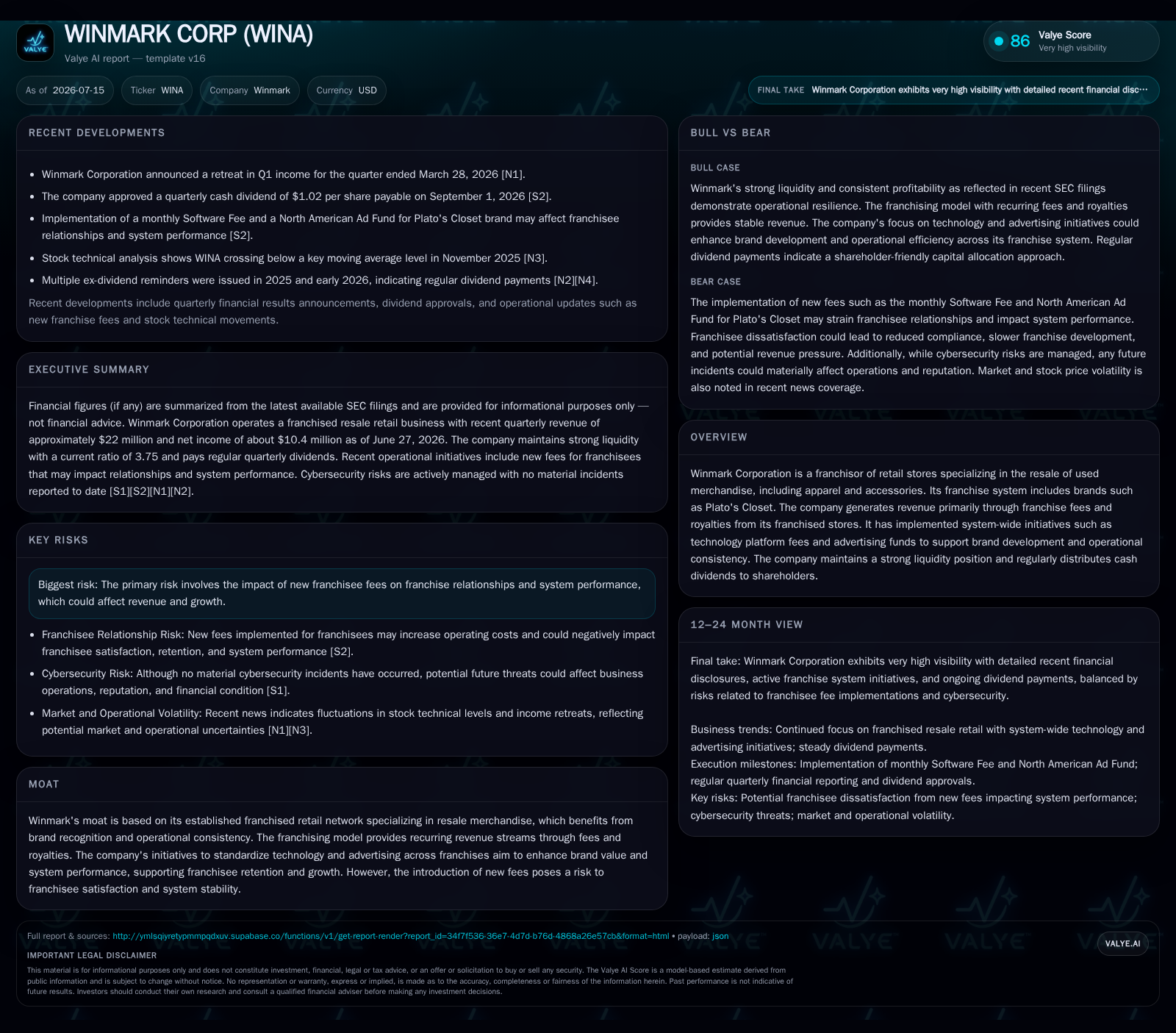
Winmark Corporation reported steady operational results in Q2 2026 while implementing a monthly Software Fee and a North American Advertising Fund for its Plato's Closet franchises. These initiatives aim to bolster brand development and operational consistency but present risks around increased franchisee costs and potential impacts on franchisee satisfaction and retention. The company continues to generate recurring revenue from royalties and fees, supported by a solid liquidity position and regular dividend payments. Key growth drivers include rising consumer interest in sustainable resale shopping and expansion of its franchise network, though vigilance is warranted around franchisee relationships as fee structures evolve.
Recent Operating Update: Q2 2026 Developments
In its latest quarterly filing dated July 15, 2026, Winmark Corporation disclosed the implementation of two notable system-wide initiatives: a monthly Software Fee applicable to all franchised locations and a North American Advertising Fund specifically for its Plato’s Closet brand [S2]. These initiatives aim to strengthen brand development efforts and promote operational consistency across the franchise network. However, they also increase the operating costs borne by franchisees, introducing potential challenges in franchisee satisfaction and retention.
The company explicitly cautioned that these new fees might be perceived as burdensome or misaligned with individual franchisee business needs, which could adversely affect compliance with brand standards, franchisee retention rates, and the pace of new franchise development. Such dynamics may ultimately impact system-wide sales growth and overall franchise system performance [S2]. This risk has been formally incorporated into the company’s risk disclosures as a factor that could materially affect future financial results.
Alongside these operational updates, Winmark announced second-quarter financial results and confirmed an increase in its quarterly dividend from $0.96 to $1.02 per share, payable in September 2026, reflecting management’s confidence in the company’s cash flow stability and ongoing profitability [S3][S8]
Business Model: Franchise Fee-Based Revenue with Emerging Ancillary Charges
Winmark operates as a franchisor specializing in resale retail stores focused on used merchandise, including apparel and accessories, with brands such as Plato’s Closet representing its core portfolio [S1]. The company does not directly operate retail locations but licenses its brand and provides franchisees with marketing support, technology infrastructure, training programs, operational guidelines, and advertising services.
The primary revenue stream consists of recurring royalties calculated as a percentage of each franchised store’s sales volume. Additional revenue sources include initial franchise fees from new store openings, technology platform fees now formalized through the monthly Software Fee, and advertising fund contributions—specifically the North American Ad Fund dedicated to Plato’s Closet franchises.
The introduction of these ancillary fees reflects a strategic evolution in monetization designed to finance investments in standardized IT systems and cohesive marketing campaigns. These investments aim to enhance operational consistency and customer experience across the franchise network, which are critical for maintaining brand integrity and competitive positioning within the fragmented retail resale market. However, these fees increase franchisee operating costs and thus directly impact franchise economics in the near term.
Industry Context & Competitive Positioning
Winmark operates within the franchised specialty retail sector focusing on resale and consignment markets, a segment benefiting from growing consumer interest in sustainability and value-based shopping. Its competitive set includes other resale-specialist franchisors, traditional retail franchisors adapting fee structures, direct retail operators of used merchandise stores without franchising, and specialized technology and advertising service providers supporting these networks.
Industry benchmarks typically feature royalty rates expressed as a percentage of system-wide sales, complemented by technology platform fees and advertising fund contributions that cover operational support costs. Successful franchisors balance these revenue streams to fund brand development and system-wide initiatives without alienating franchisees, who play a critical role in local execution and customer engagement.
Winmark’s brand portfolio enjoys differentiated consumer recognition, driving recurring traffic to its stores compared to generic secondhand outlets or online resale competitors. The company reported system-wide sales of approximately $1.7 billion for fiscal year 2025, underscoring the scale of its franchise network [S16]. Despite this scale, there remains significant opportunity for growth through network expansion and same-store sales improvements.
The recent introduction of technology platform fees marks a critical inflection point in franchisee cost structures. The company must carefully manage the balance between funding necessary system investments and maintaining franchisee goodwill to avoid impairing franchisee retention and development pace.
Growth Drivers: Franchise Network Expansion & Sustainability Trends
Winmark’s growth strategy centers on expanding its franchise footprint geographically through new store openings and demographically by appealing to consumers increasingly attracted to sustainable fashion alternatives. The monthly Software Fee is intended to accelerate technology adoption among franchisees, improving operational productivity and potentially increasing average unit volumes, which would enhance royalty income.
The North American Advertising Fund aims to boost brand visibility and customer traffic across Plato’s Closet locations, leveraging coordinated marketing campaigns to stimulate system-wide sales growth. This approach aligns with broader specialty retail trends where omni-channel marketing support significantly influences consumer traffic patterns.
Additionally, ongoing franchisee training programs focus on reinforcing brand standards and operational compliance, essential for maintaining the curated quality and customer experience that differentiate Winmark’s resale stores.
Risks & Watchpoints: Franchise Economics & System Cohesion
The primary risk lies in the impact of increased fees on franchisee economics. Higher operating costs may lead to franchisee dissatisfaction, which could manifest as reduced renewal rates and slower new franchise development. Franchisees’ perception of the value derived from technology platforms and advertising investments relative to fees paid will be critical in maintaining system cohesion.
Competitive pressures from online resale marketplaces represent an ongoing structural challenge. While Winmark’s physical franchise locations offer advantages such as local inventory access and personalized service, the company must continuously innovate to defend its market position and royalty revenue streams.
Cybersecurity risks also warrant attention, given the reliance on technology platforms. Winmark’s dedicated IT and risk management teams actively monitor and mitigate these threats to prevent operational disruptions or reputational damage [S1].
What To Watch Next
Key indicators to monitor include quarterly system-wide sales trends and franchise renewal rates, which will reveal franchisee acceptance of the new fee structures and their impact on network stability [S2]. Changes in average royalty rates as a percentage of system-wide sales will indicate whether fee increases translate into higher franchisor revenues without compromising growth.
Technology platform adoption rates among franchisees will serve as a leading indicator of operational improvements and fee justification. Additionally, the effectiveness of advertising fund expenditures should be assessed through same-store sales growth comparisons pre- and post-fund implementation.
Management’s ongoing dividend policy, including any adjustments, will provide insight into cash flow sustainability amid evolving fee structures [S8]
Financial Profile Discussion
As of June 27, 2026, Winmark reported cash and cash equivalents of approximately $25.8 million against current liabilities of about $8.2 million, resulting in a strong current ratio of approximately 3.75, indicative of robust short-term liquidity [F1]. Although the most recent total debt figure dates to December 2021, net debt, calculated as total debt minus cash, stands near $21.85 million, reflecting a manageable leverage position [F1].
Conclusion
Winmark Corporation is navigating a pivotal phase as it implements new system-wide fees to fund technology and marketing investments aimed at enhancing brand uniformity and operational consistency. While these initiatives support long-term competitive positioning in the growing resale apparel market, they introduce near-term risks related to franchisee cost burdens and potential impacts on franchisee satisfaction and retention.
The company’s established franchisor model, characterized by recurring royalty revenues and a sizeable franchise network, remains well-positioned amid shifting consumer preferences toward sustainable shopping. Strong liquidity and a consistent dividend policy underscore financial resilience, providing a foundation for continued strategic investments.
Close attention to franchise renewal rates, system-wide sales performance, technology adoption, and advertising fund effectiveness will be essential to gauge the success of these initiatives and the sustainability of Winmark’s growth trajectory.
Disclaimer: This is research-only, informational analysis and not investment advice. It may include AI-generated interpretation and general industry context. Always verify important details using primary sources.

Comments