
Nuvve Holding’s Evolving Virtual Power Plant Strategy Reflects Growth and Supply Risks
Nuvve’s latest quarterly update highlights advances in scaling its AI-driven vehicle-to-grid platform, underscoring commercial fleet electrification progress amid persistent financial and supply constraints.
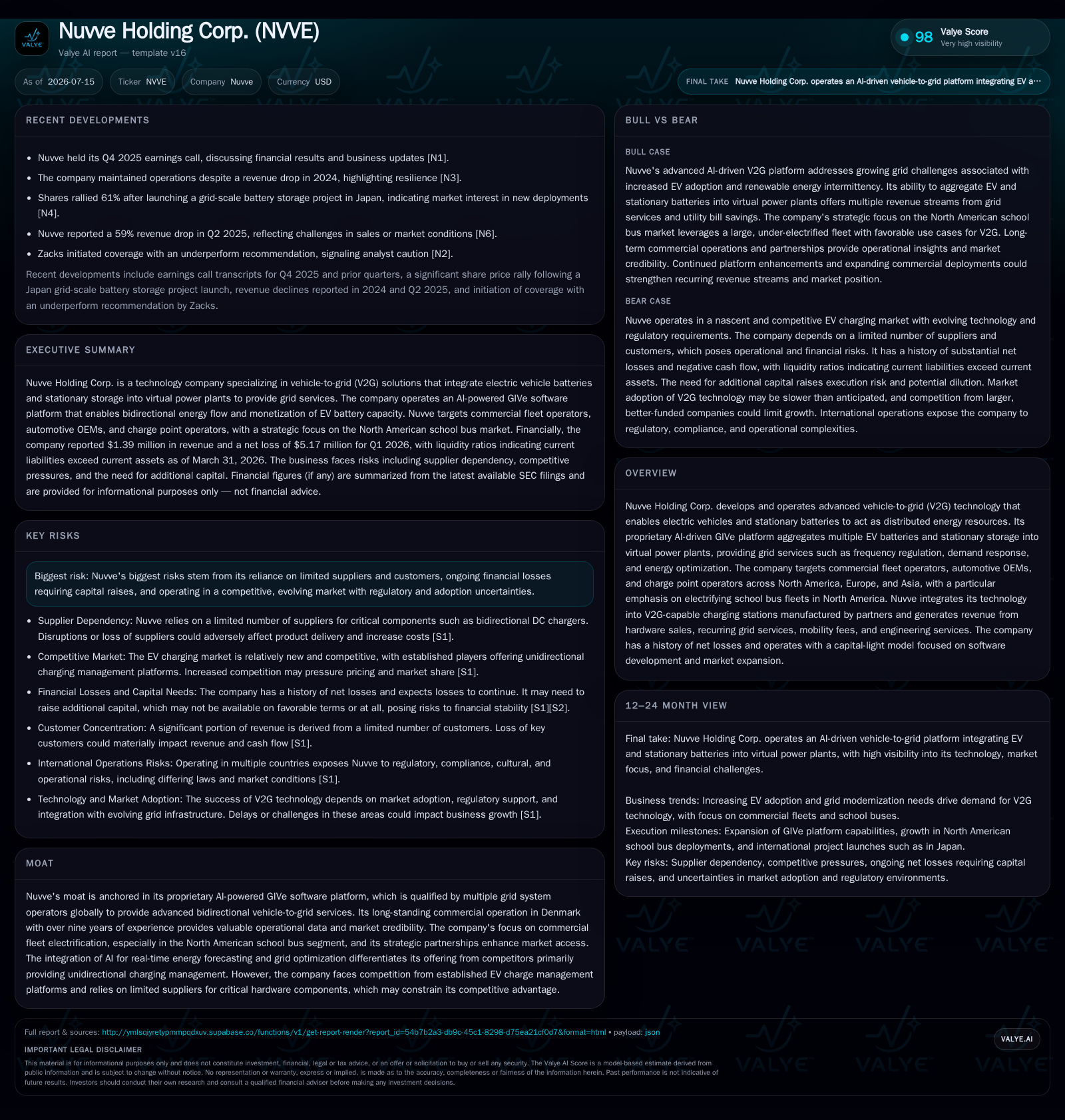
Nuvve Holding Corp.’s 2026 Q2 filings reveal modest but tangible growth in deployment of its AI-powered GIVe platform, which aggregates EV batteries into virtual power plants delivering grid services. The company’s strategic focus on electrifying North American school bus fleets and partnerships with charge point manufacturers remain central to commercial traction. However, persistent operating losses, supplier dependencies, and customer concentration risks weigh on near-term scaling prospects. Competitive differentiation hinges on bidirectional vehicle-to-grid capabilities versus traditional unidirectional charging management platforms. Financially, Nuvve sustains limited liquidity and ongoing net losses, necessitating carefully managed capital raising to support expansion.
Q2 2026 Operating Update Highlights Incremental V2G Deployment Amid Execution Challenges
Nuvve Holding Corp.'s Q2 2026 10-Q filing dated July 15, 2026, reports steady but measured progress in expanding its vehicle-to-grid (V2G) infrastructure and virtual power plant (VPP) capacity, reflecting ongoing commercial traction with fleet electrification customers [S2]. The company increased the number of V2G-capable charging stations integrated with its proprietary AI-driven GIVe platform, thereby growing the aggregate battery capacity under management within its VPPs. This expansion validates Nuvve’s scalable approach of aggregating distributed electric vehicle (EV) batteries to provide grid services such as frequency regulation and demand response. However, the deployment pace remains constrained by hardware sourcing bottlenecks and integration complexities, underscoring operational execution risks despite clear demand from commercial fleet operators, particularly in the North American school bus segment [S3]. Near-term revenue growth depends on accelerating hardware sales of integrated bidirectional charging stations and expanding recurring grid services fees tied to energy optimization and mobility management.
Proprietary AI-Driven GIVe Software Platform as Core Differentiator Amid Hardware Dependencies
Nuvve’s competitive moat centers on its proprietary GIVe software platform, which leverages AI to orchestrate real-time bidirectional energy flows between EV batteries and the electrical grid. This platform enables advanced energy forecasting, dynamic grid optimization, and aggregation of diverse distributed energy resources (DERs) into cohesive virtual power plants capable of delivering sophisticated grid services beyond the capabilities of traditional unidirectional charging management systems [S1], [S2]. The AI-driven energy management facilitates enhanced frequency regulation and demand response, improving grid stability and renewable energy integration. While peers such as ChargePoint are beginning to develop bidirectional charging features, Nuvve’s early and integrated software-hardware approach provides a strategic advantage. Nonetheless, the company remains reliant on a limited set of hardware partners for V2G-capable charging stations, creating supply chain concentration risk that could impede rapid scaling if supplier constraints or partnership issues arise.
Commercial Fleet Electrification Focus Shapes Product Strategy and Customer Base
Nuvve targets commercial fleet operators as its primary customer segment, with a particular emphasis on electrifying North American school bus fleets, which represent a large and underserved market estimated at over 600,000 diesel vehicles eligible for replacement [S1]. This segment benefits from increasing regulatory mandates for clean transportation and growing OEM production of electric school buses. Nuvve’s integrated offering combines V2G-enabled charging stations with AI-optimized software management tailored to the unique operational patterns and total cost of ownership considerations of fleet operators. Key operating metrics to watch include the number of vehicles under contract, geographic penetration, and virtual power plant capacity (MW) aggregated from fleet batteries, which will signal adoption momentum and platform scalability.
Competitive Positioning Through True Bidirectional Charging and Software Aggregation
In a competitive landscape crowded with EV charging infrastructure providers, Nuvve differentiates itself by offering true bidirectional charging capabilities that allow vehicle batteries to discharge energy back to the grid during peak demand or grid frequency events. This contrasts with the more common unidirectional platforms, such as those primarily offered by ChargePoint, which focus on charge scheduling without energy return. Additionally, Nuvve’s AI-powered aggregation of DER assets into virtual power plants competes with energy service providers like Enel X, which deliver grid flexibility but typically rely on different DER integration models. This technological positioning supports diversified revenue streams, combining hardware sales with subscription-like recurring grid services fees, enhancing pricing power and customer stickiness.
Growth Drivers: Accelerating Fleet Electrification, Grid Flexibility Demand, and Regulatory Incentives
Nuvve’s growth is underpinned by several favorable industry trends: accelerating electrification mandates for municipal and commercial fleets, rising grid demand for flexible distributed energy resources to support frequency regulation and demand response, and government incentives promoting EV adoption and clean energy infrastructure [S1]. Advances in AI algorithms enhance real-time dispatch optimization, improving operational efficiency and margins. Strategic partnerships with automotive OEMs and regional charge point operators expand distribution channels, facilitating broader V2G infrastructure deployment aligned with increasing renewable energy penetration and grid balancing needs.
Key Risks: Hardware Supplier Concentration, Financial Losses, and Customer Concentration
Despite technological leadership and market focus, Nuvve faces material risks that could impede growth. The company’s dependence on a limited number of hardware suppliers for V2G-capable charging stations constrains deployment scalability; any supply disruptions could delay revenue recognition from both hardware sales and recurring grid services contracts [S1], [S2]. Financially, Nuvve continues to operate at a net loss, reflecting significant investment in technology development and commercial expansion ahead of sustainable revenue inflows. Customer concentration risk is notable, with a small number of large commercial fleet accounts contributing disproportionately to revenues; loss or non-renewal of these contracts would materially affect financial results. Additionally, uncertainties in OEM electric vehicle production schedules and evolving regulatory frameworks could slow market adoption.
Forward-Looking Operational Metrics: Contract Renewals, VPP Capacity Growth, and Margin Expansion
Critical milestones to monitor include contract renewal rates with existing commercial fleet customers, which underpin recurring revenue visibility and validate the subscription-like monetization model embedded in the GIVe platform. Growth in virtual power plant capacity, measured in megawatts (MW), will indicate successful aggregation of distributed battery assets and improved fixed-cost absorption, supporting margin expansion. Progress toward operational profitability will depend on software platform efficiencies, hardware cost management, and scaling recurring grid services revenue.
This analysis synthesizes Nuvve Holding Corp.’s recent SEC filings with sector-specific insights into the vehicle-to-grid energy technology industry. It emphasizes the company’s evolving competitive positioning, operational progress, and financial condition within the context of accelerating commercial fleet electrification and grid services demand. The article refrains from speculative forecasts, focusing instead on verifiable operational and financial data points.
Disclaimer: This is an independent analytical summary based solely on publicly disclosed filings and industry context. It does not constitute investment advice or endorsement.
Disclaimer: This is research-only, informational analysis and not investment advice. It may include AI-generated interpretation and general industry context. Always verify important details using primary sources.

Comments