
Cryo-Cell International Navigates Regulatory and Competitive Pressures Amid Duke License Dispute
Q3 2026 results highlight steady private cord blood storage with caution around uncertain licensing and expansion efforts.
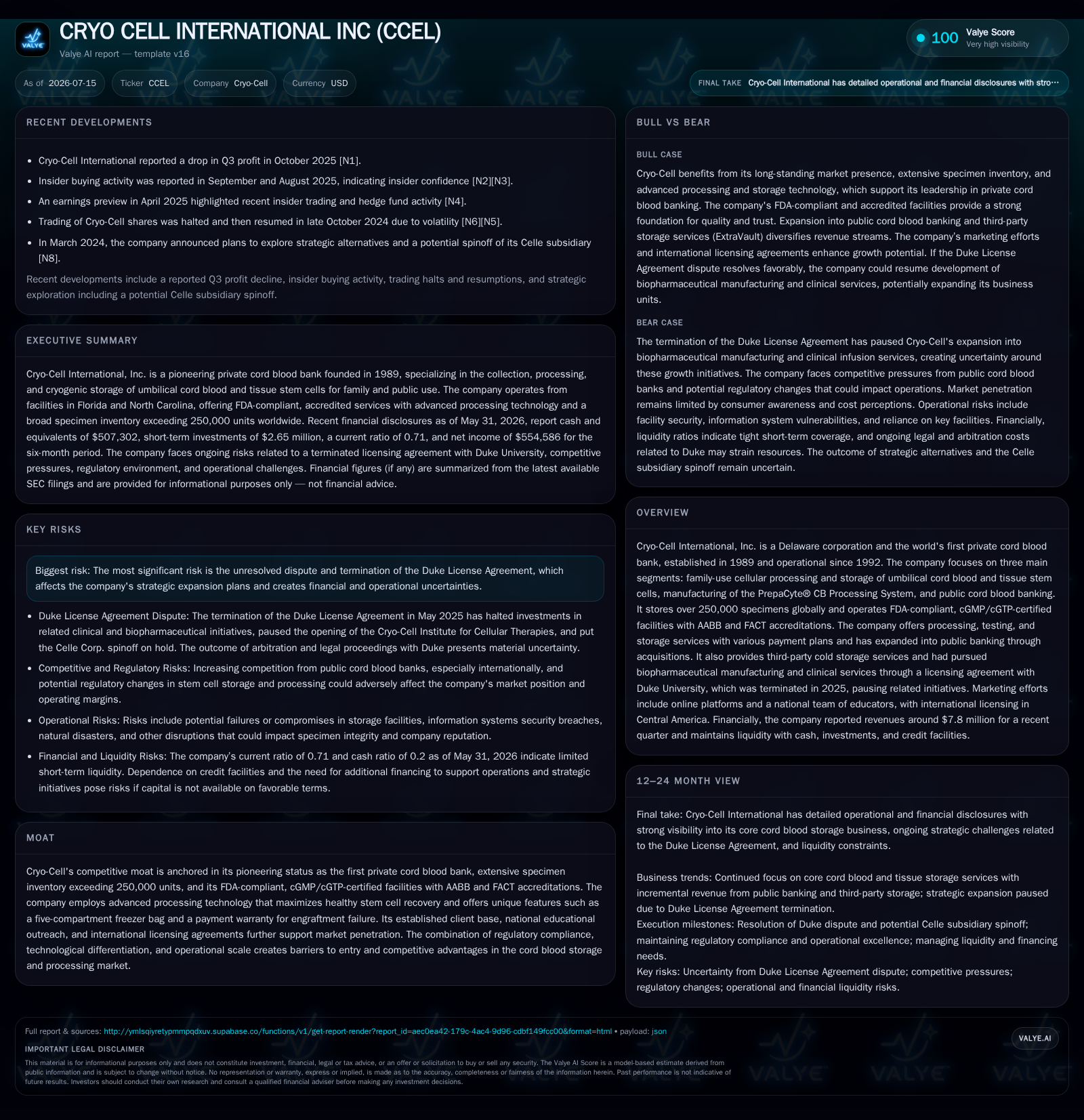
Cryo-Cell International, a pioneer in private umbilical cord blood and tissue cryogenic storage, reported a modest 2% revenue decline in Q3 2026 driven by processing and storage fees. The company continues to operate FDA-compliant, AABB/FACT-accredited facilities managing over 250,000 specimens globally. However, the termination of its Duke University licensing agreement in mid-2025 has paused its clinical therapy development initiatives, posing strategic uncertainty. Financing remains manageable with debt refinements, but competitive dynamics from public banks and regulatory complexity remain key challenges. Monitoring customer retention, new specimen volume, and resolution of the Duke dispute will be critical for business momentum.
Recent Operating Update: Q3 FY2026 Performance Reflects Modest Revenue Pressure
Operationally, Cryo-Cell continues to leverage its highly regulated infrastructure—operating FDA-registered facilities that are cGMP/cGTP-compliant and accredited by both AABB and FACT—offering critical legitimacy within the sensitive cord blood banking industry [S1]. The company holds an inventory exceeding 250,000 stored umbilical cord blood and cord tissue specimens globally that form arguably its most valuable asset base supporting ongoing storage fee revenues [S1]. This scale is a meaningful barrier to entry given the capital intensity and strict quality requirements for long-term cryogenic preservation.
Business Model: Fee-Based Cryogenic Storage Anchored by Proprietary Processing Technologies
At its core, Cryo-Cell generates recurring revenue streams from fees charged for collection kits sold via hospitals and birthing centers, laboratory processing using its proprietary PrepaCyte® Cord Blood Processing System designed to maximize stem cell viability recovery, followed by long-term cryogenic storage contracts paid annually by customers [S1]. The company also derives incremental income from public cord blood banking contracts that supply stem cell units into the national registry systems such as NMDP for transplantation use [S2].
Revenue mechanics hinge on expanding specimen volumes while maintaining high retention rates of annual storage fees—both essential KPIs in this sector where customer lifetime value materially impacts profitability. Gross margins depend heavily on efficient laboratory operations and optimized freezing protocols that minimize cell degradation or loss during processing [S1][S2]. The company also offers multiple pricing plans including prepaid multi-year packages plus monthly installment arrangements designed to reduce customer acquisition friction.
Industry Structure and Competitive Position: Regulations Tighten While Competition Rises
Cryo-Cell operates in a market bifurcated between private family-use banks—such as Viacord and Cord Blood Registry—and public entities like Be The Match (NMDP), positioning itself as a pioneer with a long operating history since 1992. Its key differentiator remains its advanced technology platform (PrepaCyte®) which offers a proprietary edge in stem cell yield compared to standard density gradient centrifugation methods used by some competitors.
Regulatory compliance exerts a powerful influence on industry dynamics; firms must maintain FDA registration and demonstrate adherence to Public Health Service Act standards alongside certifications from AABB and FACT bodies [S1]. This heavy regulatory burden limits entrants but also demands continuous investment in quality control and facility maintenance.
Competitive threats include increasing market share shifts toward public cord blood banks incentivized by government funding especially overseas markets where public donations are growing faster than private enrollments [S2]. Economic challenges potentially suppress discretionary spending on private banking services risking attrition or slowed new specimen collections—a vulnerability flagged in management forward-looking commentary [S2][S18].
Growth Drivers: Technology Leadership, Geographic Licensing, and Service Diversification
Despite near-term revenue softness, Cryo-Cell’s growth engine is supported by multiple vectors. Technological innovation—specifically improvements embodied in its PrepaCyte® CB processing system—enhances viable stem cell recovery rates which can improve clinical utility perceptions among potential customers [S1]. Additionally, geographic expansion through licensing agreements granting marketing rights across Central American countries (Costa Rica, El Salvador, Guatemala, Honduras, Nicaragua, Panama) extends market reach beyond U.S. borders into emerging healthcare environments where awareness is evolving [S2].
Public banking initiatives further diversify offerings while tapping into global transplant registry networks such as NMDP ensures access for patients needing matched stem cell transplants worldwide [S2]. Furthermore, specialized payment plans tailored for price sensitivity bolster customer acquisition in variable economic climates.
However, a significant growth uncertainty arose from the termination of Cryo-Cell's Duke License Agreement in May 2025 which was originally intended to underpin development of biopharmaceutical manufacturing capabilities and clinical infusion programs targeting conditions like cerebral palsy or autism using proprietary immunomodulatory properties of cord blood cells [S1][S28]. This discontinuation paused nascent high-margin business expansions with unclear timelines for resolution pending arbitration.
Risks and Watchpoints: Regulatory Evolution, Legal Disputes, Competitive Shifts
Key risks stemming from regulatory intensification could increase compliance costs or impose operational constraints reducing margins [S9][S18]. Legal challenges including prior filed class action claims over advertising practices were resolved without financial materiality but illustrate ongoing litigation exposures inherent in consumer-facing biotech service businesses [S1].
The Duke University license arbitration represents perhaps the largest strategic wild card as adverse outcomes might limit future royalty income or require impairment of associated investments with downside financial impacts [S9][S28]. Financing flexibility also poses constraints; while current debt facilities have been amended favorably extending maturity dates into late 2027 (revolving credit) and mid-2032 (term loan), total debt remains around $8.3 million against low cash balances (~$0.25 million) yielding a tight current ratio of ~0.62 per latest reporting [F1]. The company’s ability to secure additional capital if needed remains uncertain.
On competition fronts, public banks' growing presence internationally combined with potential stem cell therapy breakthroughs outside traditional banking necessitate ongoing innovation lest Cryo-Cell lose share or relevance.
What to Watch Next: Licensing Resolution and Customer Metrics Critical
Investors should closely track updates regarding the Duke License arbitration outcome expected after April 2026 court hearings as it will materially influence near-to-medium term strategic options especially around clinical services resumption [S9][S28]. Key demand-side indicators include monitoring new specimen collection volumes alongside annual fee renewal rates given discretionary spend sensitivity highlighted by management [S18]. Revenue trajectory signals will help gauge whether pricing power persists amid discounting pressures noted earlier [S2].
Operational cost trends particularly related to facility upkeep or expansion should be reviewed against gross margin stability targets given upfront capex plans outlined historically (~$1M+ annually) [S14][S15]. International licensing deals execution pace may also unlock incremental revenue streams diversifying away from mature U.S markets.
Financial Profile Discussion
As of the end of fiscal Q3 2026 (Feb 28th reporting), Cryo-Cell reported cash and equivalents of approximately $250,000 and total debt of about $8.3 million, reflecting mostly term loans under Susser Bank credit agreements with amended maturities extending through October 2027 (for revolving credit) and July 2032 (term loans) accompanied by interest margins indexed to prime rates plus ~3–4% spreads [F1][S2]. Net debt is near $8 million, implying leverage risks. The current ratio stands at approximately 0.62, signaling tight working capital management [F1].
Operating cash flow generation appears stable with net cash used in financing activities of $2.36 million for the six months ended May 31, 2026, reflecting partial repayments of debt and proceeds from the line of credit [S2]. These cash flows suggest solid EBITDA support, though financing activities indicate ongoing deleveraging efforts that consume significant cash resources, potentially limiting investment flexibility.
No recent dividends were noted, suggesting a conservative capital allocation approach focused on debt reduction and funding ongoing operations post-Duke agreement termination impacts [S2]. Capital expenditures remain moderate, supporting technology maintenance rather than large-scale expansions currently.
In summary, while solvency is maintained via structured credit lines with amendment flexibility limiting refinancing risk short-term, balance sheet tightness suggests close liquidity monitoring is warranted especially if growth initiatives resume requiring external funding injections.
This analysis synthesizes official recent filings through July 15th, 2026 focusing strictly on supported disclosures without conjecture beyond explicit evidence or industry framing standards relevant to cryogenic stem cell banking businesses. The company remains anchored strategically as an early pioneer with substantial stored specimen assets but faces near-term operational pressures linked principally to dividend suspension of innovative clinical pipeline activities related to regulatory licensing disputes. Monitoring how Cryo-Cell navigates these headwinds alongside continued sector-wide regulatory/compliance demands will define sustainability trends ahead.
Disclaimer: This is research-only, informational analysis and not investment advice. It may include AI-generated interpretation and general industry context. Always verify important details using primary sources.

Comments