
Ambarella Advances AI-Enabled SoC Solutions with Strengthened Auto Market Traction
Ambarella's Q1 fiscal 2027 filing reveals growing automotive demand and progress in cutting-edge process nodes, underscoring its market positioning amid ongoing customer and supply risks.
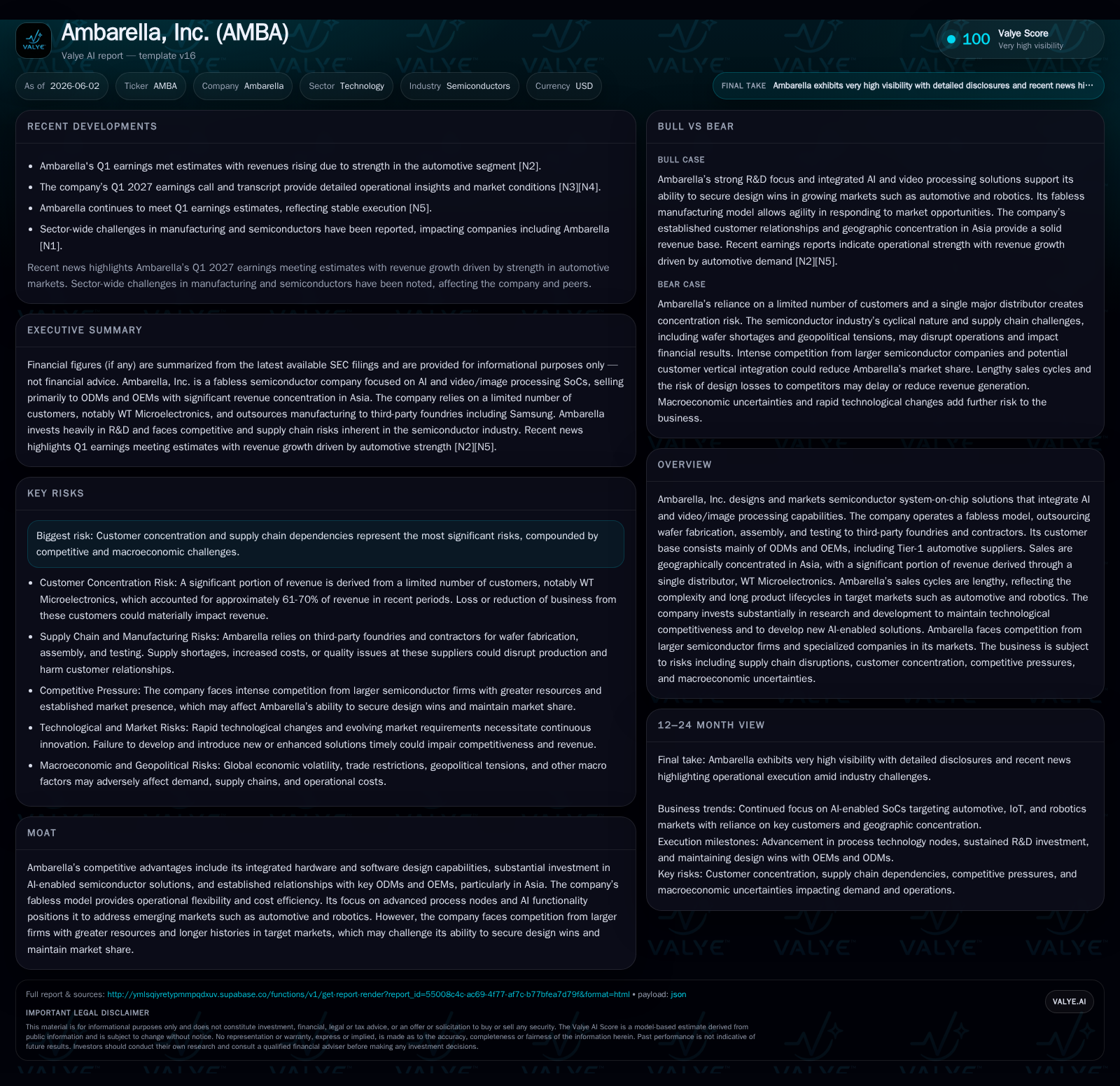
In its recent 10-Q filing dated June 2, 2026, Ambarella reported steady revenue gains fueled by strength in automotive SoC applications. The company continues to advance its technology roadmap with a tape-out of its first 2nm system-on-chip, enhancing its competitiveness in AI-centric embedded solutions. Despite robust design wins and product adoption, Ambarella faces persistent risks from high customer concentration—especially dependence on WT Microelectronics—and supply chain uncertainties. Its fabless model supports agility and cost efficiency but also ties growth to foundry access and market cyclicality. The near-term outlook hinges on execution of automotive design integrations and successful navigation of component supply pressures.
Q1 Fiscal Year 2027 Operating Update
Ambarella’s latest quarterly report filed on June 2, 2026, presents a modest but meaningful uplift in revenue primarily driven by increased uptake of its semiconductor SoCs within the automotive sector [S2][S11]. The firm highlighted continued strength from key OEMs and ODMs relying heavily on embedded AI-enabled video processing functionalities that Ambarella specializes in. WT Microelectronics—its principal distributor in Asia excluding Japan—remained the dominant channel partner, representing approximately 61% of total revenue for the three months ended April 30, underscoring ongoing customer concentration risks
Simultaneously, Ambarella noted ongoing inventory management challenges given the extended sales cycles typical for its products and demand variability resultant from supply chain constraints. While new orders reflected positive momentum, possible delays due to wafer supply tightness and upstream component shortages were flagged as headwinds [S2][S27]. Nonetheless, their operational approach remains supported by an ability to ramp production flexibly via third-party foundries.
Ambarella’s Business Model: Integrated AI Solutions with Fabless Agility
Ambarella operates a fabless semiconductor design model focused on system-on-chip (SoC) solutions fusing advanced video/image processing with artificial intelligence capabilities tailored for embedded markets such as automotive and robotics. By outsourcing wafer fabrication, assembly, and testing to specialized contractors, it maintains capital efficiency and flexibility while concentrating internal efforts on research & development and software/hardware integration [S1].
The business model depends heavily on achieving "design wins," i.e., securing inclusion of their SoCs at the product development phase with OEMs or Tier-1 suppliers who build devices for automotive or consumer applications. These design cycles are protracted—often exceeding eighteen months in automotive segments due to safety-critical certifications—which fosters deep integration into client products but results in long lead times before revenue recognition [S1][S24]
Customer relationships tend to be sticky once integrated due to switching costs embedded in software ecosystems and hardware validation requirements. Still, this creates a bottleneck where order volumes can be lumpy and sensitive to shifts in end-market demand or competitive pressures.
Industry Context: Competitive Positioning in Advanced SoC Markets
Within the semiconductor industry landscape characterized by intense rivalry from large integrated device manufacturers (IDMs) and specialized AI chip startups alike, Ambarella holds differentiation through combined hardware/software expertise focused on niche intelligent vision markets. Its current process node utilization spans from mature 10nm down to leading-edge 4nm technologies, with a recent milestone achieved by successfully taping out an SoC using a 2nm process node—a step ahead compared to many peers still predominantly at or above 5nm nodes [S1]
This technical advancement signals potential for improved power efficiency and performance gains critical for automotive applications requiring real-time AI inference at low latency. However, competitors benefit from larger R&D budgets and deeper OEM relationships which can pressure Ambarella's ability to capture scale design wins especially as pricing elasticity tightens in semiconductor markets.
Moreover, customer/geographic concentration—in particular heavy reliance on WT Microelectronics handling roughly two-thirds of revenues—introduces vulnerability if this distribution channel faces financial or operational setbacks [S11][S17]. This structural market complexity tempers margin expansion prospects despite favorable technology positioning.
Growth Catalysts: Automotive Demand and Process Node Leadership
Ambarella’s path to growth is anchored strongly in rising embedded AI adoption across intelligent transportation systems where video perception is indispensable—from ADAS (advanced driver-assistance systems) cameras to autonomous driving sensor fusion platforms. Expanding regulatory mandates favoring vehicle safety features drive higher content per vehicle equipped with sophisticated semiconductors incorporating computer vision algorithms.
Process node migration further enhances competitiveness by enabling more compute-intensive models within power/cost envelopes acceptable for mass-market vehicles. The company’s recent tape-out at the frontier 2nm node essentially opens doors to next-generation product platforms that could extend lifecycle relevance beyond traditional horizons given expected performance boosts [S1].
Long design cycles imply that pipeline indicators such as new design wins announced during earnings calls are vital KPIs signaling future incremental volume streams [N3]. Continued relationship development with Tier-1 suppliers that bundle Ambarella chips into vehicles could escalate attach rates over time.
Risk Factors: Customer Concentration and Supply Chain Exposure
While Ambarella’s partnership with WT provides a geographically focused distribution hub facilitating scale sales across Asia’s electronics ecosystem, this reliance presents pronounced risk [S11][S20]. Should WT experience credit or logistics issues—as was cautiously noted regarding accounts receivable exposure—or shift strategic priorities, Ambarella could face delayed payment collections or abrupt revenue shortfalls
Supply chain fragility remains prominent across the semiconductor industry; wafer fabrication constraints or price inflation directly erode gross margins. Ambarella’s fabless model offers operational leverage but simultaneously hinges on foundry capacity allocations that are not guaranteed—particularly at advanced nodes where capacity is scarce and prioritized for larger customers [S2][S27]
Additionally, forecasting complexities inherent to long sales cycles combined with volatile end-market demand may create inventory imbalances either causing write-down risks or lost sales if shortages arise [S17]. Geopolitical factors impacting Hong Kong—the central inventory hub—as well as broader trade tensions contribute further uncertainty.
Looking Ahead: Key Milestones and Execution Watchpoints
Investor attention should center on tracking additional disclosed design wins particularly within automotive OEMs or robotics segments indicative of broadening end-market footholds. Further progress building production capacity ramp aligned with the introduction of products based on the newly taped-out 2nm chip will serve as tangible innovation milestones supporting future margin improvement and revenue scalability.
Monitoring supply chain normalization trends—wafer availability, material cost trends—as well as updated guidance around shipment schedules will provide clarity on how effectively Ambarella navigates near-term operational risks triggered by global macroeconomic conditions.
Lastly, developments regarding diversification away from dominant customers or expansion into complementary high-growth verticals such as intelligent surveillance or industrial automation could gradually mitigate existing concentration vulnerabilities.
Financial Health Snapshot: Liquidity and Profitability Trends
As of April 30, 2026, Ambarella maintained a healthy liquidity profile evidenced by cash and cash equivalents totaling approximately $114 million complemented by a current ratio of roughly 2.43 indicating solid short-term asset coverage over liabilities [F1][S19]. This financial cushion enables sustained investments into R&D critical for next-gen AI semiconductor advancements.
However, operating income remains negative (-$82 million as of January-end), reflecting elevated R&D expenses alongside challenging cost structures typical of high-tech innovation phases within fiercely competitive domains [F1]. Maintaining balance between growth spending and eventual profitability will be imperative as scale effects accrue from ramped designs.
This analysis synthesizes recent filings and company disclosures as of June 2026 without providing investment research views. It highlights both strategic strengths inherent in Ambarella’s advanced AI-enabled SoC technology roadmap and market traction within automotive sectors while underlining continuing execution risks tied to customer concentration and supply chain dependencies critical for assessing operational resilience.
Disclaimer: This is research-only, informational analysis and not investment advice. It may include AI-generated interpretation and general industry context. Always verify important details using primary sources.

Comments