
Amkor Technology Advances AI Packaging Leadership While Managing Cyclical Industry Headwinds
Amkor's Q2 2026 results reflect margin gains fueled by AI-related packaging demand amid ongoing semiconductor industry cyclicality, supported by strategic capacity expansions and a diversified global footprint.
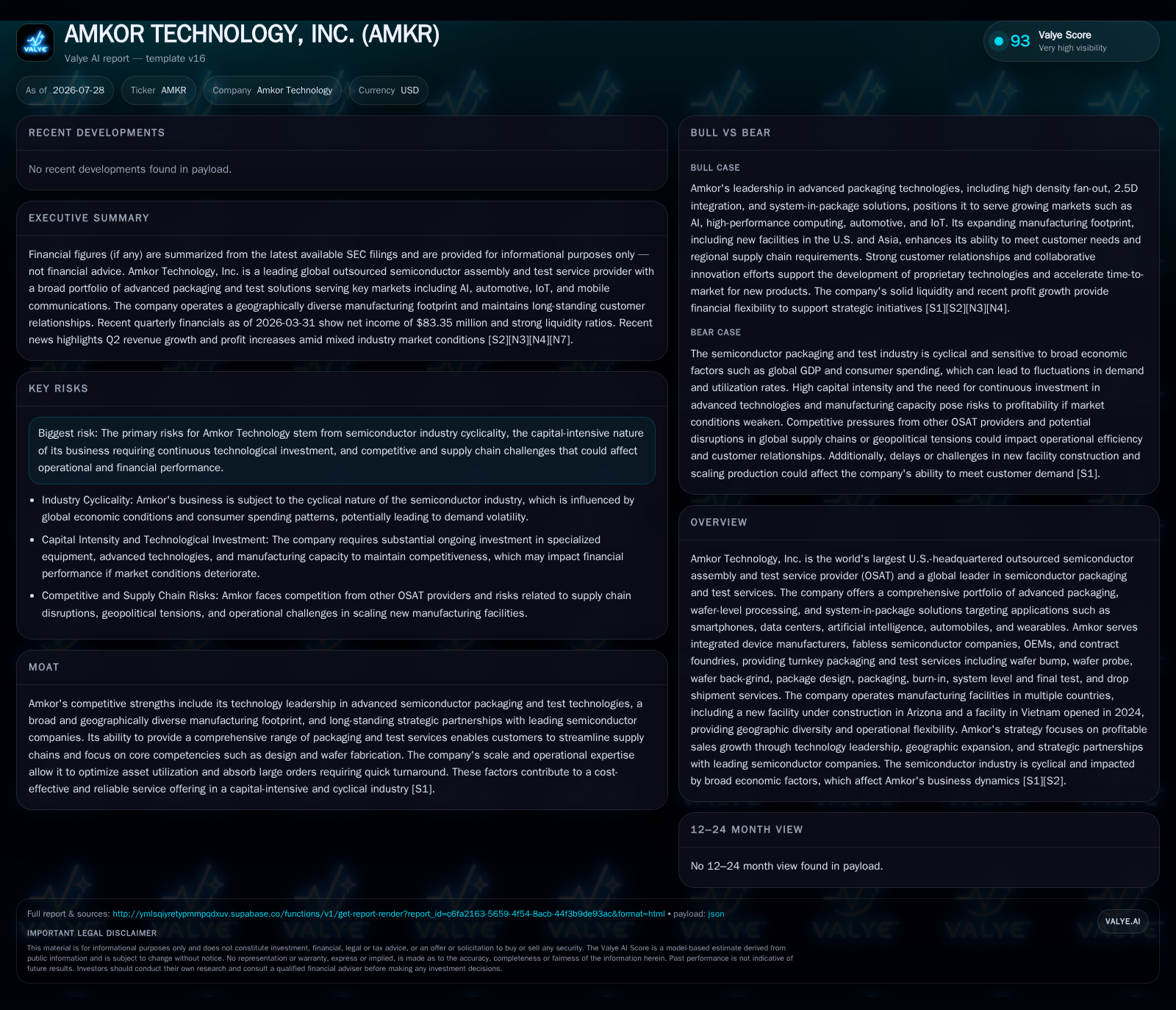
In its Q2 2026 filing, Amkor Technology reported rising margins primarily driven by increased orders in advanced packaging solutions serving artificial intelligence applications despite a broader semiconductor market slowdown. The company’s extensive turnkey packaging and test services, along with an expanding geographic manufacturing footprint—including new capacity under construction in Arizona—strengthen its competitive position in a capital-intensive, cyclical industry. Risks persist from customer concentration and pricing pressure, but growth opportunities remain robust through technology innovation and exposure to high-growth end markets like automotive electronics and data centers.
Q2 2026 Margins Gain From AI-Driven Orders Despite Semiconductor Cyclicality
Amkor Technology’s most recent quarterly filing for Q2 ended June 30, 2026, reveals improved gross and operating margins driven largely by selective growth in advanced packaging orders linked to artificial intelligence applications [S2], [S3], [N1]. Despite persistent softness across broader semiconductor end markets reflecting a cyclical downturn, this demand segment has allowed Amkor to sustain better-than-expected utilization levels on its manufacturing lines. The margin gains thus far appear durable as long as AI-related product ramps maintain momentum into the second half of 2026.
'Comprehensive Turnkey Solutions Anchor Amkor’s Packaging Revenue Model'
Amkor operates as the world’s largest U.S.-headquartered outsourced semiconductor assembly and test service (OSAT) provider, offering an extensive suite of turnkey solutions that span wafer bumping, wafer probing, wafer back-grind, package design, burn-in testing, system-level testing, final test, and drop shipment services [S1]. This breadth enables clients—ranging from integrated device manufacturers (IDMs) who may outsource portions of their packaging capacity, fabless semiconductor companies lacking in-house production facilities, OEMs, and contract foundries—to consolidate their back-end manufacturing needs under one vendor. The remuneration mechanics depend principally on volume processed per unit with complex packages commanding higher average selling prices due to greater engineering content and processing intricacy.
Such a turnkey approach helps Amkor capture multiple value chain steps post-wafer fabrication while allowing customers to focus on design and front-end processes. However, the business model is sensitive to capacity utilization rates since fixed costs are substantial given heavy capital outlays for specialized equipment. Order backlog levels and average selling prices per unit remain critical metrics to track revenue trajectory alongside mix shifts favoring higher-value system-in-package (SiP) technologies.
Global Footprint Expansion Supports Supply Chain Resilience and Customer Access
Strategically diversifying its manufacturing footprint is central to Amkor's competitive moat [S1]. The company operates facilities worldwide across Asia (including recently opened factories in Vietnam launched in 2024) and Europe while actively expanding U.S. presence via a new Arizona plant currently under construction [S1]. This geographic spread addresses persistent supply chain risks heightened by geopolitical tensions and regional trade restrictions impacting semiconductor supply chains.
By localizing production near major customers' design hubs or end markets, Amkor enhances responsiveness and mitigates disruptions from cross-border regulatory or logistic constraints. This is increasingly important given the industry trend towards regionalization spurred by government incentives for onshoring critical manufacturing activities. When benchmarked against global OSAT peers such as ASE Technology or JCET Group—both with strong Asian bases—Amkor’s growing U.S. footprint may offer differentiated customer engagement potential particularly with American fabless companies and IDMs.
'Capital Intensity Meets Demand Complexity: Navigating Capacity and Investment'
Supporting its technology leadership requires continuous capital investment in state-of-the-art equipment capable of handling increasingly sophisticated packaging forms [S1], [S2]. Capital expenditure levels reflect a strategic balance between scaling capacity to meet identified growth areas—like AI-related advanced packages—and cautious discipline amid semiconductor cyclicality.
Given the high fixed-cost nature of OSAT operations coupled with pricing pressures from both internal IDM capabilities and external competitors including Chinese government-backed entities, maintaining elevated capacity utilization is essential for margin preservation [S1]. Investments also fund research collaborations around novel approaches such as panel-level fan-out (PLFO) packaging or copper hybrid bonding which promise performance advantages while enabling cost efficiencies over time [S1], [N1].
Tracking capital intensity alongside order backlog dynamics will be paramount for assessing whether Amkor can sustainably convert R&D spend into commercial differentiation without excessive asset bases during downcycles.
'Technology Leadership Enables System-in-Package Advances on AI and Automotive Fronts'
Technology innovation remains a pillar underpinning Amkor's market positioning. The firm focuses on heterogeneous integration techniques—such as multi-chip modules with fine-pitch interconnects—and system-in-package modules that integrate diverse dies into compact form factors meeting demanding thermal and electrical specifications [S1], [N1].
These advances are increasingly relevant as customers seek performance scaling beyond traditional Moore's Law trajectories particularly within data center compute accelerators for artificial intelligence workloads. Additionally, emerging automotive electronic applications including ADAS (advanced driver-assistance systems), infotainment units, EV power management modules and optical sensors require customized high-reliability packaging that Amkor aims to address via its high-power module developments involving SiC devices [S1].
R&D expense remains significant — about $166.7 million invested in 2025 alone — reflecting commitment to sustaining leadership through proprietary process innovations tailored for these high-growth verticals [S1]. This focus not only supports higher average selling prices but also enhances switching costs for customers prioritizing partners versed in complex package co-development.
'Risks from Industry Cyclicality, Customer Concentration, and Pricing Pressures'
Despite optimistic pockets of growth, Amkor remains vulnerable to several notable risks articulated clearly in its filings [S1], [S2]. Semiconductor industry cyclicality can create abrupt demand contractions leading to suboptimal asset utilization given the capital-intensive cost structure with largely fixed overheads.
Customer concentration poses another material risk: approximately 72% of net sales derive from the top ten customers with Apple alone contributing nearly 30% in recent years [S1], heightening exposure if key partners reduce orders or shift sourcing strategies. Furthermore, ongoing ASP erosion driven by competitive pressures—from established OSAT rivals like ASE Technology as well as IDM internal packaging expansion—could compress margins absent offsetting volume or mix improvements.
Supply chain disruptions affecting raw materials (laminates, bonding wires) or equipment availability could further exacerbate operational risks. Geopolitical tensions that impact cross-border flows also remain an external uncertainty given global facility dispersion.
'Growth Catalysts in Advanced Packaging Adoption and End-Market Diversification'
Growth vectors ahead appear anchored in multiple reinforcing trends documented extensively by Amkor management [S1], [N1]. The increasing complexity of semiconductors boosts demand for advanced packaging solutions capable of integrating multiple functional elements efficiently within constrained footprints.
AI-driven compute acceleration elevates demand for customized SiP designs; meanwhile expanded adoption in automotive sectors targets ADAS systems supporting electrification trends promising long-term volume increases. Geographic diversification simultaneously aids capturing regional market share amid supply chain localization initiatives encouraged by policy makers globally.
Further tailwinds include broadband networking infrastructure expansion underpinning communications device growth alongside wearables undergoing miniaturization requiring innovative low-cost packages. Collectively these drivers align well with Amkor's current R&D emphases establishing a durable growth runway beyond base semiconductor cycles.
'Near-Term Watchpoints: Order Backlog Evolution and Facility Qualification Progress'
Operationally important indicators going forward include sustained order backlog depth signaling ongoing demand health especially within AI-related lines; meaningful because Amkor historically operates without large backlog cushions due to short-term customer commitments [S2]. Progress towards qualifying the new Arizona facility will be critical to unlocking incremental U.S.-based capacity enhancing flexibility and mitigating geopolitical risk exposures borne by heavy Asian concentration.
Supply chain stability around materials procurement amid lingering global trade uncertainties merits close observation as disruptions can lengthen turnaround times (TAT) impacting customer satisfaction [S2], [S3]. Monitoring emerging pricing trends against input cost volatility will also inform margin trajectory forecasts.
Financial Profile Discussion: Liquidity Buffer Amid Capital Spending
This liquidity buffer supports ongoing capital investments crucial for technological upgrades and capacity expansions while providing operational resilience during downcycles characterized by reduced cash flows typical of this capital-intensive sector. Overall financial flexibility aligns positively with operating momentum centered on AI package uptake described earlier.
This analysis draws exclusively from Amkor’s latest SEC filings dated up to July 28, 2026 ([S1],[S2],[S3]) complemented by contemporaneous market commentary ([N1],[N3]). It situates the company within broader OSAT industry dynamics emphasizing advanced packaging technology innovation combined with geographic diversification as enduring competitive advantages amid inherent cyclicality challenges characteristic of the semiconductor ecosystem.
Disclaimer: This is research-only, informational analysis and not investment advice. It may include AI-generated interpretation and general industry context. Always verify important details using primary sources.

Comments