
Amarin’s Financial Turnaround Challenges and Strategic Patent Defense
Amarin’s decade-long revenue expansion from VASCEPA contrasts sharply with persistent losses, as patent litigation and partner reliance shape its path.
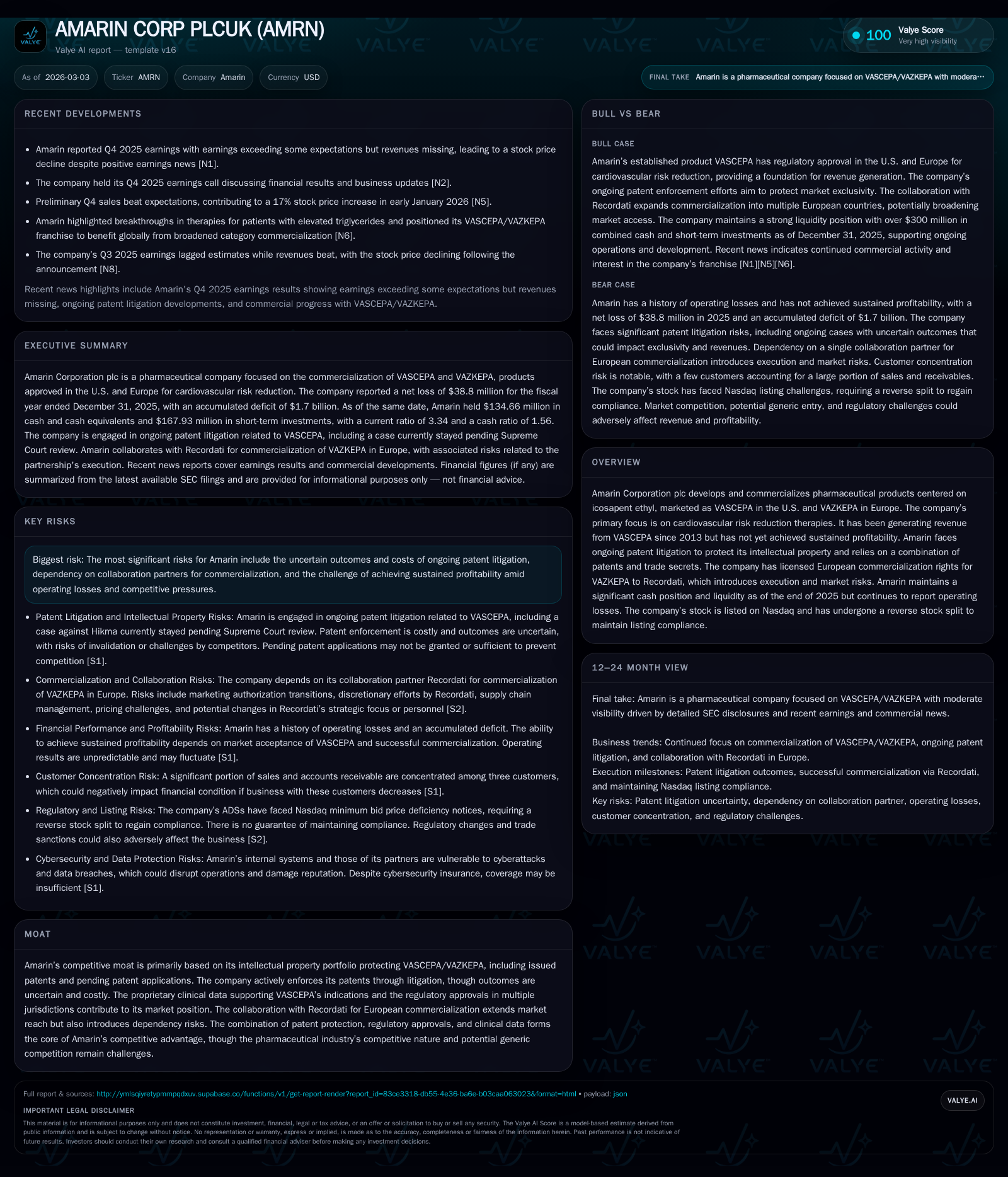
Amarin Corporation plc has steadily grown revenues from its flagship cardiovascular therapy VASCEPA since its 2013 U.S. launch. Despite this top-line progress, operating losses have continued due to high commercialization and R&D expenses. The company’s strategic defense of its intellectual property against generic entrants, particularly through ongoing litigation with Hikma and other challengers, remains central to sustaining exclusivity but introduces costly legal risks. Amarin also outsources European commercialization of VAZKEPA to Recordati, introducing execution and revenue risks tied to partner performance. Notwithstanding a robust cash position with a current ratio above 3, the absence of profitability and dependency on litigation outcomes and licensing success complicate the outlook for sustained financial turnaround.
Revenue Growth Trajectory Fueled by VASCEPA Sales Since 2013
Amarin’s primary product, VASCEPA (icosapent ethyl), launched commercially in the U.S. in early 2013 targeting cardiovascular risk reduction. Since then, revenues have exhibited a generally increasing trajectory emblematic of a pharmaceutical product transitioning from launch to growth phase within its lifecycle.
According to available data [F1], annual revenues increased from roughly $10 million in 2013 to $181 million by 2017 — an impressive expansion reflecting adoption among clinicians and patients. This aligns with typical blockbuster drug maturation patterns where initial formulary inclusions and physician prescribing behaviors accelerate revenue ramp before peaking.
However, pharmaceutical revenue growth scalability often confronts headwinds such as patent expiration or payer reimbursement shifts. The decline in year-over-year gains beyond the early surge is characteristic of products nearing maturity in competitive therapeutic categories. Amarin’s challenge is maintaining growth momentum amid intensifying competition from generics trying to replicate or supplant icosapent ethyl formulations.
Historical performance (annual)
| FY | Net ($mm) | CFO ($mm) | OpInc ($mm) | Net YoY |
|---|---|---|---|---|
| 2025 | -39 | 7 | -50 | +52.8% |
| 2024 | -82 | -31 | -92 | -39.0% |
| 2023 | -59 | 7 | -68 | +44.1% |
| 2022 | -106 | -180 | -106 |
Source: SEC companyfacts cache [F1].
Capital returns and efficiency (annual)
| FY | ROE% |
|---|---|
| 2025 | -8.4 |
| 2024 | -16.9 |
| 2023 | -10.7 |
| 2022 | -17.8 |
Source: SEC companyfacts cache [F1].
Revenue milestones show solid progression within four years post-launch [F1]. YoY values for intermediate years are omitted if data points are not continuous.
Persistent Operating Losses Amidst Commercialization Expense Pressures
Despite growing revenues, Amarin has not achieved sustained profitability. Operating income remained negative at approximately -$50 million in 2025, though this marked an improvement compared to prior years’ deeper losses (e.g., -$92 million in 2024) [F1]. This reflects ongoing high expenditures required to support commercialization — including sales force costs (notably pruned recently), marketing investments, and robust R&D spending tied to expanding clinical evidence for VASCEPA indications.
Pharmaceutical firms commonly face difficulty balancing upfront commercialization investments against unpredictable physician adoption rates and payer reimbursement variability. Amarin’s case underscores these dynamics: failure to reach scale or offset generic erosion pressures translates into extended operating deficits [S5][S19]. Their adjustment of sales infrastructure post-licensing agreement with Recordati highlights cost containment attempts amid these challenges [S9][S16].
Operating losses thus reflect necessary expenses to defend market share and enhance clinical claims but delay breakeven achievement—a frequent situation for niche therapeutic innovators lacking diversified product portfolios.
Intellectual Property Battles Defining Market Exclusivity
Central to Amarin’s moat is protecting VASCEPA’s patents, which underpin exclusive U.S. marketing rights and hence revenue sustainability. The company engages in complex patent litigation notably against Hikma Pharmaceuticals alleging induced infringement—a legal claim contending that Hikma encouraged others to infringe Amarin’s method-of-use patents for reducing cardiovascular risk via generic forms.
This multi-year litigation illustrates key procedural facets familiar in pharma patent disputes: district court dismissals overturned by the Federal Circuit panel; denial of rehearing en banc petitions; writ of certiorari granted by the Supreme Court; stays pending highest court review—all signaling protracted uncertainty [S1][S8][S14].
Such actions serve dual roles: they deter generic incumbents through threatened penalties while imposing considerable legal costs that can divert management focus [S6]. Although several patent applications related to VASCEPA’s clinical data extensions remain pending internationally, outcomes are uncertain due to evolving patent office standards and potential competitor challenges [S14][S15].
The terminology—"induced infringement," "en banc petition," "writ of certiorari"—reflects layered appeals procedures critical for upholding exclusivity beyond initial patent term lengths.
Dependence on European Licensing Partner Recordati: Opportunity and Risk
Amarin outsources European rights for VAZKEPA (equivalent formulation) commercialization via a license agreement with Recordati covering about 59 countries [S2][S9][S13]. This partner reliant model reduces Amarin’s direct market execution costs but introduces exposure to Recordati's strategic priorities.
Operational risks include:
- Pending marketing authorizations requiring local regulatory approval transfers impacting launch timing;
- Recordati’s discretionary resource allocation possibly leading to suboptimal promotion;
- Potential supply chain mismanagement affecting inventory balance;
- Pricing constraints due to regulatory environments or generic competition that could erode margins;
- Organizational changes or business combinations at Recordati influencing commercial focus;
- Intellectual property use by Recordati potentially risking licensor-IP litigation exposure.
These factors exemplify classic pharma out-licensing concerns where the licensee has latitude over commercialization variables that directly affect royalty revenues received by licensors like Amarin.
Robust Cash Position Counters Short-Term Liquidity Concerns
As of December 31, 2025, Amarin held approximately $135 million in cash and equivalents alongside current assets totaling nearly $650 million versus current liabilities around $194 million — yielding a strong current ratio of about 3.34 [F1]. This liquidity surplus suggests comfortable short-term coverage for operational needs despite ongoing losses.
Notably, despite unprofitable net income positions ($38.8 million loss in FY2025), Amarin achieved positive operating cash flow of roughly $6.7 million supported by working capital movements [F1]. Capital expenditures are minimal (sub-$0.003 million level annually), consistent with asset-light pharmaceutical commercialization that heavily outsources manufacturing.
This financial footing offers breathing room as the company navigates patent decisions and coordinates with Recordati while preserving flexibility against unforeseen contingencies such as intensified generic incursions or regulatory challenges.
What Investors Should Watch Next: Litigation Outcomes and Revenue Drivers
Looking forward, the pending Supreme Court decision on Hikma’s petition could critically reshape exclusivity parameters affecting generic competition timing [N1][N2][S3]. A ruling favoring Amarin would uphold inducement claims reinforcing barriers; an adverse verdict could open floodgates for generics eroding revenues swiftly.
Additionally, monitoring Recordati's progress securing delayed European marketing authorizations alongside rollout effectiveness will signal international revenue trajectory stability or volatility [S9][S13].
Other notable indicators include emerging FDA regulatory updates potentially broadening VASCEPA/VAZKEPA approved indications or payor reimbursement dynamics affecting prescription volumes—each pivotal for sustainable growth absent additional product launches.
Capital Allocation Strategy Reflecting Investment vs. Return Dynamics
Amarin demonstrates conservative capital deployment prioritizing operational scaling and IP defense over capital returns given persistent unprofitability. With no dividends or share repurchases reported [F1], the company focuses resources toward clinical development programs supporting patent filings and litigation preparedness alongside marketing support either directly or via partners.
Return on equity remains negative at about -8.4% based on recent annual net losses relative to equity base (~$459 million) suggesting that earnings generation remains elusive despite positive cash flows hinting at managing non-cash charges effectively [F1].
This cautious approach aligns with typical biopharma firms engaged primarily in single-product franchises requiring capital-recycling into longer-term value propositions rather than near-term shareholder distributions.
Disclaimer: This analysis uses publicly available data up to March 2026 from SEC filings and news sources without offering investment advice or recommendations. It aims solely to present an informed narrative regarding Amarin Corporation plc's financial performance and strategic positioning based on documented evidence.
Disclaimer: This is research-only, informational analysis and not investment advice. It may include AI-generated interpretation and general industry context. Always verify important details using primary sources.

Comments