
Liquidia Corp’s Growth Hinges on YUTREPIA Launch and Manufacturing Scale Amid Persistent Losses
Commercial traction of inhaled treprostinil and pipeline advancement are driving Liquidia’s evolution in pulmonary hypertension treatment.
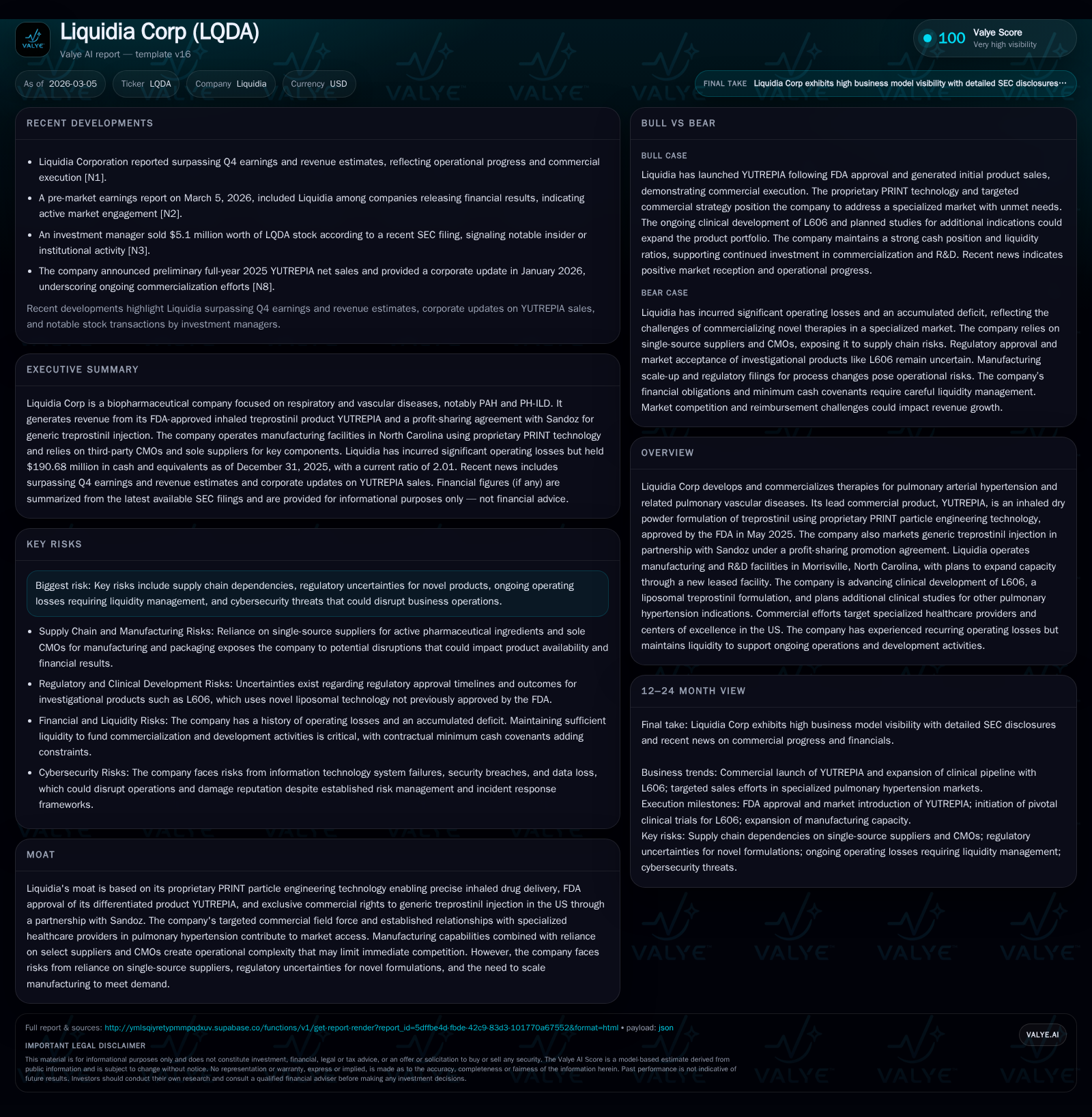
Liquidia Corp has developed a proprietary inhaled formulation of treprostinil, YUTREPIA, approved by the FDA in May 2025 and currently driving commercial revenues alongside a generic treprostinil injection marketed with Sandoz. The company’s financials show substantial operating losses but improving trends as commercialization progresses. Future growth depends on manufacturing capacity expansions, ongoing clinical development of liposomal formulations, and navigating pricing and regulatory challenges amid cost-containment pressures. Despite improved cash flow from operations, net losses persist, underscoring the importance of capital management and operational execution over the near term.
Company Background and Proprietary Technology
Liquidia Corporation operates at the intersection of drug delivery innovation and pulmonary vascular disease treatment. The company's proprietary PRINT (Particle Replication In Non-wetting Templates) particle engineering technology enables precise dry powder inhalation formulations that improve administration efficiency and patient compliance.
Its flagship product, YUTREPIA (inhaled dry powder treprostinil), received FDA approval in May 2025 after successful completion of pivotal Phase 3 studies demonstrating safety up to high doses (212 mcg QID) with favorable tolerance profiles [S1]. Parallel to this, Liquidia markets generic treprostinil injection via a profit-sharing promotion agreement with Sandoz, augmenting its commercial footprint.
Historical Financial Performance
Liquidia's financial track record reflects a biopharma transitioning from clinical-stage R&D to commercial operations. The company endured substantial operating losses during the extensive drug development phase but has demonstrated meaningful improvement coincident with YUTREPIA's market entry.
Historical performance (annual)
| FY | Net ($mm) | CFO ($mm) | OpInc ($mm) | Capex ($mm) | Net YoY |
|---|---|---|---|---|---|
| 2025 | -69 | -36 | -51 | 4 | +47.1% |
| 2024 | -130 | -93 | -121 | 5 | -66.1% |
| 2023 | -79 | -42 | -73 | 1 | -91.4% |
| 2022 | -41 | -29 | -39 | 1 |
Source: SEC companyfacts cache [F1].
Capital returns and efficiency (annual)
| FY | FCF ($mm) | ROE% |
|---|---|---|
| 2025 | -40 | -154.0 |
| 2024 | -98 | -168.7 |
| 2023 | -43 | -166.0 |
| 2022 | -29 | -45.4 |
Source: SEC companyfacts cache [F1].
Note: Operating income and net income show significant loss reduction year-over-year, while operating cash flow improved markedly between fiscal years 2024 and 2025, signaling tighter operational spending despite ongoing negative cash flows indicative of growth stage investments [F1].
Current Liquidity and Capital Structure
As of December 31, 2025, Liquidia held approximately $190.7 million in cash and equivalents against current liabilities of $135.8 million, yielding a current ratio around 2.0 — indicating reasonable short-term funding flexibility [F1].
Long-term debt remains substantial with combined current and noncurrent portions exceeding $190 million, reflecting financing arrangements supporting research & development and manufacturing scale-up initiatives [S10]. No dividends or share repurchases were reported during this period.
Capital expenditures primarily support expansion of facilities in Morrisville, North Carolina—combining research labs, office space, and manufacturing capacity to meet anticipated demand associated with YUTREPIA’s adoption [S1].
Commercialization Efforts & Market Positioning
Following its approval, Liquidia has focused commercial efforts on specialized care centers and pulmonologists experienced in pulmonary arterial hypertension (PAH), leveraging established clinical relationships critical for adoption within this rare disease segment [N1][S1].
The collaboration with Sandoz for generic treprostinil injection supplements revenue streams while mitigating competitive risks posed by alternative treprostinil formulations.
Pipeline Development & Innovation Prospects
Beyond YUTREPIA, Liquidia is advancing L606—a liposomal formulation designed to optimize treprostinil delivery potentially enhancing patient convenience or efficacy—and exploring additional indications within pulmonary hypertension [S1]. Clinical trials for L606 are ongoing; success could broaden therapeutic options across PAH subtypes.
Industry Context & Regulatory Environment
The pulmonary hypertension treatment landscape features multiple prostacyclin analogs administered via various routes including nebulized inhalation and oral therapies. Liquidia’s dry powder inhalation offers differentiation through proprietary particle engineering improving lung deposition efficiency—a competitive advantage likely to aid patient adherence.
However, evolving U.S. healthcare policies such as the Inflation Reduction Act (IRA), Medicare negotiations, and state-level pricing programs impose ongoing pricing pressures that may constrain profitability [S4][S5]. Additionally, post-marketing regulatory commitments including pediatric studies for YUTREPIA introduce further compliance risk [S20].
Risks Related to Supply Chain & Operational Scaling
Supply chain concentration risk arises from reliance on select contract manufacturers and suppliers which could disrupt product availability if not managed effectively [S1]. Scaling production capacity while maintaining stringent FDA quality standards presents operational challenges common to specialty pharmaceutical firms.
Cybersecurity risks also exist given reliance on IT systems for R&D data integrity and manufacturing controls; governance structures are in place but residual risk remains inherent [S1].
What to Watch: Milestones & Indicators
- Quarterly sales disclosures will provide insight into YUTREPIA's market acceptance trajectory.
- Clinical trial progress for L606 including enrollment metrics and safety data updates will be key pipeline indicators.
- Regulatory communications regarding post-marketing obligations may affect commercial continuity.
- Updates on manufacturing scale-up timelines will inform readiness for demand surges.
- Policy developments affecting drug pricing or reimbursement remain significant external factors influencing margins.
Summary & Outlook Considerations
Liquidia stands at an inflection point transitioning from R&D into commercialization with a recently approved proprietary inhaled therapy complemented by a generic product collaboration enhancing revenue diversification within pulmonary arterial hypertension treatments.
Historical financials reflect persistent but narrowing losses alongside improving operational cash flows indicative of maturation beyond early-stage investment phases. Liquidity levels appear adequate for near-term runway; however, disciplined capital management remains essential given ongoing investments required for R&D advancement, manufacturing expansion, and commercialization efforts.
Operational complexities related to supply chain concentration paired with evolving regulatory demands require vigilant management amidst uncertain U.S. healthcare cost containment initiatives likely to pressure pricing power over time.
Success hinges on accelerating YUTREPIA adoption within specialist networks while progressing pipeline candidates like L606 through clinical milestones without major setbacks—a challenging balance amid external economic pressures typical of orphan indication treatments requiring specialized delivery technology.
This analysis is based solely on publicly available SEC filings up to March 5th, 2026 ([F1], [S#]) combined with recent news reports ([N#]). It does not constitute investment advice or recommendations.
Disclaimer: This is research-only, informational analysis and not investment advice. It may include AI-generated interpretation and general industry context. Always verify important details using primary sources.

Comments