
Nokia’s Shifting Profitability and Growth Prospects in Connectivity Innovation
Nokia’s steep net income decline contrasts its strategic push into AI-enabled autonomous networks and broad partnership efforts.
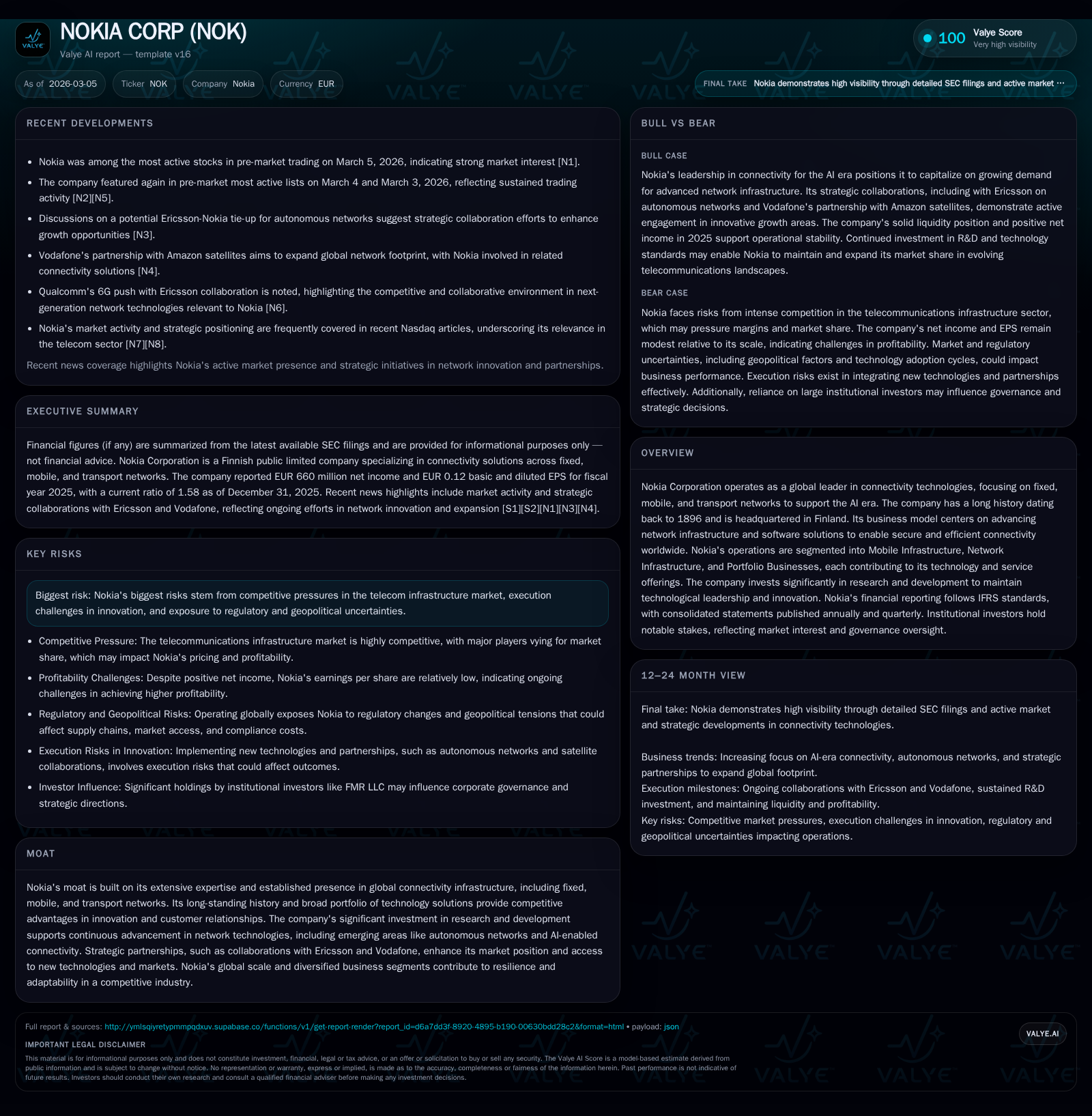
Nokia Corporation, a historic leader in connectivity technologies since 1896, reported a challenging net income drop of 48.6% in FY2025 despite maintaining robust revenue levels. The decline reflects operational pressures amid intensifying competition and evolving market demands. However, Nokia is advancing its technological footprint with significant R&D investments targeting autonomous networks and AI integration, reinforced by strategic alliances with Ericsson and Vodafone. Capital allocation remains disciplined with steady dividends but limited buybacks, underscoring a balanced approach to sustaining innovation while managing profitability headwinds.
From Growth to Contraction: Nokia’s Recent Financial Performance
Despite Nokia's long-standing pedigree as a global connectivity pioneer dating back to 1896, fiscal year 2025 highlighted notable financial strain. Net income plunged by approximately 48.6% year-on-year to €660 million, contrasting with prior years marked by volatility yet less severe contractions [F1]. This steep decline came against an essentially stable equity base around €21 billion, translating into a muted return on equity near 3.1%, underscoring downward pressure on operational profitability even as scale endures.
Total revenue figures available up through 2017 standing at €23.1 billion provide historical context; while more recent consolidated revenue data is partially extrapolated through segment recasting exercises [F1]. This ongoing income pressure invites scrutiny into underlying business drivers.
Historical Drivers Behind Nokia’s Revenue and Income Trends
Nokia has organized its operations across three principal segments: Mobile Infrastructure (comprising Core Software, Radio Networks, Technology Standards), Network Infrastructure (including Optical Networks, IP Networks, Fixed Networks), and Portfolio Businesses encapsulating various non-core units [S21].
Mobile Infrastructure generated strong net sales exceeding €11 billion in 2025 but faced margin compression due to evolving technology demands and competitive pricing pressures . Gross margins hovered near mid-40%, buffered by radio network advancements and software solutions emphasizing network slicing capabilities integral to next-generation telecom.
Network Infrastructure exhibited robust growth in optical networking (+84% increase from previous year to over €3 billion) fueled by transport layer optimizations critical for bandwidth-hungry applications [S12]. Operating margins notably improved in Q4 driven by streamlined cost structures but overall segment profitability faces headwinds from increased R&D investments.
Portfolio Businesses continued to operate at a loss with negative operating margins near -10%, reflecting restructuring efforts and transitional assets which management is assessing for monetization or divestment opportunities [S11][S13].
Innovating Connectivity: Focus on Autonomous Networks and AI Integration
In a strategic pivot capturing industry momentum around automation, Nokia is advancing "autonomous networks" enabled by AI-powered closed-loop network automation systems designed to optimize real-time network performance without human intervention [N5][S1].
This evolution signifies a transformational shift from traditional infrastructure toward networks that self-configure, predict faults, and dynamically allocate resources—a cornerstone for supporting AI-era connectivity demands.
Robust R&D expenditure totaling nearly €5 billion across Mobile and Network Infrastructure segments underscores Nokia’s commitment to developing proprietary algorithms and software platforms that integrate machine learning at the core of network management frameworks [S9][S11][S12].
Collaborations Enhancing Market Reach: Ericsson, Vodafone, and Beyond
Industry partnerships are pivotal for scaling innovation at pace. Nokia's collaborative initiatives with Ericsson emphasize joint development efforts in autonomous network architectures aiming to accelerate commercial deployments globally while sharing intellectual property benefits [N5]. Such alliances bolster Nokia’s competitive positioning against rivals aggressively pursuing similar technology domains.
Concurrently, Nokia benefits from Vodafone's strategic tie-up with Amazon satellites facilitating enhanced global connectivity reach particularly in underserved regions through satellite-ground network integration technology [N6]. This ecosystem partnership expands Nokia’s addressable markets beyond terrestrial infrastructure setups.
Together these connectivity ecosystem partnerships enable Nokia to leverage multi-dimensional technology stacks combining terrestrial networks with satellite components—a critical advantage amid increasing demand for ubiquitous AI-ready connectivity.
Weighing Near-Term Challenges: Competition, Regulation, and Execution Risks
While innovation sets the trajectory forward, Nokia confronts manifold risks detailed in its latest regulatory filings emphasizing telecom infrastructure market saturation especially in mature geographies . Competitive intensity from entrenched rivals exerts pricing pressure destabilizing margin recovery efforts.
Supply chain disruptions linked to geopolitical tensions exacerbate procurement complexity for key components such as semiconductors essential for high-frequency radio products crucial in the ongoing transition to 6G standards [S7]. Regulatory frameworks tighten scrutiny over data security features embedded within network infrastructure software complicating compliance adherence costs.
Moreover, execution risks arise from the intrinsic complexity of rolling out autonomous platforms at scale demanding rigorous cross-functional coordination across engineering, sales channels, and service operations.
Capital Deployment: Dividends and R&D Investments
Reflective of Nokia's cautious capital management amidst profit headwinds is its dividend policy which rose moderately to roughly €759 million paid out in FY2025 from €723 million prior year—signaling shareholder return stability amid earnings contraction [F1][S14][S22]. No concrete share buyback programs were deployed recently; however authorized repurchase mandates totaling approximately 10% of outstanding shares remain available if strategic conditions warrant deployment .
Investment focus concentrates on sustaining technology leadership via elevated R&D commitments exceeding €2.9 billion within Mobile Infrastructure alone alongside proportional expenditure across Network Infrastructure units supporting optical and IP evolution pathways [S9][S11][S12]. Incremental operating leverage gains are pursued through digitalization of internal processes reducing selling/general administrative costs despite sheer scale expansion challenges.
What Investors Should Watch: Upcoming Milestones and Market Signals
Looking ahead through an analytical lens, several milestones could serve as pivotal inflection points for Nokia’s growth trajectory. Key among these are expected launches of fully autonomous operating platforms integrating closed-loop intelligence into commercial network deployments slated throughout 2026 as per disclosed roadmap insights [N13][N5].
Additionally, announcements of major contracts or expansions linked to global carriers adopting next-generation AI-native infrastructure solutions will help signal commercial traction beyond pilot phases.
Market responses to these developments will be critical barometers measuring whether Nokia can reverse profitability erosion while capturing new demand drivers associated with advanced network slicing capabilities catering to enterprise verticals.
Outlook Analysis: Forecasting Nokia’s Ability to Rebound and Lead
Balancing historical financial trends against the scope of ongoing innovation investments yields a complex outlook marked by cautious optimism tempered with execution uncertainty. Although near-term earnings recovery faces constraints—from sustained competitive pricing pressures to geopolitical/regulatory cloudiness—the company’s technological breadth anchored by AI-enabled autonomous networks positions it well for medium-term leadership if commercial adoption scales effectively.
Return on invested capital remains subdued around low single digits reflecting maturity stage challenges; however management’s ability to extract operating leverage from expanding software-driven service layers alongside hardware innovations will be decisive metrics going forward.
Ultimately, retaining presence at the forefront of connectivity innovation amidst accelerating sector disruption requires vigilant operational discipline coupled with nimble strategic alliances—a balancing act currently defining Nokia’s corporate journey.
Historical performance (annual)
| FY | Net ($bn) | Net YoY |
|---|---|---|
| 2025 | 0.7 | -48.6% |
| 2024 | 1.3 | +89.1% |
| 2023 | 0.7 | -84.1% |
| 2022 | 4.3 |
Source: SEC companyfacts cache [F1].
Capital returns and efficiency (annual)
| FY | Div ($mm) | ROE% |
|---|---|---|
| 2025 | 759 | 3.1 |
| 2024 | 723 | 6.2 |
| 2023 | 621 | 3.3 |
| 2022 | 354 | 19.9 |
Source: SEC companyfacts cache [F1].
Note: Revenue last reported at group level from official filing is dated FY2017; segment revenue recasts suggest trends but not total resets post-2017 [F1][S21]. ROE calculated as net income divided by equity per year-end figures.
This analysis synthesizes current public disclosures including annual reports filed under IFRS accounting standards without providing investment recommendations or forward-looking guidance beyond documented company statements or established facts. Readers should consider broader market variables when evaluating Nokia's future prospects.
Disclaimer: This is research-only, informational analysis and not investment advice. It may include AI-generated interpretation and general industry context. Always verify important details using primary sources.

Comments