
American Superconductor Advances with Robust Q4 Performance and Strategic Acquisitions
AMSC's recent quarterly results combined with its expanded manufacturing capabilities through acquisitions underpin its strengthening role in power control solutions.
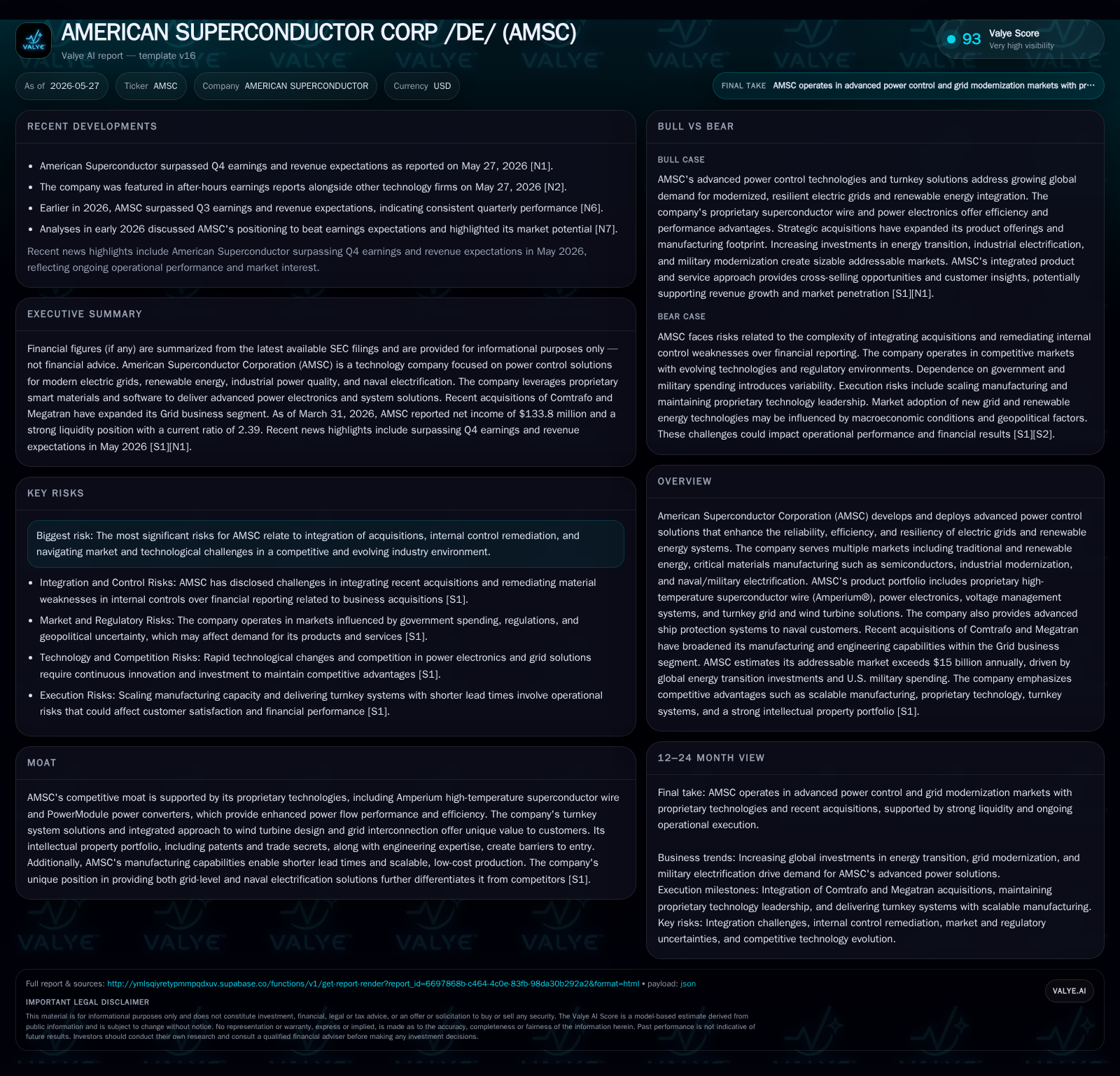
American Superconductor Corporation delivered a strong fiscal 2026 fourth quarter highlighted by significant non-GAAP net income gains driven by operational improvements and a substantial tax benefit. The integration of recent acquisitions, Comtrafo and Megatran, has notably expanded its manufacturing footprint, reinforcing AMSC’s position in advanced power electronics for grid and renewable energy systems. The company’s proprietary technologies and turnkey system capabilities provide competitive differentiation in an evolving energy landscape. Key risks include acquisition integration complexities and external macroeconomic uncertainties influencing capital costs and supply chains.
Recent Quarterly Update: Gains Reflect Operational Execution and Acquisition Integration
On May 27, 2026, American Superconductor Corporation (AMSC) reported robust financial results for its fiscal fourth quarter and full year ending March 31, 2026 [S3]. Non-GAAP net income surged to $158.1 million for the fiscal year compared to $24.0 million in the prior year, predominantly due to a substantial non-cash tax benefit from the release of valuation allowances against deferred income tax assets coupled with improved operating margins in both the Wind and Grid segments [S8]. Operating income stood at approximately $11.4 million in the latest quarter reflecting operational execution gains.
This performance is closely tied to strategic acquisitions made within the fiscal year—most notably Comtrafo (December 2025) and Megatran (August 2024)—which have expanded AMSC’s manufacturing capacity and enhanced its engineering capabilities within the Grid segment [S5][S16]. These acquisitions provide tangible scale benefits by enabling increased production of large power transformers essential to utility customers and industrial clients worldwide [S18][S25]. Furthermore, AMSC completed an equity raise during June 2025 that fortified liquidity with net proceeds near $125 million [S18], further supporting acquisition financing.
Market reaction reflected positively on these developments with news outlets noting AMSC’s beats on earnings and revenue estimates at quarter-end [N1][N2], highlighting momentum amid a complex energy transition environment.
Business Model Overview: Proprietary Technologies Driving Vertical Integration
AMSC’s business model pivots on developing proprietary power control technologies centered on enhancing electric grid reliability while enabling renewable integration [S1][S6]. Revenue streams arise from:
- Sales of hardware components such as Amperium® high-temperature superconductor wire and PowerModule™ power converters.
- Licensing fees from wind turbine electrical system designs.
- Turnkey system sales that integrate software control platforms with hardware tailored for grid operators, wind turbine manufacturers, industrial power users, and naval electrification applications.
The company segments operations into Grid (84% of revenues) and Wind (16% of revenues) markets. The Grid segment encompasses products ranging from dynamic VAR compensators to ship protection systems for naval clients—the latter indicating niche defense-related diversification. The Wind segment focuses on supplying electrical control systems alongside wind turbine design licenses with integrated customer support services aimed at accelerating product deployment at scale [S6][S17][S20].
Customer relationships span multiple geographies including U.S., South America, Asia-Pacific, and Europe. Clients include utilities like SSE plc and governmental navy contracts exemplifying diverse sector exposure [S21][S23].
Product Portfolio and Competitive Moat: From Amperium Wire to Turnkey Systems
AMSC holds a differentiated position rooted in its proprietary "smart materials" (high-temperature superconductor wire) combined with advanced software-driven power electronics [S1]. The patented Amperium® wire allows superior power transmission capacity paired with reduced losses—a technical advantage over standard conductors. In parallel, PowerModule™ converters enhance grid stability through precise voltage regulation.
Turnkey offerings further reinforce this moat by providing end-to-end solutions encompassing design engineering, installation, commissioning, and ongoing service [S1][S6]. This vertically integrated approach creates switching costs for customers reliant on AMSC's holistic solutions rather than piecemeal product purchases.
Recent acquisitions bolster manufacturing lead-time advantages by bringing in-house key transformer production capabilities previously contracted out—thereby shortening delivery times for large-scale customers [S5][S13]. This capability adds cost competitiveness against established players like ABB or Siemens who traditionally focus on broader industrial automation rather than superconducting grid components.
Strategically protected through patents, trade secrets, confidentiality agreements along with licensed IP rights globally, this synthesis of technology plus engineering know-how forms a robust barrier to entry controlling competitive dynamics in power electronics niche sectors [S24].
Industry Environment: Competitive Dynamics and Regulatory Considerations
The power electronics market underlying grid modernization is persistently competitive featuring multi-national conglomerates such as ABB, Hitachi Energy, Mitsubishi Electric, Siemens Energy among others [S4]. However, AMSC occupies unique subsegments focusing on megawatt-scale superconducting cables alongside highly integrated wind turbine electrical control systems—areas where few competitors combine breadth simultaneously.
The company's reliance on specialized raw materials including nickel, silver, yttrium (for superconductors), copper alloys as well as electronic components frames supply chain sensitivity risks accentuated by ongoing geopolitical tensions affecting tariffs especially on stainless steel inputs [S4]. Regional sales offices spanning critical markets help mitigate distribution risks given proximity to end users supports localized technical consultation necessary for high-complexity solutions.
From a regulatory angle, growing mandates for grid resiliency upgrades driven by climate adaptation policies continue to spur demand for novel technologies whereas defense contracts add steadiness amid commercial cyclicality [S1][S21].
Growth Drivers: Market Expansion, Technology Leverage, and Addressable Markets
AMSC estimates its addressable market exceeds $15 billion globally per annum predominantly propelled by:
- Accelerated penetration of renewable energy sources requiring advanced grid interconnection solutions capable of managing variable generation profiles.
- Increasing investment in grid infrastructure modernization emphasizing fault ride-through capability, reactive power compensation via power electronics.
- Geographic expansion aided by strategic office placements supporting emerging energy markets including Brazil following Comtrafo acquisition [S1][S4][S18]
Wind segment growth is supported by design licensing feeding into manufacturers new to or expanding presence in wind turbine production facilitated through low R&D cost access via AMSC’s designs coupled with comprehensive support packages [S20]
Key performance indicators to watch comprise megawatt capacity deployed through wind turbine ECS orders, order backlog expansion within the Grid segment backed by utility project wins as well as successful conversion rates for multi-year license contracts driving recurring revenues.
Risks and Potential Constraints: Integration Challenges and Market Volatility
Significant risks stem from integrating recently acquired entities—Comtrafo being the more recent—which entails harmonizing disparate operational processes while addressing material weaknesses flagged within internal controls over financial reporting on acquisitions [S1][S24].
Additionally tariffs or trade restrictions may inflate raw material costs or cause sourcing fluctuations.
Competitive pressures within power electronics necessitate continuous innovation along with IP vigilance where patent disputes or required licensing could arise given some overlap among leading players in technology domains related to energy transmission optimization [S24]. Customer concentration risk is somewhat mitigated but remains relevant as several key accounts represent meaningful portions of receivables at fiscal year-end [S23].
Supply chain dependencies on single/multiple suppliers for critical inputs could introduce vulnerability particularly under global logistical disruptions; however AMSC maintains alternative sourcing relationships where feasible reducing acute exposure [S4]. Switching costs help retain clients but also mean delayed decision cycles which can hamper short-term revenue ramp-up.
What to Monitor Next: Earnings Guidance, Acquisition Synergies, and Market Signals
Investors should closely watch management’s updates regarding fiscal 2027 earnings guidance potentially reflecting ongoing integration impacts or growth acceleration from scaling new manufacturing lines at Comtrafo/Megatran sites post-Q4 release [N1][S3]
Progress against synergy targets including streamlined procurement costs or margin improvements derived from verticalized production will be telling measures of acquisition success.
Momentum in deploying electrical control systems within offshore/onshore wind projects will indicate tangible uptake amid expanding renewables infrastructure globally. Correspondingly regulatory developments promoting green energy or resilient grids across core geographies may serve as demand catalysts.
KPIs such as EBITDA margin trends correlating with operating leverage gain or reduction in contingent consideration liabilities will further illuminate margin trajectory ahead. Monitoring backlog levels also provides early signals around sustained order flow strength within Grid business contracts.
Financial Health Snapshot: Strong Liquidity Underpinning Strategic Flexibility
As of March 31, 2026, AMSC held approximately $140.7 million in cash and equivalents supported by strong working capital metrics including a current ratio around 2.39—indicating robust short-term liquidity supportive of operational needs without reliance on immediate external funding [F1][S5][S8]
Operating cash flow generation was $23.1 million for fiscal 2026 lending support to ongoing R&D investments (~$15.7 million annually) aimed at sustaining product innovation while SG&A increases reflect headcount additions primarily related to acquisition integration cost absorption [S11][S26]. Equity offerings executed recently have replenished capital allowing continued pursuit of strategic growth initiatives without jeopardizing financial flexibility [S18].
This liquidity profile is critical given acquisition-related earnout potential payments forecasted contingent upon achievement of specified EBITDA thresholds with Comtrafo stockholders over coming periods enhancing alignment yet imposing financial planning considerations [S5][S25]
Disclaimer: This analysis is based solely on available SEC filings dated through May 27, 2026 ([F1], ) and corroborating news sources (). It seeks to elucidate operational developments within American Superconductor Corporation without providing investment advice or research views.
Disclaimer: This is research-only, informational analysis and not investment advice. It may include AI-generated interpretation and general industry context. Always verify important details using primary sources.

Comments