
American Picture House’s Strategic Shift in Independent Film Financing and IP Control
Latest quarterly disclosures highlight APHP’s liquidity challenges amid progress in disciplined underwriting and content ownership strategies.
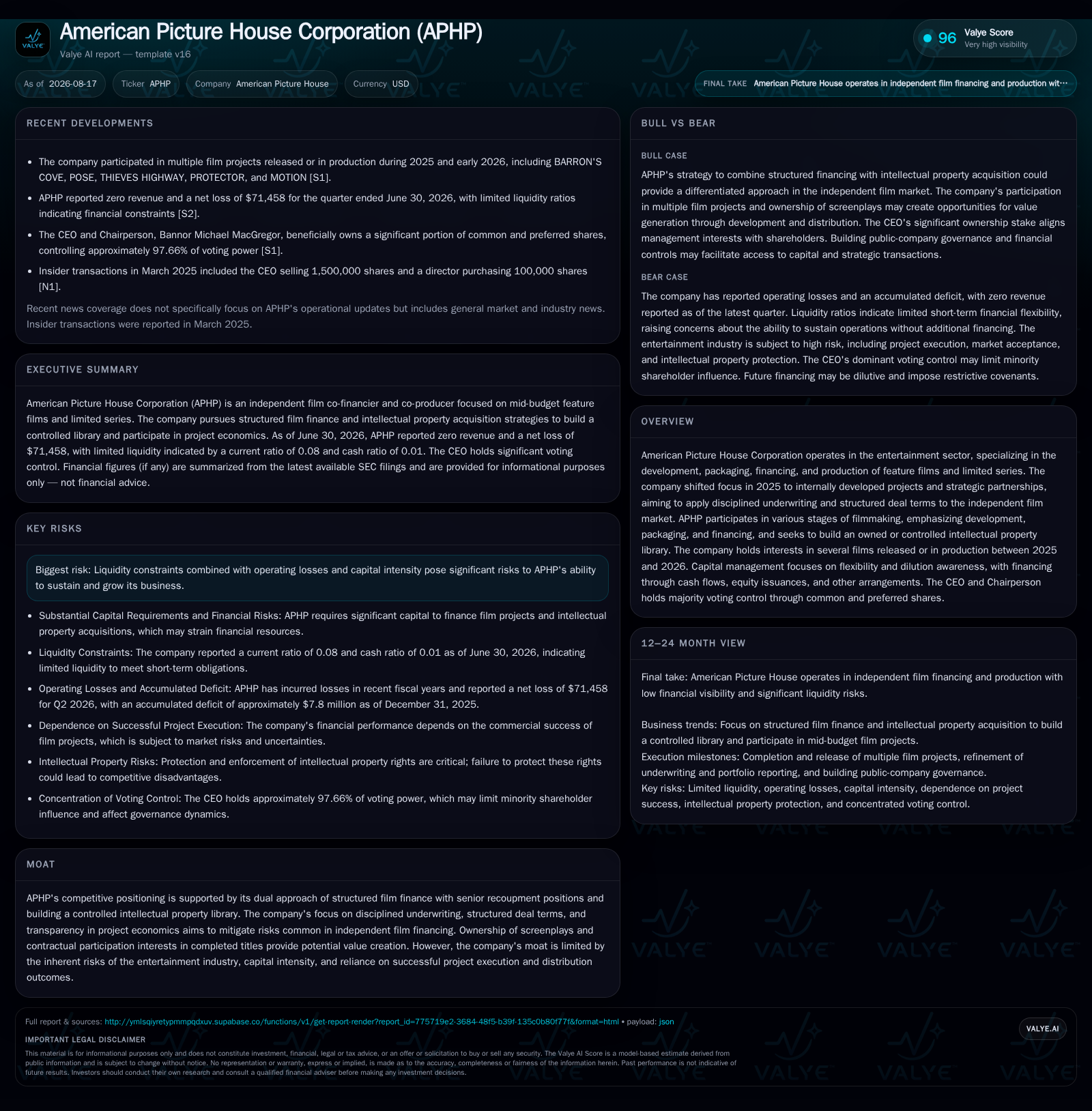
American Picture House Corporation continues to execute a strategic pivot towards internally developed film projects combined with structured financing arrangements to mitigate inherent risks in independent film production. Its recent 10-Q filing exposes acute liquidity pressures, underscoring the capital-intensive nature of the business and the need for stringent capital management. The company aims to build value through ownership and control of intellectual property, enhancing long-term revenue potential beyond traditional financing fees. However, operating losses, negative working capital, and reliance on successful project execution remain key risks affecting APHP’s near-term resilience.
The reported current ratio stands at an acutely low 0.08 as of June 30, 2026, signifying that current liabilities of approximately $1.65 million vastly overshadow current assets of roughly $128 thousand [S2], [F1]. Cash and equivalents remain tight at just over $22 thousand as of March 31, 2026 [F1]. This pronounced shortfall highlights extreme working capital strain within APHP’s operating environment where timely access to financial resources underpins project funding continuity.
Such liquidity constraints are typical in independent mid-budget film production companies which face significant upfront capital outlays well before monetization via licensing or distribution revenues materialize. Sustaining operations under these conditions demands rigorous capital discipline alongside flexible financing solutions including equity issuances or structured credit facilities [S1]. Failure to alleviate working capital pressure could force postponements or cancellations within APHP’s production slate, as well as imperil contract enforcement around intellectual property rights—both vital pillars underpinning long-term value creation.
Internal Content Development: Building a Controlled Intellectual Property Library
APHP has repositioned its core business model since 2025 by prioritizing internally developed projects over external acquisitions. This strategic shift targets enhanced margin capture through ownership or controlled access to proprietary intellectual property (IP), encompassing screenplays and related rights instrumental in downstream licensing opportunities [S1]. By fostering projects from conception through packaging and financing phases internally, APHP seeks to retain greater economic interest rather than solely fee-based income common among pure financiers.
This emphasis on building an owned or tightly-controlled IP library aligns with industry norms where companies aim to generate recurring revenue streams beyond initial production investments. Ownership facilitates multiple monetization channels—from pre-sales to distribution fees—mitigating revenue volatility associated with individual title performance. The intellectual property library size thus serves as a key KPI reflecting potential for future licensing income and constitutes an emerging moat element amid intense sector competition.
Disciplined Underwriting: Structured Deal Terms as Risk Mitigation Pillars
Independent film production invariably carries high risk due to unpredictable commercial outcomes, but APHP addresses this through stringent underwriting practices embedded into its deal structuring [S1]. The company emphasizes securing senior recoupment positions in project financings—priority claims on revenue streams that reduce investor downside exposure compared to subordinated equity stakes prevalent in many independent deals
Structured deal terms typically incorporate layers such as production incentives eligibility verification, completion guarantees from third parties where possible, and careful cost containment plans embedded within budgeting processes. These serve as risk buffers against common pitfalls like budget overruns or project delays, which can severely impact cash flows and returns due to long cash conversion cycles inherent in entertainment production.
This approach parallels peer companies balancing internal development with partnership investments designed to spread risk while maintaining control over critical financial variables. Seniority in recoupment hierarchy remains a crucial metric signaling relative security of invested capital.
Operating Indicators: Production Slate Composition and Budget Controls
Effective pipeline management is central to sustained operational viability for APHP. Key operating KPIs include the number of active projects under development and adherence to designated production budgets which inherently govern cash requirements over time horizons stretching months or years [S1]
While the company does not disclose exhaustive project counts or budgets explicitly by title, it acknowledges that mid-budget features predominate its slate—requiring disciplined scheduling and cost efficiency often enhanced by deploying productions in tax-incentive qualifying jurisdictions. Project completion rates critically affect revenue recognition timing via licensing agreements; any slippage can exacerbate liquidity stresses.
Budget overruns remain a perennial threat typical across peers; mitigating this requires robust producer oversight coupled with pre-arranged contingency funding where feasible. The extent of such contingency planning would further inform confidence in APHP’s projected cash flow stability.
Peer Benchmarking: APHP’s Position Among Independent Film Financiers
Within the broader landscape, American Picture House operates alongside independent producers who juggle comparable challenges of capital intensity and market unpredictability. Common strategies among peers include combining internal content creation with co-productions or distribution partnerships that diversify financing sources.
Additionally, industry players extensively leverage tax incentives offered by various jurisdictions to reduce net production costs—an acknowledged practice in APHP’s approach [S1]. Building proprietary IP libraries also features prominently across competitors seeking durable revenue bases from licensing royalties rather than one-time production fees.
However, scale differences impose distinct valuation risk premiums; smaller firms like APHP must demonstrate exceptional underwriting rigor and operational efficiency to compensate for their limited access to large-scale financing compared to established studios or diversified content conglomerates.
Growth Catalysts: Streaming Demand, Strategic Partnerships, and Tax Incentives
A meaningful tailwind for APHP is the continued expansion of streaming platforms globally driving sustained demand for original feature films and limited series content. This elevates opportunities for pre-sales placements, licensing arrangements, and co-production partnerships which can accelerate monetization while mitigating upfront risk exposure.
Further growth catalysts stem from geographic diversification of shooting locations optimized for tax credits and grants—practices embedded within APHP’s budgeting discipline—to enhance project economics without compromising creative quality [S1]. Additionally, strategic alliances formed during packaging stages may unlock supplemental financing pools or facilitate wider distribution channels.
Execution against these growth vectors will influence both top-line scalability of APHP’s slate and its capacity to improve margins through economies of scale.
Risks Ahead: Capital Intensity, Operating Losses, and Market Uncertainty
Persistent operating losses characterize APHP’s recent appearances with cumulative deficits approximating $7.8 million at year-end 2025—a signal of cash burn amidst early-stage growth efforts [S1], [F1]. The company's profitability remains uncertain given variable audience reception volatile market preferences impacting licensing success.
Capital intensity inherent in motion picture production necessitates continual infusions of external funding or equity dilution events that may erode existing shareholder value if not managed prudently. Budget overruns represent black swan risks capable of severely disrupting planned recoupment schedules.
Legal contingencies related to contractual disputes over consulting agreements introduce additional uncertainties but currently no probable loss has been identified that would materially alter financial condition [S1]
Near-Term Monitors: Upcoming Project Releases, Financing Milestones, and Distribution Deals
Stakeholders should watch for forthcoming project completions triggering license fee flows that contribute tangible revenue recognition points delineating progress from development costs incurred. Concurrently securing distribution agreements will enhance revenue visibility essential for improved forecasting accuracy.
On the financial front, successful execution of equity raises or credit facility extensions is critical given working capital constraints outlined above. Any delayed or failed capital infusions could disproportionately impact ongoing operations across APHP’s investment cycle.
Tracking contract wins or expansions with streaming platforms will further signal acceptance of internally developed content—a strong proxy for commercial validation going forward.
Financial Profile Discussion: Critical Liquidity Ratios Meet Capital Needs
APHP's financial snapshot as of mid-2026 paints a picture of urgent working capital imbalance; current liabilities outstrip current assets by more than tenfold resulting in a dangerously low current ratio (0.08) [S2], [F1]. While total cash balances remain nominal at roughly $22 thousand earlier in Q1 '26 [F1], near-term obligations surpass $1.6 million within six months—portraying acute short-term survival pressures absent fresh capital injections.
This divergence reflects the classic operating model mismatch faced by many small independent film companies managing protracted cash conversion cycles due to upfront-heavy spending on development, packaging, talent acquisition, filming expenses followed by lengthy distribution negotiations before revenue receipt.
Mitigating this stress requires judicious management decisions balancing asset monetization timelines with cost deferral initiatives while exploring structured fundraising alternatives designed not to induce excessive dilution diluting core voting control maintained predominantly by the CEO/Chairperson through preferred share holdings [S1].
Overall liquidity fragility reinforces that while strategic execution around IP ownership and underwriting principles fosters durability theoretically; practical sustainability depends closely on maintaining sufficient runway through periodic financing milestones amidst ongoing operating losses.
This analysis is grounded strictly in documented SEC disclosures without conjecture beyond supported evidence. It aims to illuminate American Picture House Corporation's business model dynamics within its industry context as of mid-2026.
Disclaimer: This is research-only, informational analysis and not investment advice. It may include AI-generated interpretation and general industry context. Always verify important details using primary sources.

Comments