
AST SpaceMobile Accelerates Satellite Deployment Amid Steep Cash Burn and Expanding Debt
AST SpaceMobile’s evolving satellite constellation and strategic partnerships mark notable technological progress but weigh heavily on financials.
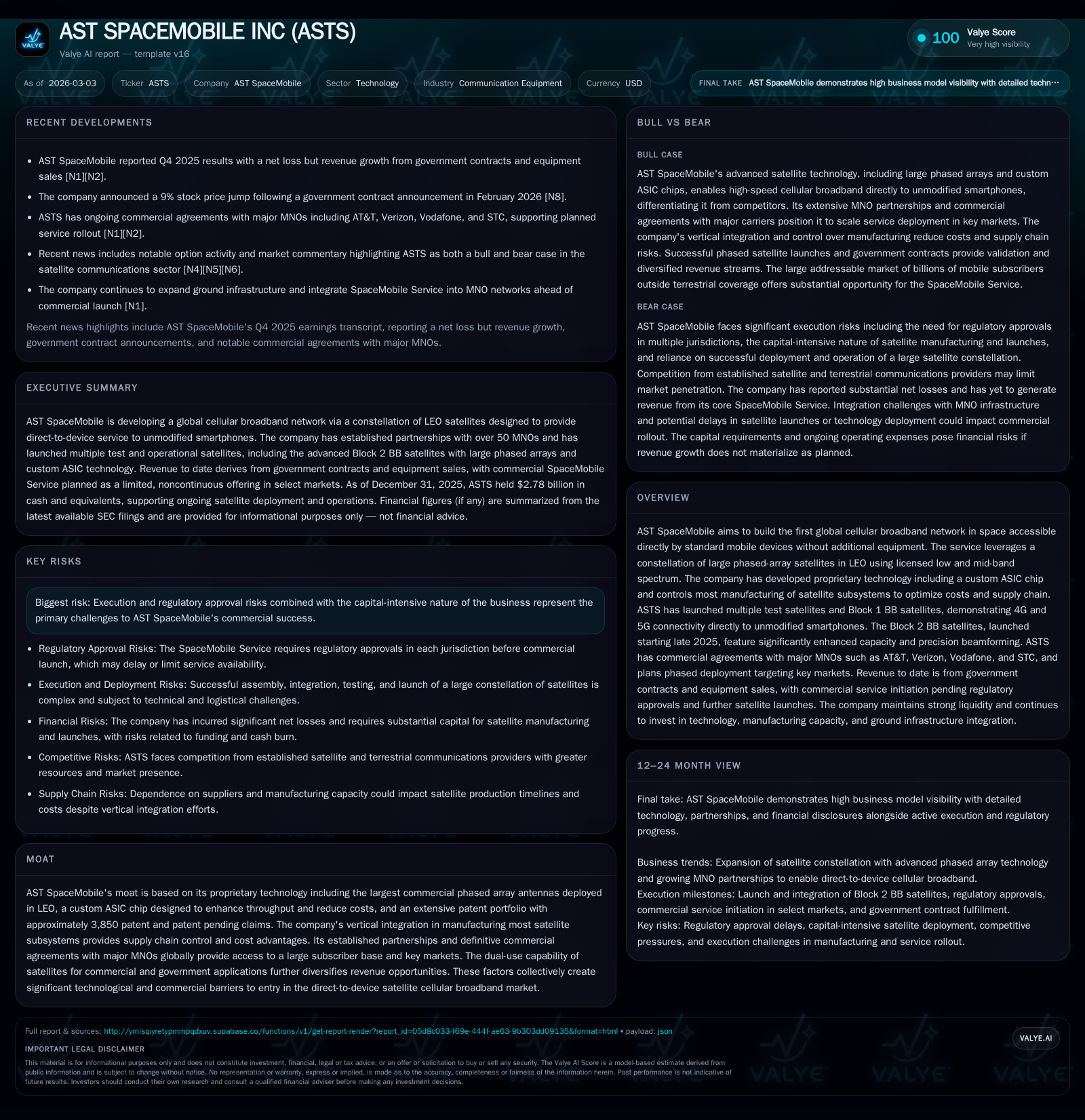
AST SpaceMobile Inc. (ASTS) is advancing its vision of a global cellular broadband network delivered directly from LEO satellites to unmodified smartphones, leveraging proprietary phased array technology and extensive spectrum rights secured through key acquisitions. The company’s recent launches of Block 1 and Block 2 BlueBird satellites demonstrate increasing capacity and commercial validation via partnerships with major mobile network operators (MNOs). However, the capital-intensive nature of satellite manufacturing and launches, alongside ongoing operating losses and negative free cash flow exceeding $1 billion in 2025, underscore significant execution and financial risks. ASTS remains well-capitalized following a sizable convertible debt raise in early 2026, which supports planned satellite constellation expansion targeting continuous coverage over key global markets.
Company Overview and Technological Moat
AST SpaceMobile is pioneering a direct-to-device (D2D) cellular broadband network delivered from Low Earth Orbit (LEO), targeting seamless mobile connectivity where terrestrial networks do not reach. Their approach replaces traditional satellite phones or terminals by enabling any standard mobile device to communicate straight with their large phased-array satellites utilizing licensed low and mid-band spectrum.
Owning seminal patents (~3,850 claims) related to LEO phased arrays and custom ASIC technology enables ASTS to maintain a significant technological moat. Their vertical integration spans major satellite subsystem manufacturing processes, optimizing supply chain management for cost control—a critical advantage given industry-wide production complexities.
The company’s controlled access to mid-band spectrum enhances service quality potential. Key purchases include Ligado Networks’ spectrum usage rights for up to 45 MHz in North America after bankruptcy court approval and acquisition of ITU-priority S-Band frequencies for global mid-band allocations. These holdings underpin planned phased deployment across strategically important regions such as the U.S., Europe, Japan, Canada, and parts of Asia.
Historical Performance Drivers
ASTS’s revenue model centers on business-to-business partnerships with Mobile Network Operators (MNOs) rather than direct consumer subscriptions, relying on revenue-sharing agreements that leverage the incumbent MNO customer base.
Although full commercial service commenced recently, historical revenues have largely stemmed from government contracts supporting early-stage network validation.
Key milestones supporting growth until FY2025 included:
- Launching multiple demonstration satellites proving direct-to-smartphone connectivity using legacy cellular standards.
- Initiating production and deployment of the Block 1 BlueBird (BB) satellites to expand coverage capacity.
- Commencing late-2025 deployments of more advanced Block 2 BB satellites featuring higher throughput via precision beamforming enhancements.[S15][N1]
Historical performance (annual)
| FY | Net ($mm) | CFO ($mm) | Capex ($mm) | Net YoY |
|---|---|---|---|---|
| 2025 | -342 | -72 | 1065 | -13.9% |
| 2024 | -300 | -126 | 174 | -242.7% |
| 2023 | -88 | -149 | 119 | -176.7% |
| 2022 | -32 | -156 | 30 |
Source: SEC companyfacts cache [F1].
Capital returns and efficiency (annual)
| FY | FCF ($mm) |
|---|---|
| 2025 | -1136 |
| 2024 | -300 |
| 2023 | -268 |
| 2022 | -187 |
Source: SEC companyfacts cache [F1].
Historical revenue figures are limited; reported revenues derive predominantly from government contracts per filings.
The steep increase in capital expenditures during FY2025 corresponds with accelerated satellite manufacturing scale-up and advance spectrum payments—most notably a $420 million advance to Ligado Networks tied to mid-band usage rights.[F1][S25]
Future Growth Drivers
The prospect for AST SpaceMobile hinges critically on several factors:
- Satellite Constellation Expansion: AST plans a full constellation exceeding 90 Block 2 BB satellites for comprehensive geographic coverage enabling near-continuous SpaceMobile service access across target markets.[S15]
- Regulatory Approvals: Completion of pending regulatory authorizations including FCC approvals related to Ligado spectrum usage remains essential for commercial rollout scaling.[S2]
- MNO Partnerships: Expanding existing partnerships with major carriers—AT&T, Verizon, Vodafone—and onboarding additional operators will drive subscriber reach into billions without requiring new hardware per user.
- Technological Developments: Continued improvements in satellite design lower per-unit costs from approximately $21–$23 million average expected for Block 2 satellites through supply diversification and economies of scale while enhancing spectral efficiency through advanced beamforming.[S13]
However, constraints loom prominently:
- Capital Intensity: Each incremental satellite demands tens of millions in upfront capital plus launch costs; missteps or supply chain disruptions could elevate unit economics adversely.[S13][N14]
- Competitive Landscape: Though a pioneer, potential future entrants or alternative LEO systems might pressure pricing or market share if commercialization timelines slip.[N9]
- Execution Risks: Satellite assembly/testing delays or failed launches impact coverage continuity negatively disrupting service reliability promises.
Financial Expectations & Milestones
No explicit full-year FY2026 guidance was provided publicly at filing date; however the release highlighted key upcoming milestones:
- Increasing deployment cadence of Block 2 BB satellites starting late CY2025 with target coverage expansion into H1/H2 CY2026.[N1]
- Expected ramp-up in recurring commercial contract revenues as MNO partners integrate SpaceMobile services deeper into offerings.
- Monitoring capital cost trends associated with incremental constellation addition which will strain cash flows absent material revenue gains.[S13]
Analysts should watch closely:
- Quarterly updates on regulatory progress concerning mid-band frequency usage rights.
- Progression of active satellite counts vs stated deployment targets against macroeconomic cost pressures.
- Commercial onboarding timelines announced by partner MNOs reflecting distribution scale-up.
Capital Allocation & Returns Profile
AST SpaceMobile continues operating at scale-inhibiting operating losses while investing heavily in growth infrastructure:
- Net losses recorded at $342 million in FY2025 (-14% YoY worsening), reflective of R&D intensive phase efforts prior to widespread revenue generation.[F1]
- Operating cash flow improved modestly compared to prior years but remains deeply negative at -$71 million amid intensifying capex.[F1]
- Capex exploded by over six-fold YoY reaching $1.06 billion driven by satellite acquisition/launch payments plus spectrum intangibles purchase commitments,[F1][S25] implying heavy reinvestment cycle.
On the balance sheet front:
- Cash & cash equivalents surged dramatically to approximately $2.34 billion end-FY2025 following several equity offerings and convertible debt issuances executed primarily through an at-the-market program.[F1][S11]
- In February-March 2026 alone ASTS raised net proceeds exceeding $1 billion via issuance of senior unsecured convertible notes bearing a fixed coupon of just over 2%, maturing in 2036.[S1]
- Long-term debt ballooned from under $170 million at end-FY2024 to over $2.26 billion at end-FY2025 incorporating convertible notes servicing these funding rounds plus equipment loans secured by property/equipment assets.[F1]
No dividends or buybacks were reported; all capital surpluses are reinvested into satellite constellation growth initiatives given the pre-commercial stage of operations.[S13]
ROE remains deeply negative primarily due to accumulated net losses relative to nominal equity levels; estimate based on FY2025 figures indicates a negative ROE exceeding -6800% emphasizing developmental phase capital structure characteristics rather than return generation.[F1]
Risks Summary
Principal risks encompass:
- Regulatory approval delays or failures particularly concerning spectrum use constrain service launch timelines critically impacting revenue realization.
- The highly capital-intensive nature exposes ASTS to funding market conditions impacting ability to sustain accelerated capex cycles without dilutive financing.
- Execution risks include susceptibility to launch failures or production bottlenecks undermining constellation completeness affecting overall network service quality.
- Pricing power uncertainty given emerging competition from traditional terrestrial infrastructure expansions or alternative space-based providers raising competitive dynamics complexity.
Conclusion & Outlook Considerations
AST SpaceMobile has transitioned meaningfully from concept validation into partial constellation deployment with tangible technological breakthroughs demonstrated via first generation Block 1 BB satellites and follow-on higher-capacity Block 2 launches initiated late last year. This is complemented by strategic spectrum asset integrations positioning it uniquely among LEO-based space telecom companies for scalable direct-to-smartphone cellular broadband services.
Nevertheless, despite substantial capital inflows bolstering liquidity buffers near term (~$2.8B total liquidity), negative cash flows exceed $1 billion annually due primarily to massive upfront capex requirements placing high dependency on successful commercial conversions within next few years matched with operational efficiencies gains.
Evaluators should focus on monitoring pace of regulatory clearances around spectrum licensing frameworks mainly in North America plus adoption footprint expansion signaled by increasing MNO partner engagement levels throughout CY2026.
Disclaimer: This analysis is prepared solely for informational purposes based on publicly available documents as of March 3, 2026; it does not constitute investment advice or recommendations.
Disclaimer: This is research-only, informational analysis and not investment advice. It may include AI-generated interpretation and general industry context. Always verify important details using primary sources.

Comments