
Stratasys Ltd. Faces Profitability Challenges Despite Solid Market Position and Restructuring
Stratasys remains a key player in polymer-based 3D printing with a broad global footprint, yet profitability pressures and restructuring costs persist.
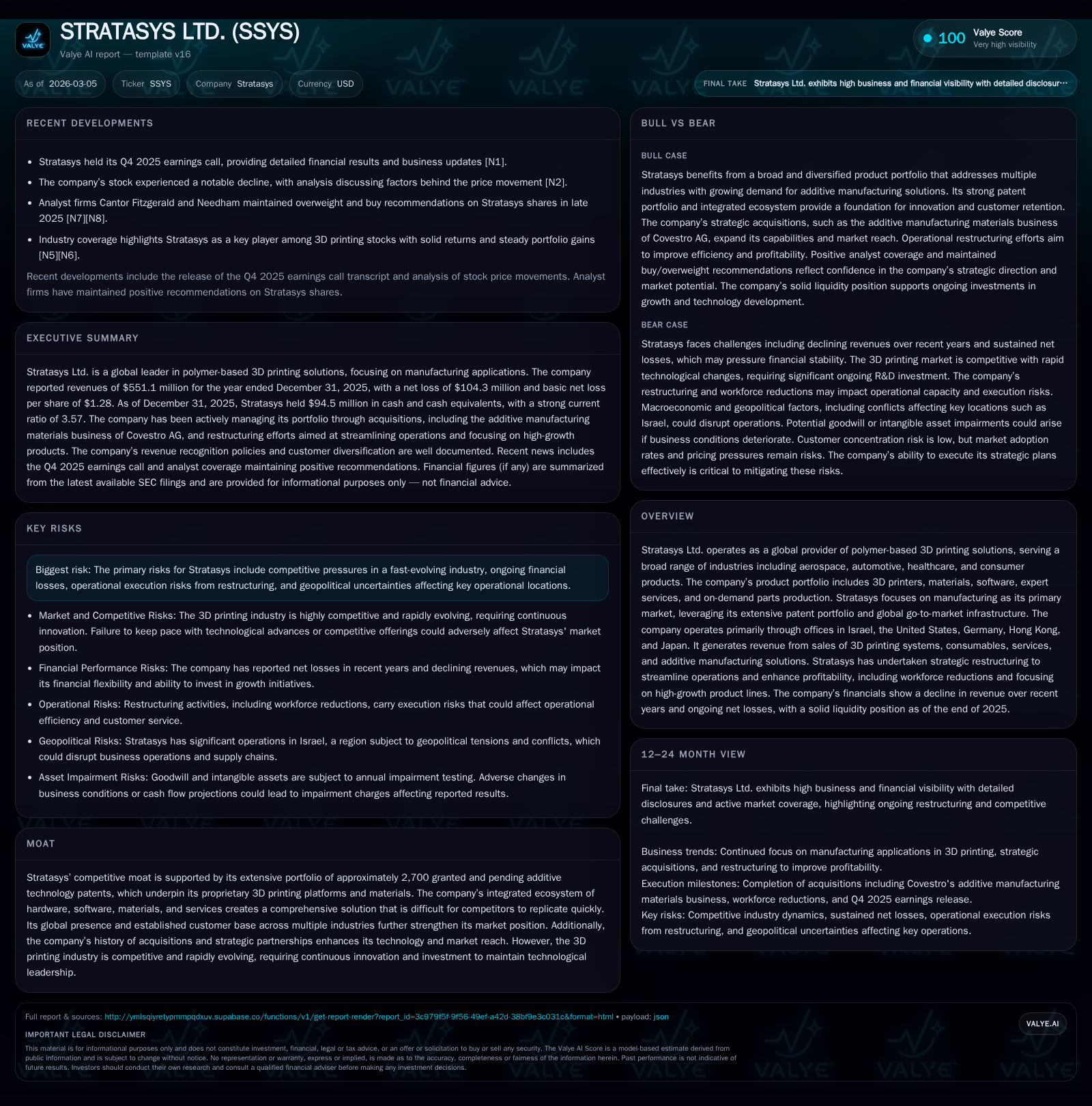
Stratasys operates as a global leader in polymer-based 3D printing solutions, serving diverse industries through its integrated ecosystem of hardware, software, materials, and services. Despite carrying an extensive patent portfolio and widespread market reach, the company has experienced declining revenues and continued operating losses over recent years. Strategic restructuring efforts focusing on workforce reductions and prioritization of high-growth product lines have yielded some improvement in operating loss trends and cash flow generation. However, net losses remain significant. The firm's future growth depends on capturing manufacturing industry adoption amid fierce competition and evolving technologies, while capital allocation has included a notable private equity infusion but no recent share repurchases.
Historical Performance
Stratasys has demonstrated a steady decline in top-line revenue over the last four fiscal years—from $651.5 million in FY2022 down to $551.1 million in FY2025—a cumulative decrease of approximately 15% [F1]. This contraction reflects challenging market dynamics within the polymer-based additive manufacturing segment and possibly customer hesitation amid evolving technology offerings. Operating income remains negative, though shows some improvement: Stratasys reduced its operating loss from nearly $57.2 million in FY2022 to about $72.5 million loss in FY2025, reflecting operational adjustments including cost cutting and restructuring [F1]. Net income figures have been persistently negative, with a steep net loss of $123.1 million reported as recently as FY2023.
Capital expenditures fluctuated but saw a significant increase to $22.1 million in FY2025 after relatively stable spending around $13–14 million levels prior years; this upswing suggests reinvestment aimed at retaining competitive edge amid technological evolution [F1]. Concurrently, cash from operations swung back positive to $15.1 million in the most recent fiscal year after multiple years of cash outflows, signaling improved operational discipline [F1].
Historical performance (annual)
| FY | Rev ($mm) | Net ($mm) | CFO ($mm) | OpInc ($mm) | Rev YoY | Net YoY |
|---|---|---|---|---|---|---|
| 2025 | 551 | 15 | -72 | -3.7% | ||
| 2024 | 572 | 8 | -86 | -8.8% | ||
| 2023 | 628 | -123 | -62 | -88 | -3.7% | -324.8% |
| 2022 | 651 | -29 | -75 | -57 | +53.3% |
Source: SEC companyfacts cache [F1].
Capital returns and efficiency (annual)
| FY | FCF ($mm) | ROE% |
|---|---|---|
| 2025 | -7 | |
| 2024 | -3 | |
| 2023 | -75 | -13.9 |
| 2022 | -89 | -3.0 |
Source: SEC companyfacts cache [F1].
Note: All figures in millions USD except percentages; operating income and equity per latest available data [F1].
Business Model and Competitive Positioning
Stratasys Ltd operates solely through one consolidated operating segment that spans sales of polymer-based 3D printing systems (hardware), consumables (e.g., printing materials), software tailored for additive manufacturing workflows, expert services, plus on-demand parts production capabilities [S17]. This integrated ecosystem forms a core differentiation enabling customers across aerospace, automotive, healthcare, consumer products and dental industries to improve development times, lower costs and enhance product quality.
The company’s fortress-like moat rests on about 2,700 granted and pending patents—among the largest portfolios in additive manufacturing—which protect proprietary printing technologies and innovative material formulations preventing rapid replication by competitors . This extensive IP combined with an established multi-geography footprint—headquarters spanning Israel and the U.S., supplemented by branches throughout Germany, Hong Kong and Japan—supports global commercial reach necessary within complex supply chains across sectors reliant on precision manufacturing [S22].
Strategic Initiatives and Future Growth Prospects
In response to financial pressures amid challenging macroeconomic factors (including geopolitical instability affecting Israeli operations till late-2025) and evolving industry competition, Stratasys engaged a comprehensive strategic reassessment starting late-2023 culminating into announced actions during 2024 focused on streamlining operations by approximately reducing global workforce by ~15% completed by end-2024—manifested as restructuring charges primarily allocated across cost of revenues, R&D expenses and SG&A [S18][S5]. These moves target sharpening organizational focus toward highest-growth segments like advanced materials and software-delivered manufacturing solutions rather than broader legacy hardware sales.
Further underpinning liquidity strength was a notable private investment financing round completed April 8, 2025—the PIPE transaction—raising $120 million from Fortissimo Capital which acquired around a 15% equity stake providing non-dilutive capital to fuel innovation initiatives with contractual shareholder lock-ups mitigating near-term selling pressure risk on shares outstanding [S6]. Notably there were no share repurchases during FY2025 despite authorization for up to $50 million buybacks approved during late-2024 given prioritization of investments amidst turnaround efforts.
Growth drivers lie principally within accelerating additive manufacturing adoption across industrial OEMs seeking digital transformation toward faster product cycles and lighter components leveraging polymer composites—from tooling applications increasing toward direct production parts especially where customization or low volume is required (a sector expected to grow robustly over coming years) [N1][N4]. The company also invests selectively in adjacent technology via minority investments (e.g., Tritone Technologies focused on ceramic/metal AM technologies) to potentially expand total addressable market penetration through diversified printing modalities while leveraging exclusive distribution rights globally granted under such partnerships enhancing vertical integration prospects [S19].
However, constraints exist including intensifying competitive pressures not only from incumbents like 3D Systems but also emerging nano-material additive firms driving faster innovation cycles; persistent operational losses require consistent funding raising or capital discipline; geopolitical risks remain relevant given partial Israeli operational concentration; plus rapid technological evolution demands ongoing heavy R&D investment to avoid obsolescence risking erosion of patent protection value over time given fast-moving standards landscape within AM sector [S3][S9][N4].
Financial Returns and Capital Allocation
Analysis highlights that despite improving operating loss trajectory with a roughly ~15% year-over-year reduction in operating loss magnitude between FY24–FY25 [$85.7M to $72.5M] Stratasys continues not to generate net profits nor positive free cash flow—the latter approximated as negative ~$7 million after subtracting capex from operating cash flows for latest fiscal year (CFO +$15.1M minus Capex -$22.1M) [F1]. Return on equity is negative approximately -14–15%, reflecting recurring net losses versus shareholders’ equity nearing $843 million at the end of FY25 without dividend distributions or share buybacks executed in that period although an active equity issuance occurred earlier via PIPE injection raising committed shareholder capital without substantially diluting existing ownership states due to lock-up provisions [F1][S6][S10].
Historically Stratasys pursued some modest buyback activity including repurchasing ~266 thousand shares at about $2 million spend during FY24 but did not continue same program into FY25 likely due to liquidity preservation needs combined with greater priority assigned to strategic restructuring outlays plus investment requirements for growth initiatives [S6]. Dividend payments are not noted as the company focuses on reinvestments amid turnaround phase.
Overall capital deployment rests importantly on balancing R&D spend needed for competitive advantage maintenance versus navigating low-margin environment while seeking long-term scale efficiencies post restructuring.
What To Watch Going Forward (Analysis)
Key milestones will include Stratasys’ ability to toggle its business mix further toward subscription or consumption-based software/materials models generating recurring revenue; adoption success of new product launches aligned with prioritized high-growth market segments; continued execution against cost rationalization targets preserving gross margin integrity; tracking geopolitical risk normalization relative to Israeli operations stability; and management’s communication around longer-term synergy realization from recent deals including Ultimaker partnership equity accounting outcomes where impairment charge recorded signals valuation challenges requiring attentive monitoring [S16][N1]. Additionally monitoring competing offerings’ innovations is critical given industry pace.
Cash flow sustainability will remain vital given historical negative free cash flow trends despite improvements—and any future significant acquisitions or partnerships could reshape financial profiles significantly requiring reassessment.
In summary:
- Sustained revenue stabilization or reversal would reinforce narrative execution gains.
- Further narrowing operating losses alongside eventual EBIT break-even would substantiate growth credibility.
- Investor receptiveness toward balance sheet resilience highlighted by PIPE backing enhances strategic optionality.
- Continued patent-driven innovations remain foundational protective factors.
- Navigating external macro uncertainties prudently remains important due diligence context.
Disclaimer: This analysis is intended for informational purposes only and does not constitute investment advice or recommendations.
Disclaimer: This is research-only, informational analysis and not investment advice. It may include AI-generated interpretation and general industry context. Always verify important details using primary sources.

Comments