
Global Crossing Airlines Group: ACMI and Charter Segments Driving 2025 Performance Shift
Global Crossing Airlines leveraged ACMI expansion and fleet growth to reverse operating losses in 2025 despite persistent challenges.
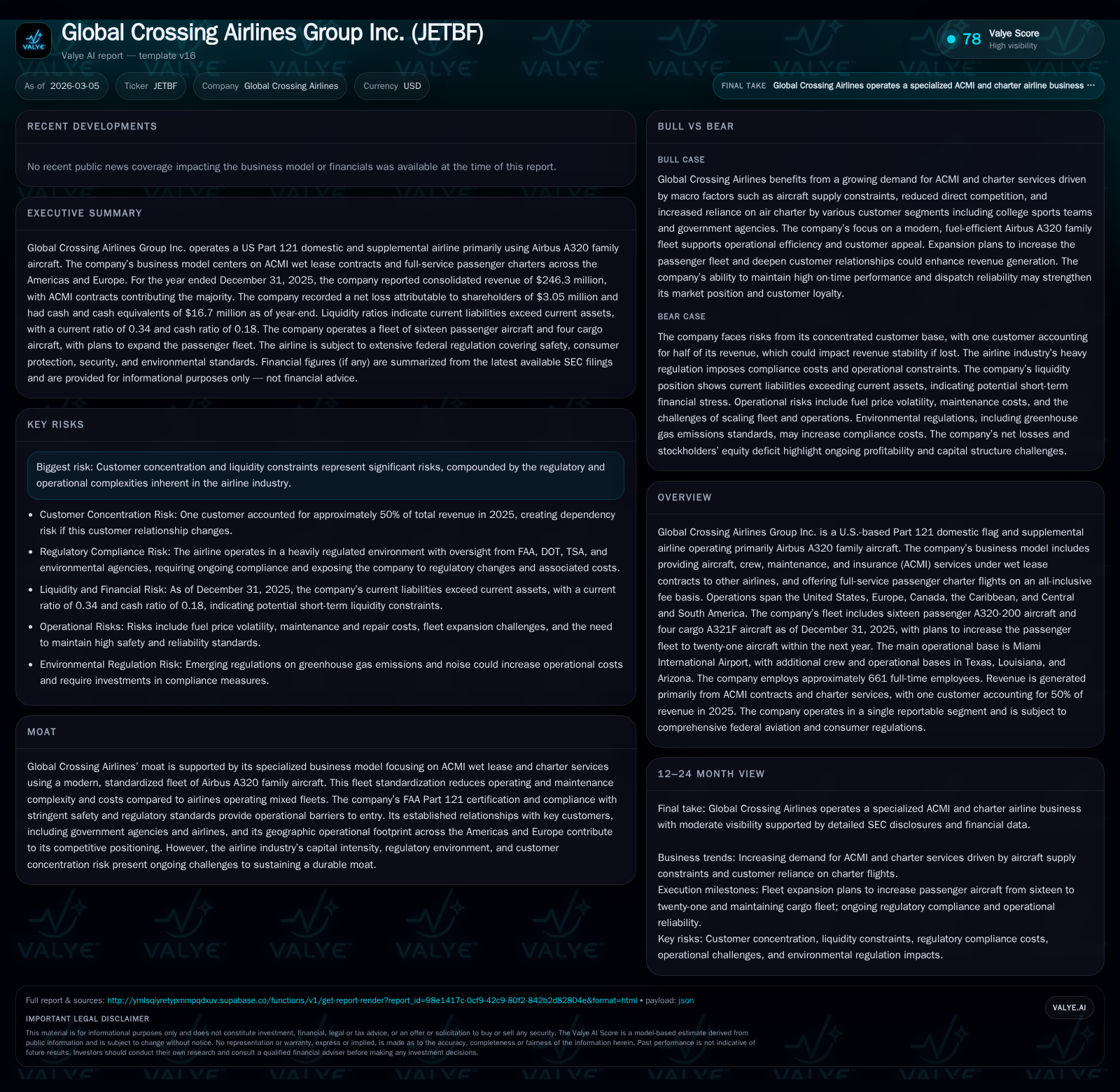
In 2025, Global Crossing Airlines Group Inc. achieved a dramatic operational turnaround, swinging from operating losses to positive operating income largely driven by robust growth in its ACMI wet lease operations. The company’s strategic fleet expansion and focus on contract diversification have underpinned enhanced capacity utilization and revenue mix improvements. However, significant customer concentration risk and liquidity constraints continue to temper the outlook amid an intensely capital-intensive and highly regulated airline environment.
Historical Performance: Charting the Shift from Losses to Operating Income
The financial trajectory of Global Crossing Airlines Group Inc. ("GlobalX") depicts a meaningful turnaround in its operating results through 2025. After several years marked by steep operating losses — including an operating loss exceeding $11 million in 2024 — the company recorded positive operating income totaling $8.9 million in 2025, an increase of approximately 889.5% year-over-year [F1]. Concurrently, net losses narrowed significantly by over 73%, declining from -$11.5 million in 2024 to -$3.1 million in 2025.
This financial inflection is attributable primarily to ramped-up ACMI operations that offset deteriorating Charter segment revenues [S4][S6]. Importantly, operating cash flow improved markedly with net CFO rising over threefold from $8.1 million in the prior year to $28.1 million in 2025 [F1][S13]. Capital expenditures increased alongside operational scale, jumping roughly 61% year-over-year to $11.6 million as GlobalX invested heavily to expand its fleet and support maintenance initiatives [F1].
Historical performance (annual)
| FY | Net ($mm) | CFO ($mm) | OpInc ($mm) | Capex ($mm) | Net YoY |
|---|---|---|---|---|---|
| 2025 | -3 | 28 | 9 | 12 | +73.4% |
| 2024 | -11 | 8 | -1 | 7 | +45.4% |
| 2023 | -21 | -1 | -16 | 4 | -32.8% |
| 2022 | -16 | -7 | -11 | 2 |
Source: SEC companyfacts cache [F1].
Capital returns and efficiency (annual)
| FY | FCF ($mm) | ROE% |
|---|---|---|
| 2025 | 16 | 10.3 |
| 2024 | 1 | 38.8 |
| 2023 | -5 | 104.6 |
| 2022 | -9 | 218.1 |
Source: SEC companyfacts cache [F1].
Revenue figures are from reported amounts [S4][S6]; financials sourced from [F1].
ACMI and Charter Business Dynamics Fueling Revenue Growth
GlobalX operates through two primary revenue streams: ACMI (aircraft, crew, maintenance, insurance) wet lease contracts and Charter passenger services charged on an all-inclusive fee basis including fuel and operational costs [S4][S6]. In 2025, the ACMI segment demonstrated considerable strength with revenues climbing from approximately $123 million in 2024 to $176 million in 2025, representing a roughly 43% increase year-over-year [S4][S6]. This rise illustrates expanding block hours flown under wet lease agreements where customers assume fuel price risk but benefit from outsourcing full aircraft operations.
Conversely, Charter revenues declined materially from approximately $95 million in 2024 to $62 million in 2025 due to strategic deprioritization amid focused resource allocation toward the more scalable ACMI model [S4][S6]. As charters generally involve fixed "all-in" fees inclusive of fuel, insurance, landing fees and related costs fixed by contract, margins can be more sensitive to external cost inflation unlike ACMI arrangements where fuel risk is passed to customers.
This revenue mix shift underscores GlobalX's business model moat — specialization in high-utilization wet leases combined with operational flexibility enabled by standardized Airbus A320 family aircraft — which supports long-term contract relationships despite notable client concentration risk [S4]. The firm’s ability to deliver comprehensive outsourced flight services remains critical for client retention.
Fleet Expansion Strategy Supporting Capacity and Utilization Improvements
GlobalX's fleet has seen rapid scaling since initiating flight operations with one leased Airbus A320-200 aircraft in August 2021 [S1]. By December 31, 2025, the passenger fleet expanded impressively to sixteen A320-200s complemented by four cargo-configured A321F aircraft dedicated primarily to cargo charter operations [S1]. The company plans aggressive further growth calling for twenty-one passenger aircraft within the next twelve months while maintaining four cargo planes.
Fleet homogeneity represents a key differentiator; focusing exclusively on Airbus narrow-body families enables streamlined pilot training cycles, simplified parts inventory management, and efficiencies particularly pertinent during heavy maintenance events known as "2Y" or "6Y Checks," which can ground aircraft for extended periods [S1]. These heavy maintenance checks are executed every two or six years respectively, requiring advanced scheduling coordination but reduce disruptions relative to mixed fleets.
The fit-for-purpose nature of Airbus A320/A321 types provides GlobalX operational reach spanning domestic U.S., Caribbean routes plus Europe and Latin America—leveraging range advantages over Boeing’s comparable models while offering passenger comfort benefits such as wider seats and larger cargo volumes crucial for competitive charter operations [S14].
Geographic Footprint and Customer Concentration Risks
Geographically concentrated almost entirely within the United States as of end-2025—with incremental international exposures into Europe, Canada, Caribbean islands, Central and South America—the company's revenue origination reflects primarily U.S.-based clients totaling approximately $237 million of the $246 million total revenue reported [S4][S28].
A notable risk arises from customer concentration: one dominant customer accounted for roughly half of total revenues during calendar year ended December 31, 2025 [S4]. This single-customer dependency imposes material revenue volatility risk should contract terms shift or renewal fail.
While this concentration aligns with industry realities for specialized wet lease operators serving a limited pool of large airlines or government agencies with recurring demand profiles, it amplifies exposure relative to peers with more diversified client bases.
Regulatory barriers such as FAA Part 121 certification requirements impose entry hurdles deterring casual competitors but also necessitate rigorous compliance efforts that inflate operating complexity and cost structures—protecting incumbents like GlobalX but limiting rapid scale elsewhere [S12].
Liquidity, Capital Structure, and Debt Profile Overview
Despite improving profitability signals in core operations during fiscal year ending December 31, 2025, GlobalX faces structural liquidity constraints evidenced by a current ratio approximating just 0.34—current assets stood at approximately $31.2 million against current liabilities nearing $91.7 million as per year-end figures [F1][S8][S7].
Cash balances rose moderately during this period to nearly $16.7 million unrestricted cash plus an additional $3.8 million restricted cash held for flight guarantees—a positive trend amidst ongoing capital expenditures required for fleet acquisition and maintenance commitments (capitalized at about $11.6 million) [F1][S8][S13].
Debt composition includes secured notes totaling around $35.7 million issued mid-2023 alongside additional loan agreements used predominantly for aircraft purchase financing—augmented by finance leases accounting for substantial liability portions tied directly to aircraft financing obligations [S15][S16]. Minimum lease payments under finance leases amount to over $70 million with present values near $51 million on long-term maturities stretching into early next decade; operating lease obligations similarly contribute sizable future fixed commitments estimated above $100 million [S25].
Management actively monitors working capital needs contending with capital infusions necessity via debt or equity issuance possibilities balanced against dilution considerations—illustrative of ongoing capital intensity endemic within ACMI niche air charter operators pursuing growth while managing leverage prudently [S3][S13][S26].
Capital Allocation Choices: Lack of Dividends and Focus on Operational Investment
GlobalX preserves liquidity deliberately; no cash dividends were declared or paid in recent periods consistent with stated Board intentions prioritizing earnings retention to satisfy operational cash needs amid negative retained earnings totaling approximately -$73.6 million as of fiscal year-end [F1][S19]. Share repurchases have not been conducted either—reflecting a strategic focus on reinvestment into scaling fleet capacity plus sustaining regulatory compliance investments.
The company issued shares pursuant to employee incentive programs but refrained from shareholder distributions given precarious equity positions (-$29.5 million total stockholders’ deficit) coupled with ongoing financing requirements linked directly to capital asset deployment and working capital demands rather than returning funds externally at this phase [F1][S19].
Disclaimer: This is research-only, informational analysis and not investment advice. It may include AI-generated interpretation and general industry context. Always verify important details using primary sources.

Comments