
Toro Company’s Strategic Expansion and Earnings Momentum Reflect Industrial Synergies
Toro’s recent acquisition broadens its industrial footprint while financial results highlight operational resilience and capital discipline.
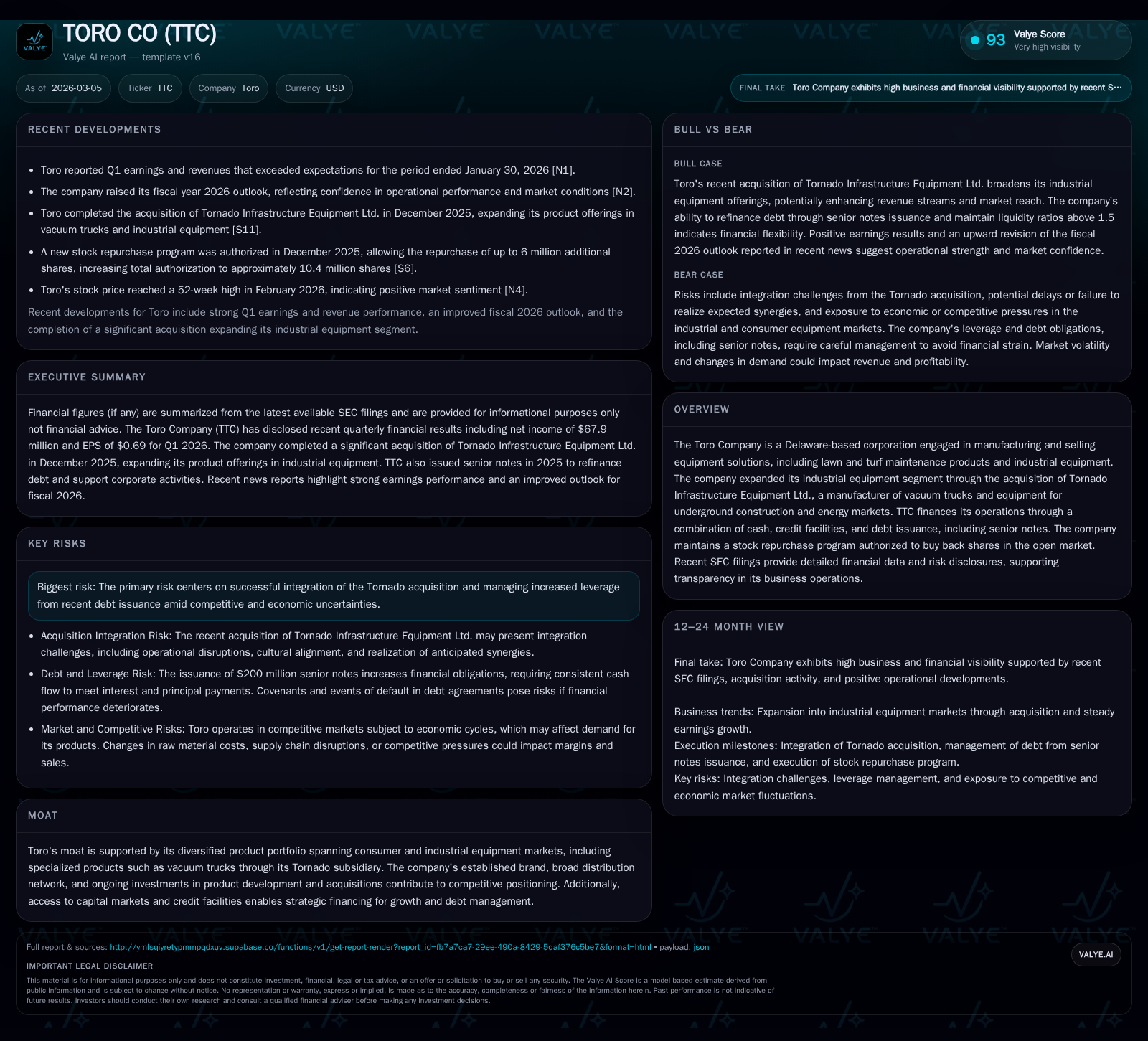
The Toro Company has bolstered its product portfolio and market reach through the acquisition of Tornado Infrastructure Equipment Ltd., strategically entering the vacuum truck and underground construction equipment sector. Despite a notable year-over-year decline in operating and net income for fiscal 2025, cash flow generation strengthened materially, reflecting effective working capital management and operational cash efficiency. Concurrently, Toro’s capital allocation favors sustained dividends and an aggressive share repurchase program, underpinned by robust free cash flow and a respectable return on equity. Looking ahead, integration of Tornado’s operations and realization of anticipated synergies remain critical milestones amid manageable leverage and steady liquidity.
Track Record of Growth Amid Cyclical Volatility
Toro Company’s historical financial trajectory shows a nuanced pattern of growth punctuated by cyclical headwinds. Operating income fell sharply from $533.3 million in FY2024 to $409.9 million in FY2025, a -23.1% decline [F1]. This contraction coincides with increased costs likely related to integration activities post-Tornado acquisition as well as inflationary input pressures noted in their SEC filings [S1]. Net income similarly dropped by 24.5% year-over-year to $316.1 million.
Conversely, operating cash flow demonstrated resilience, increasing by 16.2% YoY to $662 million [F1]. This uplift reflects improved working capital management—indicative of operational efficiency—even as top-line growth moderated. Capital expenditures were trimmed by 19.1% YoY to $83.7 million, signaling tighter investment spending amid focus on integration [F1]. Equity grew moderately to $1.45 billion supporting a solid approximate return on equity near 21.8% [F1].
Historical performance (annual)
| FY | Net ($mm) | CFO ($mm) | OpInc ($mm) | Capex ($mm) | Net YoY |
|---|---|---|---|---|---|
| 2025 | 316 | 662 | 410 | 84 | -24.5% |
| 2024 | 419 | 570 | 533 | 104 | +27.1% |
| 2023 | 330 | 307 | 431 | 150 | -25.6% |
| 2022 | 443 | 297 | 576 | 143 |
Source: SEC companyfacts cache [F1].
Capital returns and efficiency (annual)
| FY | Div ($mm) | Buybacks ($mm) | FCF ($mm) |
|---|---|---|---|
| 2025 | 151 | 290 | 578 |
| 2024 | 150 | 246 | 466 |
| 2023 | 142 | 60 | 157 |
| 2022 | 126 | 140 | 154 |
Source: SEC companyfacts cache [F1].
Table summarizes key annual financial metrics highlighting earnings volatility tempered by growing cash flows and disciplined capex.
Impact of Tornado Acquisition on Product Portfolio and Market Reach
Strategic diversification marked Toro's December 2025 acquisition of Tornado Infrastructure Equipment Ltd., a Calgary-based manufacturer specializing in vacuum trucks and industrial equipment targeting underground construction, power transmission, and energy markets [S14][N7]. This move extends Toro’s industrial equipment segment beyond its core lawn and turf product lines into specialized heavy-duty equipment essential for infrastructure development.
This vertical expansion aims to capitalize on demand for commercial grade vacuum trucks used for hydro excavation and pipeline maintenance — niches characterized by high aftermarket support potential and lower cyclicality compared with consumer landscaper products [S5][S8]. Integration offers potential synergies through shared distribution channels and enhanced R&D leveraging Toro's engineering capabilities.
Fiscal 2025 Financial Performance: Revenue, Income, and Cash Flow Trends
While precise revenue data post-acquisition is not explicitly stated for FY2025, overall operating income compression indicates margin pressure due perhaps to upfront restructuring or amortization costs linked to Tornado integration [F1][S8]. The company maintained positive cash flow momentum with Operating Cash Flow hitting $662 million versus $570 million prior year; concurrently capital expenditures scaled back notably consistent with integration phase cost control [F1].
This financial pattern suggests that although immediate earnings dilution occurred, the underlying cash generating capacity remains robust, enabling capacity for debt servicing and shareholder distributions.
Key Operating Metrics: Analyzing Segment Contributions and Margin Effects
Segment analysis reveals bifurcated dynamics: the traditional lawn/turf segment focuses on productivity-enhancing equipment—zero-turn mowers optimized for commercial turf maintenance payload efficiency—while the newly acquired Tornado unit drives growth anchored in vacuum truck fleet utilization metrics crucial for underground service contractors [S6][N1].
Margins in consumer-facing products face pressure from material cost inflation whereas industrial equipment margins reflect upfront investments balanced by resilient pricing structures tied to contract-based sales cycles [S8]. The mixed portfolio reduces overall exposure to consumer spending swings while enhancing revenue stability.
Balancing Leverage and Liquidity Post-Acquisition
To finance the Tornado acquisition (~CAD$279M or approximately USD equivalent), Toro deployed a combination of cash reserves and leveraged financing comprising $200 million senior notes issued September 2025 at a coupon rate of 5.27%, replacing existing term loans under more favorable terms [S11][S12][S10].
This refinancing brought enhanced covenant flexibility including maximum leverage ratio limits calibrated prudently given acquisition-related debt layering [S17]. The company's current ratio calculated from assets/labilities stands around a healthy 1.69 as of January-end quarter close indicating solid near-term liquidity buffers [F1][S26].
Capital Allocation Priorities: Dividends, Share Repurchases, and Investment
Toro sustains steady dividend payments which edged up slightly to $151 million in FY2025 from prior years while accelerating share buybacks totaling $290 million—nearly doubling prior year repurchase spend—supported by free cash flow exceeding $578 million after capex deductions [F1][S21][S14].
The Board authorized an open-ended stock repurchase program with no expiration date covering over 10 million shares evidencing confidence in intrinsic value accretion potential alongside balanced reinvestment requirements [S9][S21]. The firm thus pursues disciplined capital recycling favoring shareholder returns amidst selective strategic investments driven by integration needs.
Outlook for Fiscal Year 2026: Management Guidance and Market Expectations
Explicit fiscal year guidance for FY2026 remains generalized; however management commentary following Q1 earnings beat reflects an upward revision in outlook attributable primarily to accelerated synergy capture from Tornado integration alongside stable demand agriculture infrastructure sectors [N7][N8].
Key milestones include absorption of Torrado’s operations into Toro’s systems optimizing supply chains while carefully managing working capital as new product lines ramp [N1]. Industry observers will monitor margin recovery trajectories amid evolving macroeconomic headwinds.
Risks on the Horizon: Integration Challenges and Economic Uncertainties
Risk disclosures emphasize execution risk surrounding successful integration of Tornado’s business without loss of key personnel or disruption to core operations [S4][S7]. Elevated leverage post-acquisition mandates vigilant covenant compliance especially if adverse economic conditions impair end-market demand.
Competition intensifies particularly within specialized industrial equipment sectors where OEM differentiation hinges on product innovation and aftermarket service networks—a domain where Toro must maintain investment vigilance alongside operational focus [N7][S4]. Regulatory or litigation risks currently appear limited per disclosures.
This analysis synthesizes publicly available SEC filings including Forms 10-K, Q10, recent earnings reports, company press releases alongside industry contextual insights without extrapolating beyond disclosed financial data or company statements. It is intended solely for informational purposes without constituting investment advice or recommendations.
Disclaimer: This is research-only, informational analysis and not investment advice. It may include AI-generated interpretation and general industry context. Always verify important details using primary sources.

Comments