
Carter Bankshares Enhances Regional Banking with Strong Capital and Strategic Risk Management
The bank holding company leverages its Virginia and North Carolina footprint amid competitive pressure and regulatory scrutiny.
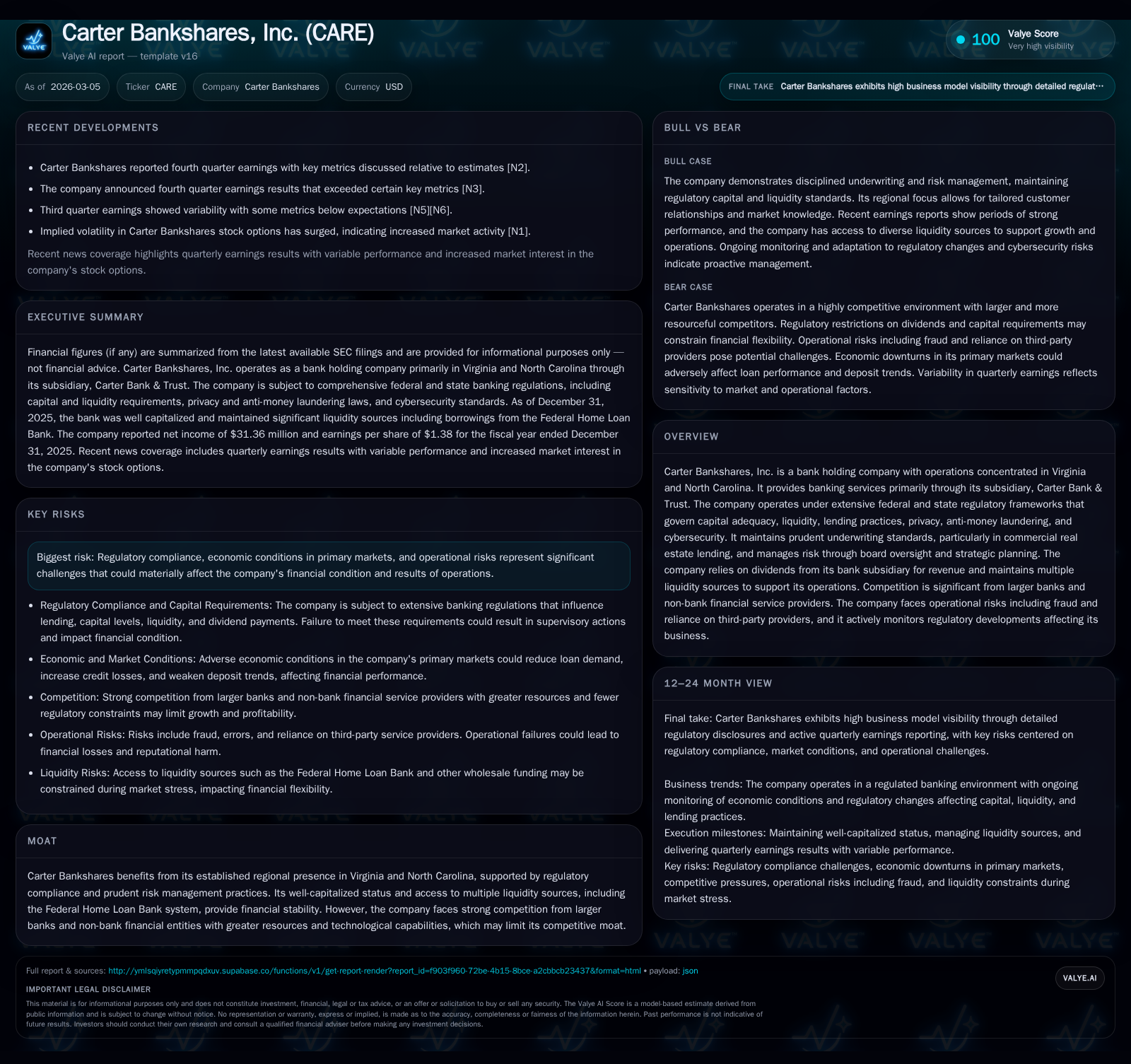
Carter Bankshares, Inc. maintains a solid financial foundation through prudent underwriting and robust liquidity sources, positioning itself as a steady regional player in the Virginia and North Carolina banking markets. Historic earnings growth reflects controlled expansions in loans and deposits along with disciplined capital allocation, including a recent share repurchase program. However, intensifying competition from larger institutions and nonbank entities, alongside evolving regulatory demands, present ongoing challenges that could temper near-term growth and returns. The company's reliance on dividends from its bank subsidiary underscores the importance of regulatory trends influencing payouts and liquidity.
Company Overview
Carter Bankshares, Inc. is a regional bank holding company primarily operating through its subsidiary Carter Bank & Trust within Virginia and North Carolina. The firm emphasizes traditional banking services bolstered by comprehensive risk management frameworks focused on capital adequacy, liquidity, loan quality (especially in commercial real estate), anti-money laundering controls, cybersecurity resilience, and compliance with extensive federal and state regulations [S1][S4][S11].
Historical Financial Performance
During the past four years ending in fiscal 2025, Carter Bankshares has demonstrated consistent profitability growth alongside measured enhancements in capital base and cash flow generation. Net income climbed substantially from $15.6 million in 2022 to $31.4 million in 2025 — an almost doubling driven by effective loan portfolio growth and controlled expense management [F1]. Operating cash flow has seen variability but stabilized at just under $40 million as of 2025 after peaking at over $70 million in 2022.
Capital expenditures have remained moderate but steady around $8 million annually. Equity increased over time reaching about $420 million reflecting reinvested earnings and capital retention strategies.
Historical performance (annual)
| FY | Net ($mm) | CFO ($mm) | Capex ($mm) | Net YoY |
|---|---|---|---|---|
| 2025 | 31 | 40 | 8 | +27.9% |
| 2024 | 25 | 37 | 8 | +4.9% |
| 2023 | 23 | 47 | 10 | +49.8% |
| 2022 | 16 | 71 | 6 |
Source: SEC companyfacts cache [F1].
Capital returns and efficiency (annual)
| FY | Buybacks ($mm) | FCF ($mm) | ROE% |
|---|---|---|---|
| 2025 | 20 | 32 | 7.5 |
| 2024 | 0 | 29 | 6.4 |
| 2023 | 16 | 37 | 6.7 |
| 2022 | 43 | 65 | 4.7 |
Source: SEC companyfacts cache [F1].
Net income growth was driven largely by expansion of loan balances underpinned by prudent credit standards targeting primarily commercial real estate assets with clear underwriting metrics such as loan-to-value limits tied to real estate collateral [S15]. Meanwhile operating cash flow improvement was tempered by investment needs and changing asset-liability compositions.
Growth Prospects and Constraints
The primary growth driver remains economic development in the company's Virginia and North Carolina markets which influences loan demand especially commercial real estate lending [S23]. Favorable local economic conditions can stimulate both credit expansion and deposit accumulation.
However several factors may cap or complicate future growth:
- Intense Competition: Rivalry from larger banks with more extensive digital platforms and non-bank financial entities offering faster-service fintech products challenges Carter Bankshares' ability to grow loans or deposits without compromising margins [S13].
- Regulatory Burden: Ongoing legislative changes may restrict overdraft fees and heighten compliance costs affecting profitability [S4].
- Concentration Risks: The bank's significant exposure to commercial real estate requires heightened board oversight given potential volatility linked to property valuations [S1][S15].
- Liquidity Dependence: The substantial reliance on Federal Home Loan Bank advances (approximate borrowing capacity of $1.5 billion or roughly one-third of assets) means disruptions in this source or collateral valuation shifts could impede funding capability [S5].
Management continues to monitor these risks while exploring strategic initiatives designed to balance measured growth with capital preservation.
Forecasts and Strategic Directions
The company issued no explicit forward guidance but recent disclosures indicate priorities including continued optimization of the branch network footprint via acquisitions or consolidations as warranted [S26], digital platform enhancements to offset fintech competition [S13], and stringent credit quality controls amidst varying economic outlooks.
Of note is the February 2nd board authorization of a new $10 million share repurchase plan valid for twelve months contingent on Federal Reserve non-objection — signaling management's confidence in underlying intrinsic value despite broader market volatility [S3]. Observers should watch for any amendments to dividend policies given their dependence on bank subsidiary earnings distribution constraints under state/federal regulations [S1][S5][S23].
Returns and Capital Allocation
Carter Bankshares’ approximately 7.5% ROE based on reported net income relative to equity highlights moderate profitability characteristic of regional banking institutions maintaining conservative leverage profiles [F1]. The company generated an estimated free cash flow of over $31 million in the latest fiscal year after accounting for capital expenditures.
Share repurchases resumed meaningfully in FY25 up to $20 million following no repurchases during FY24; this contrasts with elevated buyback activity observed in FY22 ($42.9M) prior to normalization post-pandemic market adjustments [F1]. No dividends were paid historically through FY22 but payout decisions remain contingent on regulatory approvals for funds flowing from subsidiary profits upwards to the holding entity [S1][S29].
Capital policy appears geared toward preserving buffer levels while enabling tactical shareholder returns when conditions permit.
Competitive Positioning and Industry Dynamics
Operating within a multi-layered competitive environment spanning community banks up to large cap regional/national players puts Carter Bankshares at a resource disadvantage especially regarding technology investments enabling digital banking innovation [S13]. Larger competitors benefit from economies of scale allowing more aggressive pricing on loans and deposits plus wider product suites beyond traditional banking services causing margin compression pressures.
Nonbank entrants exploiting lighter regulation further exacerbate these competitive threats by serving niche credit needs or leveraging AI-powered underwriting tools faster than traditional lenders can adapt — a trend noted as critical for ongoing operational resilience planning [S16]. Carter’s focus on solid risk governance frameworks mitigates some risks but digital adaptation remains pivotal going forward.
Risk Factors Summary
The company faces key risks from regulatory shifts including restrictions on fee income components such as overdraft programs and increased compliance monitoring that raise operational costs considerably [S4][S14]. Additionally:
- Macroeconomic swings impacting borrowers’ ability to service loans notably within CRE sectors could elevate non-performing asset ratios.
- Cybersecurity threat landscape necessitates rigorous controls under recently intensified federal incident notification rules: failure here entails regulatory penalties plus reputational damages [S27].
- Reliance on third-party vendors introduces operational complexities especially amid accelerated deployment of AI tools governed by evolving legal frameworks implicating privacy/data security aspects [S16].
- Dividend payment limitations anchored by bank subsidiary earnings create potential liquidity challenges for meeting debt service obligations or rewarding shareholders organically if business weakens materially [S1][S5][S23].
Conclusion
Carter Bankshares presents as a well-capitalized regional banking entity anchored within its geographic markets through disciplined underwriting standards and multi-source liquidity management emphasizing FHLB advances plus brokered deposits lines. Its recent financial performance reflects robust income growth supported by steady operating cash flows while cautious capital allocation rebounds via share repurchases acknowledge the need for investor value sustenance.
Nonetheless the company must navigate intensified sectoral competition fueled by scaling digital innovations external to traditional banks alongside tightening regulatory scrutiny encompassing consumer protections and cybersecurity mandates — all contributing hurdles that require adaptive strategic execution.
Monitoring dividend policy evolutions alongside asset quality trends will be critical signals for forthcoming performance trajectories while the newly sanctioned stock buyback offers a tangible lever management believes appropriate within prevailing conditions.
This analysis is based solely on publicly available documents including recent SEC filings as of March 2026 and reputable news sources without projecting or forecasting investment outcomes. It does not constitute investment advice or recommendations.
Disclaimer: This is research-only, informational analysis and not investment advice. It may include AI-generated interpretation and general industry context. Always verify important details using primary sources.

Comments