
Barclays Bank PLC's 2025 Financial Resilience Amidst Operational Opacity and Governance Reforms
An in-depth examination of Barclays Bank PLC’s robust financial position in 2025 contrasted with limited operational transparency and recent governance enhancements.
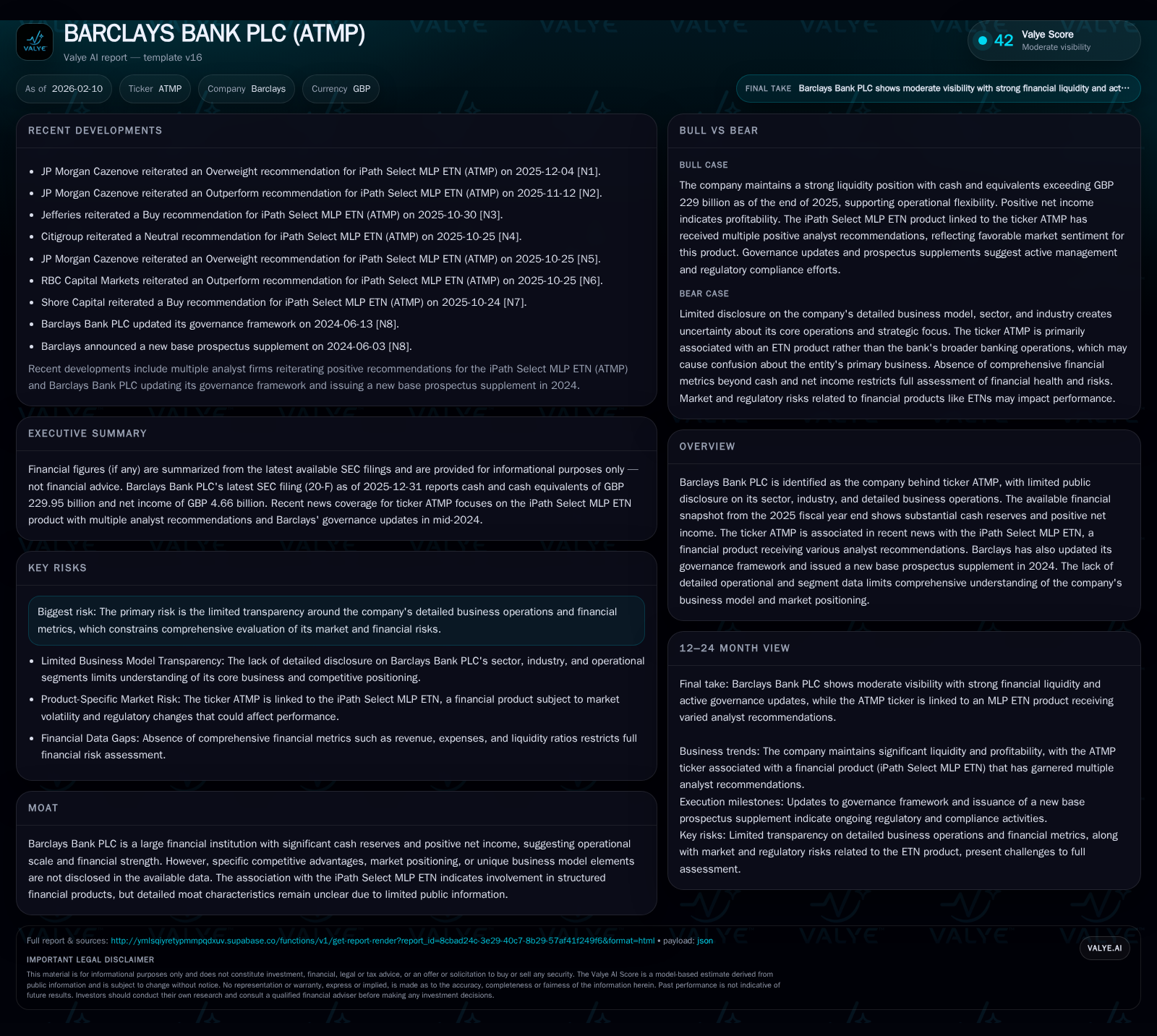
Barclays Bank PLC demonstrated considerable financial strength in 2025, evidenced by net income of approximately £4.66 billion and cash and equivalents nearing £230 billion. However, the firm's disclosures significantly lack detail on sectoral activities, operational segments, and management composition, which complicates a full understanding of its business model and competitive positioning. Notably, Barclays has undertaken governance framework updates reflecting institutional strengthening, while its association with the iPath Select MLP ETN hints at involvement in specialized financial products. The scarcity of detailed information injects challenges into risk assessment despite clear evidence of fiscal solidity.
Barclays at a Glance: Financial Highlights from 2025
Barclays Bank PLC’s financial snapshot for the fiscal year ending December 31, 2025, portrays a picture of substantial profitability coupled with immense liquidity. The reported net income reached £4.66 billion [F1], signaling effective revenue generation after considering impairments and operational costs. Complementing this profitability is an impressive £229.95 billion held in cash and cash equivalents at year end [F1], suggesting exceptional short-term asset availability to meet obligations or fund strategic initiatives.
Though the consolidated financial statements affirm scalability and fiscal soundness, this abundance of cash markedly surpasses typical banking industry norms relative to balance sheet sizes. Such liquidity cushions likely reflect a conservative approach to capital deployment or sensitivity to evolving regulatory or market conditions [S1].
Untangling the Corporate Veil: Limited Disclosure Challenges
A conspicuous characteristic surrounding Barclays Bank PLC’s public reporting is the absence of sectoral classification, industry designation, or detailed segment information [valye_report_excerpt][S1]. The bank leverages certain reduced disclosure exemptions as a wholly owned subsidiary of Barclays PLC, leading to selective omission across multiple Item sections including Directors (6A), Compensation (6B), Employees (6D), Major Shareholders (7A), and detailed Risk Factors specifics.
This lack of transparency severely hampers granular assessment by analysts or stakeholders seeking insight into business lines, geographic exposure, product mix, or strategic priorities. Without segment revenues or asset allocations publicly available, it becomes difficult to discern which areas drive profits or carry higher risks.
Additionally, absence of individual directors’ identities or senior management biographies restricts evaluation of leadership depth or succession planning frameworks [S1]. Such opacity can curtail confidence levels among some buy-side professionals accustomed to more granular disclosures.
Governance Overhaul and Institutional Framework Upgrades
Although many governance details remain undisclosed, Barclays has made salient updates within its corporate governance structure as referenced in Sections 6C (Board Practice) and 16G (Corporate Governance) [S1]. These reforms encompass enhancements in board composition policies, meeting protocols, committee functions, and ethical conduct guidelines.
Further information indicates that shareholder rights related to participation in general meetings are clearly defined with stipulated notice periods (21 days for annual meetings) alongside provisions for extraordinary meetings upon requisition by shareholders holding at least 5% voting capital [S1]. Voting processes allow for proxy representation and require specific quorums ensuring legitimate decision-making.
Such institutional strengthening efforts demonstrate intent to align with evolving regulatory expectations while potentially mitigating governance-related risks by fostering clearer accountability channels.
Financial Fortitude Without a Clear Moat: Interpreting the Strengths
While Barclays exhibits undeniable financial strength through scale evidenced by robust earnings power and gargantuan liquid asset pools [F1], public disclosures do not illuminate proprietary competitive advantages that confer enduring economic moats.
There is no available information describing differentiated technology platforms, client franchise exclusivity, unique underwriting methodologies, or dominant market niches that might solidify sustainable edge over rivals. Instead, the moat characterization remains inferred largely from sheer institutional size and balance sheet capacity rather than distinctive business model features [valye_report_excerpt].
This scale-driven strength nonetheless affords numerous conventional banking benefits such as funding cost efficiencies, diversification of credit portfolios, and expanded risk absorption buffers—attributes valuable especially amid fluctuating macroeconomic cycles.
The Mysterious Role of iPath Select MLP ETN in Barclays’ Portfolio
An intriguing element concerns Barclays’ association with the iPath Select MLP ETN—an exchange-traded note focused on master limited partnerships (MLPs) within energy infrastructure sectors—which has appeared in recent analyst discourse recommending related financial products under ticker ATMP [valye_report_excerpt].
The extent of Barclays’ involvement with this structured product is insufficiently documented but intimates participation in complex investment vehicles possibly tailored for targeted investor segments seeking commodity exposure complemented by yield strategies.
Given the absence of elaboration regarding strategic rationale or risk profile in filings, this linkage forms a curious outlier insight requiring further scrutiny when additional data surfaces.
Assessing Risks in an Environment of Information Scarcity
Key risk factors articulated under Item 1A Risk Review emphasize market volatilities across trading assets including prime brokerage services with repos and securities lending exposures [S1]. Credit risk modeling employs Probability of Default (PD) assessments integrating multiple internal/external metrics enhancing portfolio monitoring.
However, overall risk evaluation is constrained by missing disclosures on credit concentrations by sector or geography as well as less transparency on private equity stakes or proprietary trading activities.
Furthermore, the pro-cyclicality inherent in banking operations poses amplification risks during economic downturns where capital requirements and lending behavior can exacerbate stress scenarios—a dynamic acknowledged but not deeply quantified publicly [S1].
The overarching scarcity of information exacerbates these uncertainties impeding precise gauging of capital adequacy beyond regulatory minimums conveyed indirectly.
Regulatory Landscape and Forward-Looking Statements: What to Watch
Barclays clearly aligns itself under supervision by the United Kingdom’s Prudential Regulation Authority (PRA), adhering to prudential standards encompassing capital leverage ratios and valuation adjustments designed to buffer against exit value uncertainties [S1].
The Management Discussion & Analysis sections explicitly caution readers about forward-looking statements incorporating words like 'may', 'will', 'anticipate', underscoring inherent unpredictability attached to future performance projections [S1]. This communicates prudent transparency about limitations surrounding forecasts affected by macroeconomic shifts, regulatory policy changes, or market disruptions.
Continuous monitoring for updates on capital distribution policies—including dividend declarations or repurchase programs—is recommended given their influence on shareholder return profiles.
Shareholder Dynamics and Implications for Control
Shareholder engagement operates through well-defined annual general meetings supplemented by extraordinary meetings when invoked by qualifying shareholders holding sufficient voting power (≥5%) [S1]. Notice requirements ensure informed participation while quorum mandates maintain procedural legitimacy.
Voting methods include show-of-hand procedures generally favoring simple majority resolution pass rates (~50%) but escalate to supermajority thresholds (≥75%) for special resolutions affecting articles of association amendments or substantive corporate actions.
Preference shares holders are excluded from voting privileges which delineates power structures between share classes maintaining differentiation in control rights [S1]. These frameworks illustrate a controlled yet shareholder-responsive governance architecture important for institutional investors evaluating participatory influence versus passive stakes.
Cybersecurity and Controls: Foundations for Stability
Acknowledgement of cybersecurity risks features prominently within disclosure controls indicating robust management focus on protecting information assets against operational threats [S1]. Sections detailing management's annual report on internal control over financial reporting outline mechanisms devised to detect material misstatements ensuring reliability.
Such commitments align with broader regulatory expectations mandating comprehensive risk mitigation through proactive technology defenses coupled with continuous auditing cycles aimed at maintaining integrity across all business units.
These facets collectively contribute toward underpinning confidence among stakeholders regarding safeguards against systemic operational failures arising from cyber incidents or control lapses.
Key Questions Moving Forward: Opportunities and Unknowns
Barclays Bank PLC presents paradoxical characteristics: undeniable financial robustness coexists with significant opacity obscuring business composition and strategic orientation. This duality prompts several crucial inquiries:
- What are the core drivers behind its impressive net income absent clear segment disclosures?
- How does Barclays intend to leverage its substantial liquidity amidst evolving banking regulations?
- To what degree does involvement with specialized structured products like the iPath Select MLP ETN reflect deeper strategic innovation?
- How effective are governance reforms likely to be in steering risk oversight given limited senior management visibility?
- What are potential vulnerabilities hidden within undisclosed credit portfolios or private equity investments that could surface under adverse conditions?
- How will forward-looking statements translate into tangible policy shifts impacting capital allocation or dividend strategies?
- What enhancements might future filings deliver in terms of transparency encouraging more definitive external analysis?
While Barclays’ fiscal data affirms a strong foundation through 2025 supported by enhanced governance postures and cybersecurity preparedness, addressing these open questions remains essential for forming a comprehensive understanding moving forward.
Disclaimer: This analysis is based solely on publicly available information up to February 10, 2026. It does not constitute investment advice nor an endorsement regarding securities issued by Barclays Bank PLC.
Disclaimer: This is research-only, informational analysis and not investment advice. It may include AI-generated interpretation and general industry context. Always verify important details using primary sources.

Comments