
AptarGroup in 2026: Segment Strength, Margin Pressures, and the Stakes of Platform Innovation
AptarGroup’s broad reach in pharmaceutical and consumer dispensing technologies drives diversified revenues, yet recent profit declines spotlight emerging margin pressures and the challenge of scaling innovation across global end markets. The company’s strategic acquisitions and sustainability push could reinforce its competitive edge, but execution risks and evolving regulatory demands will determine whether AptarGroup can sustain leadership and unlock higher returns.
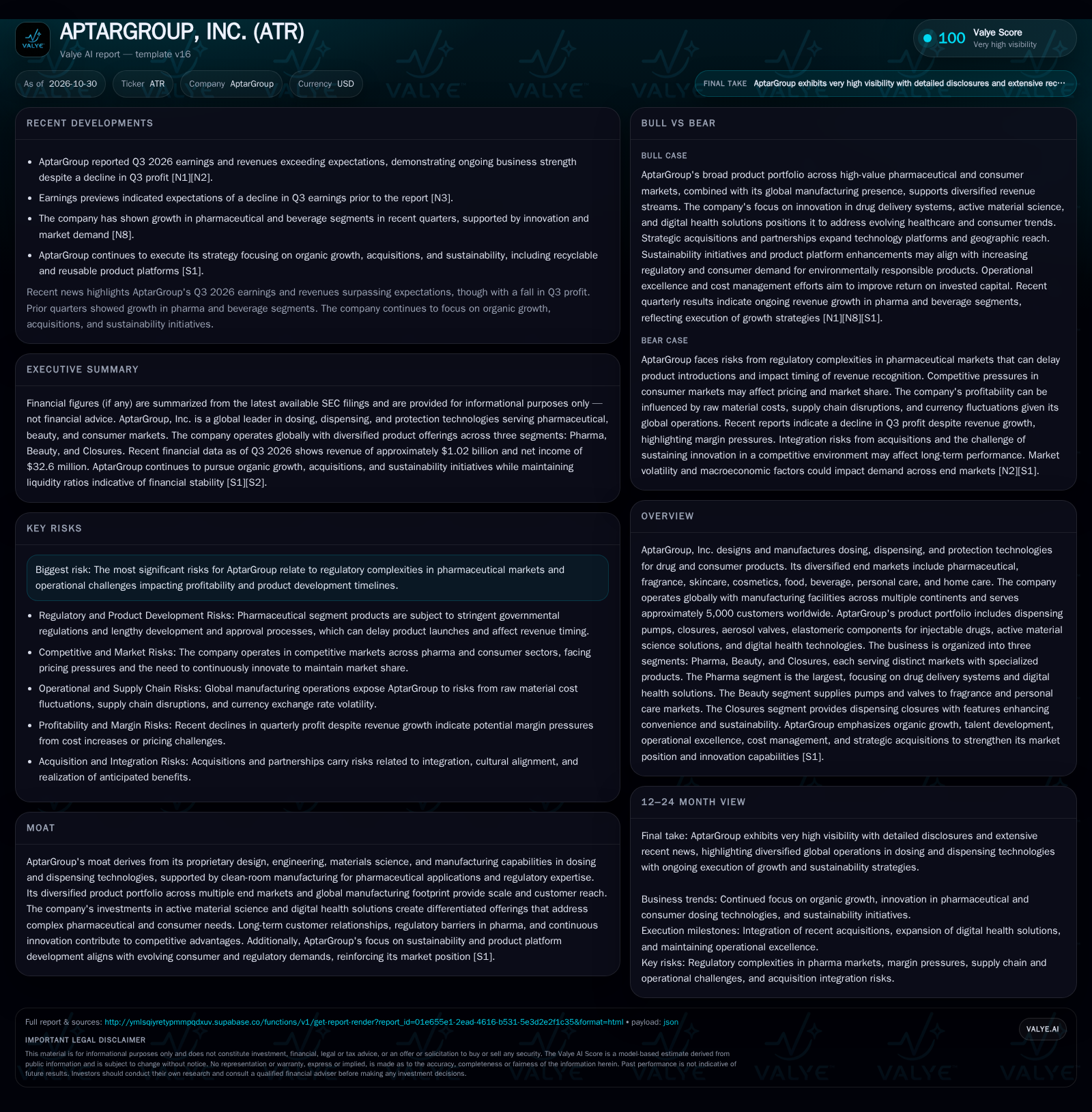
AptarGroup’s Q3 2026 results show continued revenue growth—especially in pharma and beverage segments—but a fall in quarterly profit, highlighting margin and cost pressures. Strategic acquisitions and sustainability investments signal ongoing expansion, yet the ability to translate innovation and scale into durable margin gains remains a central question. Regulatory, integration, and supply chain risks could shape future performance, making execution and end-market mix critical watchpoints. [S1] [S2] [N1] [N2] [N8]
AptarGroup stands at a strategic crossroads: the company’s global portfolio in dosing, dispensing, and protection solutions has delivered steady top-line growth, particularly in the resilient pharmaceutical segment and emerging beverage opportunities. Yet, the latest quarter saw profit fall despite revenue gains, underscoring intensifying cost and margin pressures. As AptarGroup accelerates innovation—ranging from digital health to advanced materials—and integrates recent acquisitions, its ability to maintain pricing power, execute on sustainability, and manage regulatory complexity will determine whether it can convert its broad market presence into sustained value creation.
2026 Operating Snapshot: Growth in Pharma and Beverage, But Margins Under Strain
AptarGroup reported Q3 2026 revenue of approximately $1.02 billion and net income of $32.6 million, with basic and diluted EPS of $0.51 as of September 30, 2026 [S2]. While earnings and revenues surpassed expectations, profit declined year-over-year, reflecting emerging margin pressures even as topline momentum continued [N1] [N2]. The company’s largest segment, Pharma, represented 46% of net sales in 2025 and has been a key driver of recent growth, alongside notable gains in the beverage category [S1] [N8]. Recent acquisitions—including Sommaplast (December 2025), increased ownership in BTY (July 2025), and an equity stake in Goldrain (October 2024)—signal ongoing efforts to broaden technology and geographic reach [S1]. As of September 30, 2026, AptarGroup reported a current ratio of 1.5 and cash and equivalents of $204 million [S2].
How AptarGroup’s Segment Economics and Innovation Drive Revenue—And Expose Cost Leverage
AptarGroup’s economics reflect its mix of high-value, regulated pharmaceutical applications and competitive, innovation-driven consumer markets. The Pharma segment’s focus on drug delivery systems (e.g., nasal spray pumps, metered dose inhaler valves, elastomeric packaging) generates recurring demand tied to drug approvals and lifecycle extensions, often benefiting from regulatory and technical barriers that can support premium pricing and longer-term contracts. However, these same barriers also entail lengthy development cycles and upfront investment in regulatory compliance, which can delay revenue recognition and compress near-term margins if costs escalate or launches slip.
The Beauty and Closures segments serve diverse consumer and personal care markets, where demand is more sensitive to economic cycles and subject to greater price competition. Here, innovation in dispensing technology, sustainability (e.g., recyclable/reusable platforms), and convenience features can enable differentiation, but margins are typically lower and more vulnerable to raw material price swings and customer bargaining power.
AptarGroup’s broad manufacturing base (across approximately 20 countries) enables scale and geographic flexibility, but also exposes the company to currency fluctuations, supply chain disruptions, and operating complexity. Fixed costs are significant, especially in regulated pharma operations requiring clean-room manufacturing. The company’s capital allocation strategy emphasizes organic growth and targeted acquisitions, with a growing focus on sustainability and digital health solutions—areas that could command higher margins but also require continued R&D and integration spend. The challenge is to achieve operating leverage as innovation investments scale, without eroding profitability through cost overruns or integration drag.
Competitive Moats and the Pressure of Substitution in Pharma and Consumer Dispensing
AptarGroup’s competitive position is anchored by its proprietary design and engineering capabilities in dosing and dispensing, regulatory expertise, and global manufacturing footprint. In pharma, barriers to entry are high due to regulatory requirements, clean-room manufacturing, and the need for consistent quality and compliance—factors that favor established players and long-term customer relationships. The company’s investments in active material science and digital health solutions may further differentiate its offering, particularly as drug delivery becomes more complex and data-driven.
However, the consumer-facing Beauty and Closures segments face persistent competitive pressures from global packaging suppliers, regional specialists, and potential substitution by private-label or lower-cost alternatives. Innovation cycles are shorter, and switching costs can be low outside of highly customized or regulated applications. The risk is that, in the absence of sustained technology leadership or strong customer integration, AptarGroup could see pricing power erode—especially if sustainability or digital features become commoditized.
Substitution risk is also emerging in pharma, where alternative delivery technologies (e.g., oral thin films, digital therapeutics, or new device formats) could shift demand away from traditional pumps and closures. The company’s strategy of platform enhancement and acquisition is designed to pre-empt some of these shifts, but integration and execution remain critical.
If Innovation and Integration Deliver—Margin Expansion and Strategic Moat Widen
The most favorable scenario for AptarGroup is one in which its investments in innovation (notably in digital health, active materials, and sustainability) translate into premium-priced, high-margin products that see broad adoption across both pharmaceutical and consumer markets. Successful integration of recent acquisitions could accelerate technology transfer, expand the addressable market, and deepen customer relationships in new geographies or product categories.
A key catalyst would be evidence of margin improvement despite raw material or labor cost pressures—such as rising segment-level operating margins, successful commercialization of new pharma platforms, or expanded recurring revenue from digital health solutions. Confirmation could come from sustained revenue growth in pharma and beverage segments, improved gross and operating margins, and positive customer adoption or contract wins for new product platforms.
Falsification would be signaled by continued margin compression, weak uptake of new technologies, or integration setbacks that dilute rather than enhance segment economics.
Steady Revenue Growth, Margin Volatility, and Execution-Driven Differentiation
The most plausible near-term trajectory is continued top-line growth driven by the Pharma segment and selective strength in beverage and personal care, offset by ongoing margin volatility as AptarGroup absorbs higher input costs and integration expenses from recent acquisitions. The company is likely to maintain its innovation pace and sustainability push, but the benefit to margins may be incremental rather than transformative unless digital and advanced material platforms achieve broader market traction.
This scenario would be confirmed by further revenue gains in core segments, stable or slightly improving operating margins, and visible progress in integrating acquired businesses without significant disruption. Falsification would be indicated by stagnating segment growth, persistent profitability declines, or operational disruptions tied to integration or supply chain issues.
Margin Erosion and Strategic Drift if Cost and Integration Risks Dominate
A negative outcome could emerge if cost inflation, supply chain disruptions, or acquisition integration challenges overwhelm AptarGroup’s ability to maintain profitability. Prolonged margin erosion—despite revenue growth—would suggest that innovation and scale are not translating into economic advantage, potentially undermining the company’s competitive position.
This scenario could be confirmed by continued declines in quarterly profit, negative operating leverage (rising costs outpacing revenue gains), delays or failures in bringing new products to market, or customer attrition in key segments. Regulatory delays in pharma, product recalls, or sustainability investments failing to resonate with customers would further reinforce downside risk.
Milestones and Metrics That Will Reveal AptarGroup’s Long-Term Value Creation
Segment-level gross and operating margin trends, especially in Pharma versus Beauty and Closures, to assess whether innovation and scale are yielding improved profitability.
Revenue growth and customer adoption rates for new digital health and sustainability-focused product platforms—if disclosed—as leading indicators of differentiation.
Progress on integrating recent acquisitions (Sommaplast, BTY, Goldrain), including any disclosed synergies, cross-selling, or operational efficiencies.
Evidence of recurring or contractually committed revenue in digital health or advanced pharma packaging—if disclosed—to test the shift toward higher-value, stickier offerings.
Trends in raw material and labor costs relative to pricing actions and customer retention, to gauge AptarGroup’s ability to pass through inflation.
Regulatory milestones for new pharma product launches, including any delays or approvals, as a proxy for pipeline execution and market timing.
Sustainability-related disclosures, such as percentage of revenue from recyclable/reusable products, to test alignment with evolving customer and regulatory demands.
Any disclosed customer churn or major contract losses in core segments, as a sign of competitive pressure or substitution risk.
Disclaimer: This is research-only, informational analysis and not investment advice. It may include AI-generated interpretation and general industry context. Always verify important details using primary sources.

Comments