
Aurinia Pharmaceuticals: LUPKYNIS Growth, Patent Defenses, and the Stakes of Pipeline Expansion
Aurinia’s franchise in lupus nephritis is delivering growth and profit, but the company’s long-term trajectory hinges on defending LUPKYNIS exclusivity and translating novel pipeline assets like aritinercept into new autoimmune indications.
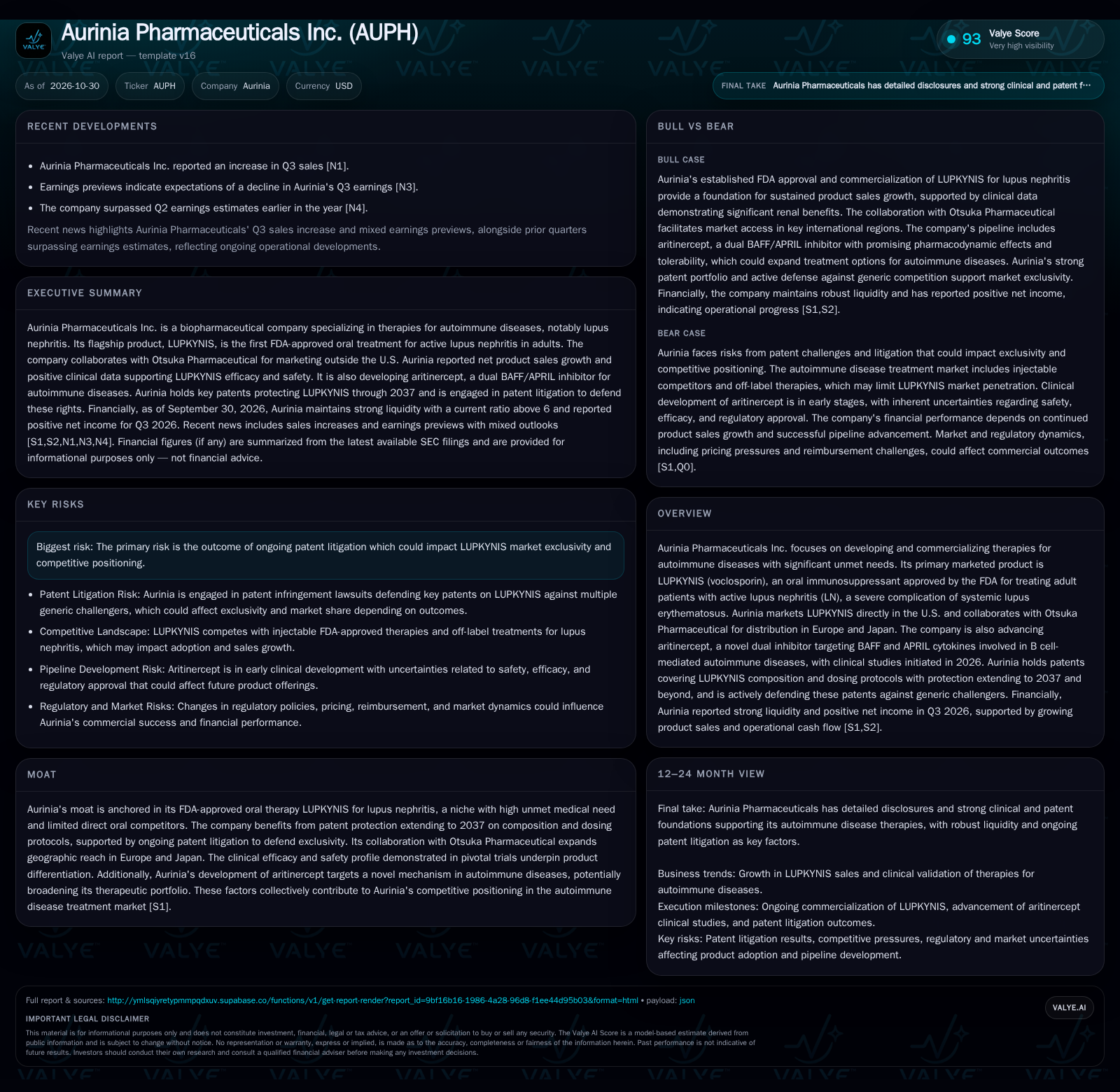
Aurinia Pharmaceuticals reported strong 2025 sales growth and positive Q3 2026 earnings, driven by LUPKYNIS for lupus nephritis. Its patent portfolio extends exclusivity for LUPKYNIS, but litigation against generics is ongoing. The next phase depends on pipeline progress—particularly dual BAFF/APRIL inhibitor aritinercept—and maintaining market differentiation amid competition from injectables and off-label therapies. Robust current assets support near-term operations, but future value creation will rely on successful pipeline execution and patent defense [S1] [S2].
Aurinia Pharmaceuticals stands at a critical juncture: its flagship drug LUPKYNIS has established a commercial and clinical beachhead in lupus nephritis, driving double-digit sales growth and positive earnings. However, the company’s future will be shaped by its ability to defend LUPKYNIS’s patent moat against generic challengers and to diversify with new therapies like aritinercept. As the competitive and regulatory landscape for autoimmune treatments intensifies, Aurinia’s mix of current profitability, pipeline ambition, and litigation risk sets up a high-stakes next chapter for investors and patients alike.
Recent Sales Momentum, Patent Litigation, and Pipeline Initiation Define 2026 Backdrop
Aurinia’s 2025 net product sales of $271.3 million for LUPKYNIS marked a 25% increase year-over-year, reflecting continued commercial traction in the lupus nephritis market [S1]. The company reported Q3 2026 net income of $31.7 million, with basic EPS of $0.24 and diluted EPS of $0.23 [S2]. Financially, Aurinia held $45.8 million in cash and $440.7 million in short-term investments as of September 30, 2026, yielding a current ratio of 6.12 and cash ratio of 5.07 [S2].
On the strategic front, Aurinia maintains patent protection for LUPKYNIS’s composition and dosing through 2037 and beyond, but is actively litigating against generic challengers seeking to enter the market [S1]. Meanwhile, the company initiated clinical studies for aritinercept, a dual BAFF/APRIL inhibitor targeting additional autoimmune indications, in 2026 [S1]. These facts frame the company’s near-term profitability, ongoing legal risks, and future growth optionality.
How LUPKYNIS’s Commercial Model Supports Profitability—And What Could Change
Aurinia’s revenue model is currently dominated by LUPKYNIS, an oral immunosuppressant for lupus nephritis, distributed in the U.S. via specialty pharmacies and through Otsuka in Europe and Japan [S1]. As an oral alternative to injectables, LUPKYNIS may command a premium price, but must compete on both efficacy and convenience. The product’s fixed-cost base—encompassing a specialized sales and marketing team—suggests strong potential for operating leverage as volumes grow.
Gross-to-net adjustments, payer mix, and access hurdles are likely to influence realized pricing. If LUPKYNIS can further penetrate the addressable LN population, incremental sales may flow disproportionately to the bottom line given Aurinia’s reported current ratio and positive net income [S2]. However, the company’s financial trajectory remains highly sensitive to exclusivity duration: a loss in patent litigation could trigger rapid price erosion and volume loss as generics enter. Near-term capital needs appear modest, but the economics of aritinercept—still in early clinical development—are highly uncertain and will depend on trial outcomes, competitive differentiation, and payer acceptance.
Defending a Niche: Patent Barriers, Oral Formulation, and the Challenge of Injectables
Aurinia’s competitive positioning rests on several pillars: first-mover advantage with LUPKYNIS as the only FDA-approved oral therapy for lupus nephritis, a patent estate extending to 2037, and a distribution alliance with Otsuka for non-U.S. markets [S1]. The oral route differentiates LUPKYNIS from injectable competitors, potentially improving patient adherence and quality of life. However, the LN market remains crowded with biologics, off-label immunosuppressants, and evolving standard-of-care regimens.
The most immediate threat is generic entry, which would likely erode both price and share. Patent litigation outcomes are thus central to Aurinia’s defensibility. Beyond LUPKYNIS, aritinercept’s dual BAFF/APRIL inhibition offers a novel mechanism, but faces a competitive field of next-generation autoimmune drugs—many from larger, better-resourced pharmaceutical players. Aurinia’s ability to maintain exclusivity, expand indications, and build a durable prescriber base will determine whether its current advantage proves fleeting or sustainable.
What Would Unleash Durable Growth: Patent Wins and Pipeline Success
The most constructive scenario for Aurinia is a combination of successful patent defense—extending LUPKYNIS exclusivity through at least 2037—and robust expansion of the drug’s market share, both in the U.S. and through Otsuka-partnered geographies. In this case, continued double-digit sales growth could drive sustained profitability and cash accumulation, with operating leverage improving as fixed costs are absorbed by higher volumes.
Aritinercept, if clinical development validates its dual BAFF/APRIL approach in autoimmune diseases beyond lupus nephritis, could add a second commercial pillar and diversify revenue. Evidence confirming this scenario would include favorable court decisions upholding patent claims, further LUPKYNIS sales acceleration, successful regulatory approvals in new markets or indications, and positive Phase 2/3 data for aritinercept. Any signal of payer adoption or guideline inclusion for new indications would further reinforce the thesis.
Sustained LUPKYNIS Sales with Patent Overhang and Measured Pipeline Progress
The most plausible path is that Aurinia continues to grow LUPKYNIS sales but at a moderating rate as the pool of treatment-naïve LN patients is gradually penetrated and competitive pressure from injectables and off-label regimens intensifies. Patent litigation may drag on, creating periodic headline risk and uncertainty about future exclusivity, but with no immediate loss of protection.
Aritinercept advances through early-stage clinical trials, incurring R&D expense but not yet contributing materially to revenue or margin. Financially, the company maintains a strong current-asset position, supporting ongoing operations and pipeline investment. Confirmation of this scenario would be steady, if less dramatic, year-over-year revenue growth, continued positive operating income, and incremental pipeline disclosures without major binary outcomes.
Patent Loss or Clinical Setbacks Could Trigger Rapid Value Erosion
The bear case centers on adverse patent litigation outcomes that allow generic LUPKYNIS competitors to enter the market before 2037, leading to sharp price reductions and rapid erosion of both market share and profitability. Given the current product concentration, such a scenario could quickly reverse earnings momentum and strain Aurinia’s ability to fund R&D from internal cash flow.
A secondary risk is clinical or regulatory setbacks for aritinercept, which would eliminate the next-best hope for pipeline-driven diversification. Additional negative drivers could include payer pushback on LUPKYNIS pricing, faster-than-expected saturation of the LN market, or new entrants with superior efficacy, safety, or convenience. Confirmation would come from unfavorable court rulings, disclosure of generic settlements or launches, failed or inconclusive clinical trial results, or unexpected negative trends in LUPKYNIS sales or margins.
Factors That Could Shift Aurinia’s Risk-Reward Profile in the Next 12–24 Months
Outcome and timeline of ongoing LUPKYNIS patent litigation—any legal decisions, settlements, or generic entry announcements would be highly material.
Quarterly LUPKYNIS sales growth rates, payer mix, and realized net pricing—especially if disclosed by region or channel.
Updates on aritinercept clinical trial enrollment, data readouts, and regulatory interactions—early efficacy or safety signals would help test pipeline potential.
Trends in operating expenses, particularly R&D versus SG&A allocation, to assess scalability and pipeline investment discipline.
Changes in competitive landscape—new approvals, guideline updates, or major off-label use shifts in lupus nephritis.
Announcements of additional licensing, partnership, or M&A activity that could diversify the revenue base or accelerate pipeline progress.
If disclosed, patient adherence rates and real-world outcomes for LUPKYNIS to gauge long-term differentiation and retention.
Disclaimer: This is research-only, informational analysis and not investment advice. It may include AI-generated interpretation and general industry context. Always verify important details using primary sources.

Comments