
Oppenheimer Holdings: Wealth Management Expansion, Legal Overhangs, and the Stakes of Technology Integration
Oppenheimer Holdings is navigating a period of strategic investment in wealth management and technology, while resolving major legal liabilities and adapting to evolving market and regulatory pressures. The firm's broad business mix, experienced advisor base, and focus on digital modernization offer levers for growth, but persistent legal, compliance, and talent risks shape the outlook.
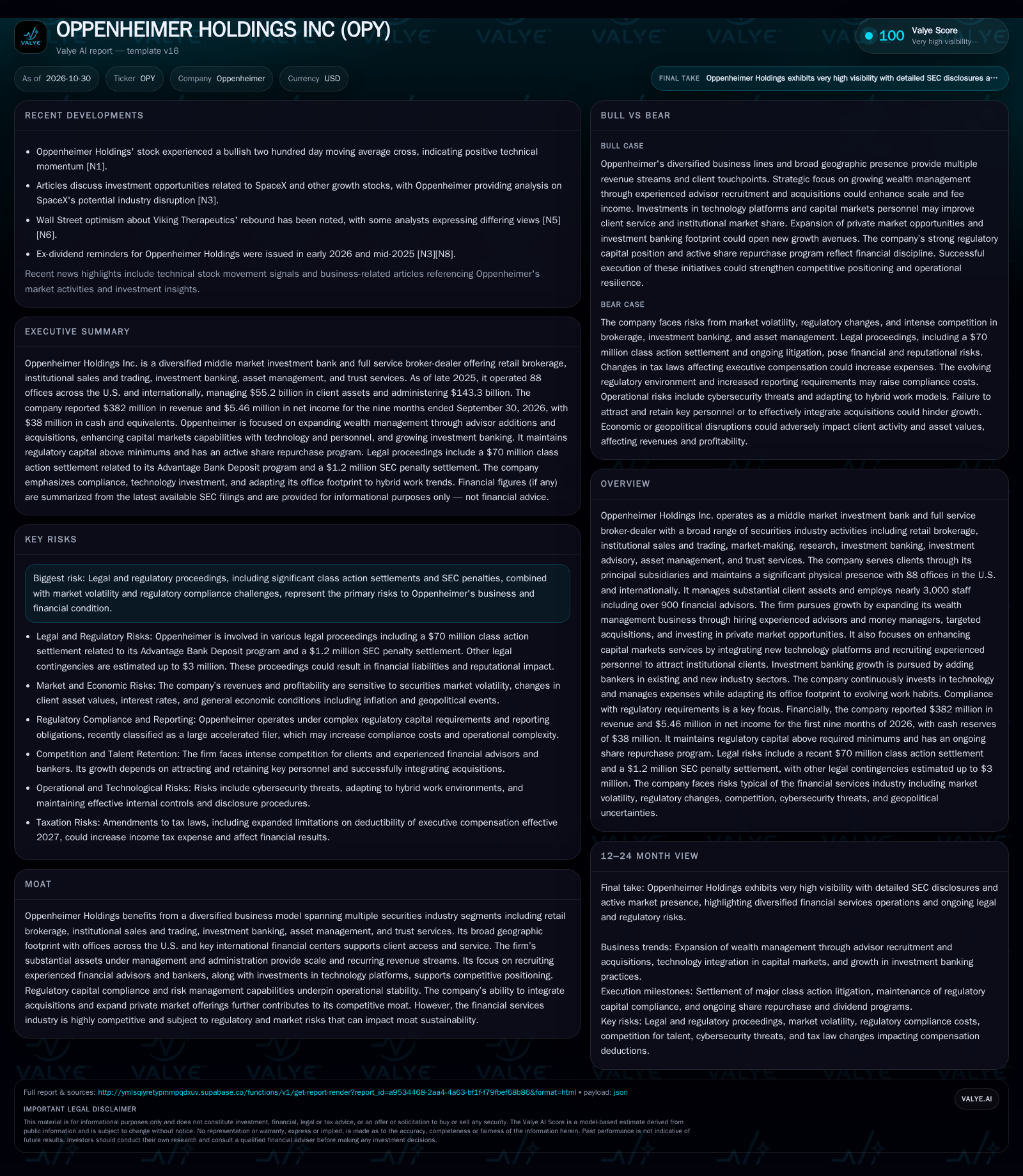
Oppenheimer Holdings is expanding its wealth management and capital markets businesses through advisor recruitment, technology upgrades, and targeted acquisitions. Recent settlements—including a $70 million class action—underscore ongoing legal and compliance risks. The company’s financial performance reflects diversified revenue streams, but future growth will depend on talent retention, successful integration of new technology, and resilience to regulatory and market volatility. [S2]
Oppenheimer Holdings stands at a crossroads familiar to mid-sized financial services firms: leveraging its scale in wealth management and capital markets to drive growth, while actively managing the risks of litigation, regulatory change, and competitive pressure. The company’s current strategy emphasizes advisor recruitment, technology investment, and selective acquisitions—moves that could reinforce its fee-based revenue streams and client retention. However, recent large legal settlements and evolving compliance demands illustrate the persistent headwinds facing the sector. The question is whether Oppenheimer’s operational discipline and investment in talent and technology can outpace rising costs and external risks over the next cycle.
Recent Settlements, Asset Scale, and Strategic Priorities Shape the Starting Point
Oppenheimer Holdings recently resolved two major legal matters: a $70 million class action settlement related to its Advantage Bank Deposit program and a $1.2 million SEC penalty, both of which were finalized in 2026. These events remove near-term legal uncertainty but underscore the firm’s ongoing exposure to regulatory and litigation risk, with other potential liabilities estimated up to $3 million. [S2]
Financially, Oppenheimer reported $382 million in revenue and $5.46 million in net income for the nine months ending September 30, 2026. Client assets under administration (CAUA) were $143.3 billion, and assets under management (AUM) stood at $55.2 billion as of year-end 2025, highlighting the company’s footprint in wealth management and advisory. [S2] [S1]
Strategically, the firm is focused on expanding its wealth management business by hiring experienced advisors and pursuing targeted acquisitions, while also investing in technology platforms for capital markets and reviewing its physical office footprint in response to hybrid work trends. [S2]
How Oppenheimer’s Revenue Model and Cost Structure Drive Profitability
Oppenheimer generates revenue through a diversified mix: commissions and fees from retail brokerage, advisory and management fees from wealth management, underwriting and advisory fees from investment banking, and trading income from institutional sales and market-making. The firm’s scale in client assets allows for recurring fee income, particularly in asset and wealth management, which can dampen volatility relative to transaction-driven revenue streams.
Wealth management is a capital-light, fee-based business where operating leverage can emerge as client assets and advisor headcount grow, provided that compensation and compliance costs are contained. In contrast, investment banking and trading are more cyclical and sensitive to market volumes, deal activity, and risk appetite.
The company’s ongoing investments in technology—aimed at both client experience and operational efficiency—could lower long-term unit costs, but may raise near-term expenses. Additionally, Oppenheimer’s approach to expansion through advisor recruitment and acquisitions suggests a variable cost structure tied to revenue-generating personnel. This may help contain fixed costs, but could also limit margin expansion if competitive labor markets drive up compensation.
Legal and regulatory costs remain a wildcard in the expense base, with recent settlements directly impacting net income. The company’s ability to maintain regulatory capital above minimums supports business continuity and client trust, but persistent compliance demands could further pressure margins.
Navigating Middle Market Competition and the Race for Talent
Oppenheimer operates in a highly competitive landscape, facing pressure from large wirehouses, regional broker-dealers, independent RIAs, and fintech entrants. The firm’s advantage lies in its middle-market focus, broad service offering, and established relationships—yet these are not insurmountable moats in a sector where switching costs for clients and advisors can be moderate.
A critical battleground is talent: experienced financial advisors and bankers are mobile and often targeted by aggressive recruiting from both traditional and digital-first competitors. Oppenheimer’s strategy of expanding through advisor hires and selective acquisitions is a recognition that scale and relationship depth underpin both revenue and retention.
Technology is another axis of competition. Digital platforms, client portals, and integrated back-office systems are increasingly table stakes—not only for client satisfaction but also for regulatory compliance and cost management. Oppenheimer’s ongoing technology investments may help sustain relevance and efficiency, but the pace of innovation among fintechs and larger rivals is formidable.
While regulatory capital strength and a history of compliance support client confidence, legal and reputational risks can threaten competitive standing if not managed proactively.
If Wealth Management Expansion and Technology Integration Unlock Operating Leverage
The most favorable scenario for Oppenheimer is one in which its investments in advisor recruitment, acquisitions, and technology integration translate into accelerated growth in client assets, improved advisor productivity, and enhanced fee-based revenue. If the company succeeds in onboarding high-producing advisors, cross-selling services, and scaling its digital capabilities, operating leverage could emerge—driving margin expansion even as the business grows.
Confirmation of this scenario would come from sustained increases in CAUA and AUM, rising advisory and management fee income, and improving pre-tax margins. Evidence of successful technology deployment would include higher client satisfaction, reduced operational errors, and lower administrative costs. Further, if legal and regulatory costs stabilize post-settlement, more cash could be directed toward growth investments or shareholder returns.
A falsification would be persistent stagnation in net new assets, advisor headcount, or fee revenue—especially if technology spending fails to yield measurable efficiency gains or client wins.
Growth Moderates as Legal, Compliance, and Labor Costs Offset Gains
The most plausible outcome is that Oppenheimer achieves moderate organic and acquisition-driven growth in wealth management and capital markets, but that rising legal, compliance, and talent costs offset much of the margin benefit. The firm continues to recruit advisors and integrate new technology, but competitive pressure on compensation and ongoing regulatory demands keep profitability in check.
Evidence supporting this scenario would be steady but unspectacular growth in client assets and advisory revenue, stable or slightly rising expense ratios, and periodic legal or regulatory charges that reduce net income volatility but do not threaten solvency. The company’s ability to maintain regulatory capital above minimums and continue modest shareholder returns (repurchases, dividends) would further confirm this middle path.
This scenario would be challenged if either cost escalation materially outpaces revenue growth, or if regulatory or reputational setbacks undermine advisor or client retention.
Margin Erosion from Litigation, Compliance Overheads, and Talent Drain
The adverse scenario is characterized by recurring legal and regulatory liabilities, escalating compliance costs, and an inability to attract or retain key advisors and bankers. In this situation, Oppenheimer’s revenue base stagnates or declines as client assets migrate to competitors with stronger digital offerings or lower-cost models.
This could manifest as further large legal settlements, rising insurance costs, or adverse regulatory findings that restrict business lines or increase capital requirements. If advisor headcount falls or net asset flows turn negative, fee-based income would come under pressure. The company may also be forced to curtail shareholder returns or raise capital to address regulatory shortfalls.
Confirmation would come from declining AUM/CAUA, falling advisor numbers, deteriorating margins, and new disclosures of legal or compliance setbacks. Conversely, stabilization of legal outflows and advisor retention would challenge this outcome.
Signals That Will Test Oppenheimer’s Wealth Management and Compliance Thesis
Net new client assets under administration (CAUA) and assets under management (AUM) growth rates—especially relative to advisor headcount—would help validate the effectiveness of recruitment and retention strategies.
Advisory and management fee income as a proportion of total revenue, if disclosed, would reveal the success of the shift toward recurring, fee-based business.
Advisor and banker turnover or net hiring rates would indicate Oppenheimer’s competitiveness in attracting and retaining top talent.
Quarterly legal and regulatory expense disclosures—including any new settlements, fines, or litigation reserves—will be critical for assessing ongoing risk.
Updates on technology integration milestones—such as platform rollouts, digital client adoption, or process automation—would help test the operational leverage thesis.
Expense ratios (compensation, technology, compliance) relative to revenue over time would reveal the company’s ability to manage costs as it scales.
Changes in regulatory capital ratios and any commentary on capital adequacy would indicate resilience to market or compliance shocks.
Management commentary or disclosure on the impact of tax law changes (e.g., Section 162(m) amendments) on compensation expense and after-tax profitability would clarify forward earnings risk.
Disclaimer: This is research-only, informational analysis and not investment advice. It may include AI-generated interpretation and general industry context. Always verify important details using primary sources.

Comments