
Mastech Digital: Managing Seasonality and Competition with a reported balance sheet position
Mastech Digital’s latest quarter underscores its debt-free, liquid position and highlights the operational challenges of seasonality and revenue recognition in the digital staffing industry.
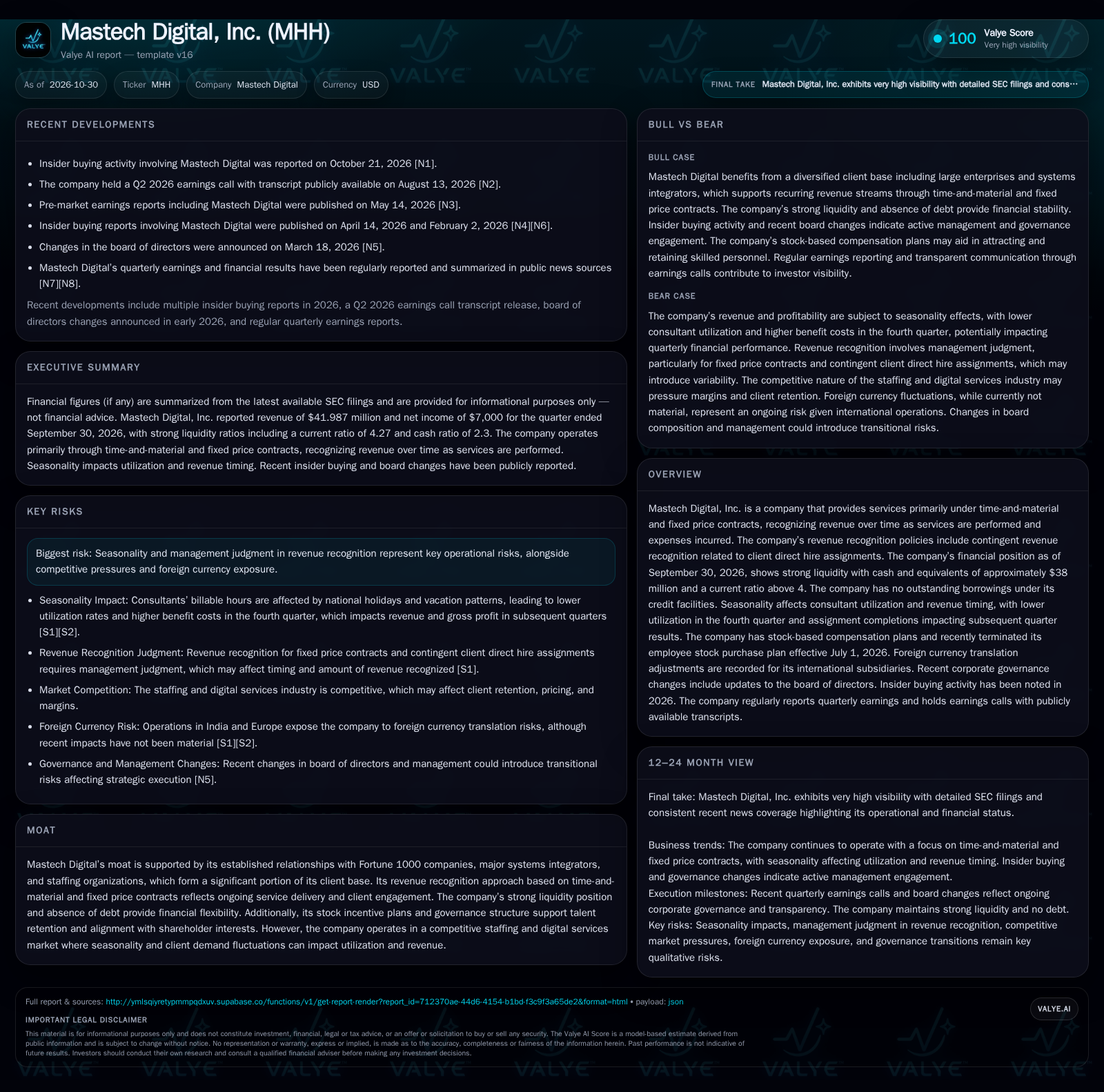
Mastech Digital reported $41.99 million in Q3 2026 revenue and a net income near breakeven, while maintaining a reported cash position and no outstanding debt. Seasonality and management judgment in revenue recognition remain key operational variables. Board changes and repeated insider buying in 2026 point to engaged governance, but competitive industry dynamics and utilization swings are core challenges ahead. [S2] [N1] [N4] [N5]
Mastech Digital, a provider of digital staffing and IT services, enters late 2026 with a notably reported balance sheet position—nearly $38 million in cash, no debt, and a reported current ratio. Yet, despite this financial solidity, Q3 profitability was razor-thin, reflecting the sector’s operational volatility. The company’s business hinges on time-and-material and fixed price contracts, but faces pronounced seasonality and the competitive realities of digital staffing. Recent board changes and insider buying suggest engaged oversight, but the real test will be whether Mastech can translate its potential financial flexibility and client relationships into improved margins and more consistent profit growth.
Q3 2026 Snapshot: Profit Breakeven, High Liquidity, and Governance Activity
In the quarter ended September 30, 2026, Mastech Digital reported revenue of $41.987 million and net income of just $7,000, resulting in earnings per share of $0.00 [S2]. The company’s cash and cash equivalents stood at $37.939 million, with current assets of $70.532 million and current liabilities of $16.526 million, yielding a current ratio of 4.27 and a cash ratio of 2.3 [S2]. Importantly, there are no outstanding borrowings under the company’s credit agreements [S2].
2026 has seen multiple insider buying events and a change in board composition, highlighting a period of active governance and potential strategic recalibration [N1] [N4] [N5]. Seasonality remains a material operational factor, with the company noting lower consultant utilization and higher benefit costs in the fourth quarter, which then affect revenue and margin in the following quarter [S1] [S2].
How Mastech Digital’s Revenue Model and Cost Structure Shape Its Earnings Profile
Mastech Digital primarily generates revenue through time-and-material (T&M) and fixed price contracts, with revenue recognized over time as services are delivered and expenses incurred [S1]. This model offers flexibility in matching revenue with costs, but creates exposure to fluctuations in billable consultant hours and client demand. T&M contracts typically provide more immediate revenue visibility, while fixed price engagements can introduce margin variability depending on project execution and resource allocation.
Management judgment is required for revenue recognition, particularly for fixed price and contingent direct hire assignments, introducing potential volatility in reported results [S1]. Seasonality further complicates earnings predictability, as consultant utilization dips and benefit costs rise in the fourth quarter, reducing gross profit margins and impacting subsequent quarters [S1] [S2].
The company reported cash and liquidity metrics for the period; these figures do not by themselves establish operating runway, investment capacity, financial flexibility, or financing capacity. Operating leverage is present but likely muted by the variable nature of staffing costs and the project-based revenue model. The termination of the employee stock purchase plan in July 2026 may modestly reduce share-based dilution, but the impact on employee retention or incentive alignment is less clear.
Client Relationships, Industry Rivalry, and Substitution Risks in Digital Staffing
Mastech Digital’s moat is anchored in its relationships with Fortune 1000 clients and major systems integrators, providing access to large, repeat business opportunities and potential for expanded wallet share. However, the staffing and digital services industry is highly fragmented and competitive, with numerous players—ranging from global IT consultancies to niche staffing firms—competing on price, speed, and access to talent.
Switching costs for clients are generally low, especially for commoditized staffing assignments, though deeper digital transformation projects may embed the company more tightly within client ecosystems. Substitution risk is ever-present: advances in automation, offshoring, and the rise of gig platforms could pressure traditional staffing models, potentially eroding pricing power and compressing margins over time.
Foreign currency exposure from operations in India and Europe is currently not material but could become a factor if exchange rates shift meaningfully [S1] [S2].
If Utilization Improves and Governance Delivers: What a Margin Recovery Could Look Like
An upside scenario would see Mastech Digital leveraging its client base and potential financial flexibility to drive higher consultant utilization rates, particularly in the seasonally weak quarters. Improved project win rates, more efficient resource allocation, or enhanced digital solution offerings could all contribute to better billable hour realization and higher gross margins.
Board changes and insider buying in 2026 may presage a renewed strategic focus or operational discipline, potentially resulting in a more agile response to cyclical swings or competitive threats [N1] [N4] [N5]. If the company is able to reduce reliance on lower-margin assignments, improve pricing discipline, or secure longer-term contracts with higher embedded value, operating leverage could drive a more meaningful step-up in profitability.
Confirmation of this scenario would require sustained increases in quarterly net income, higher consultant utilization rates (if disclosed), and evidence of client wins or contract expansions in higher-value digital services. Conversely, if margin improvement fails to materialize despite these governance signals, the upside thesis would be weakened.
Sustaining Operations Amid Seasonality and Competitive Churn
The most plausible outcome is that Mastech Digital continues to operate with modest profitability, reported liquidity position, and periodic swings in quarterly earnings driven by seasonality and competitive dynamics. The company’s reliance on T&M and fixed price contracts should support a base level of revenue, but consultant utilization and benefit costs will likely continue to drive quarter-to-quarter volatility.
Board and management transitions may yield incremental improvements in execution, but are unlikely to dramatically alter the company’s competitive positioning or cost structure in the near term. The digital staffing sector’s inherent price competition and low switching costs will probably cap margin expansion absent a step-change in value-added offerings or client mix.
Evidence supporting this scenario would include continued breakeven or low-single-digit net income quarters, stable cash balances, and no material increase in debt or deterioration in liquidity. A significant deviation—either positive or negative—in utilization rates, gross margins, or contract win rates would shift the outlook.
When Seasonality and Margin Compression Overwhelm the Balance Sheet
A negative scenario could unfold if seasonality becomes more pronounced, leading to sustained periods of low consultant utilization and higher benefit costs that erode gross margins and push the company into recurring losses. Competitive pricing pressure or loss of major clients could further compress revenue, while the fixed cost base limits flexibility to adjust quickly.
If management judgment in revenue recognition leads to greater volatility or negative surprises—particularly in fixed price or contingent assignments—investor confidence could suffer, potentially constraining access to new business or future capital (if needed). Board and management transitions, if not well executed, could exacerbate operational disruption or distract from core execution.
Confirmation of a downside case would be evident in consecutive quarters of net losses, declining cash balances, or the emergence of short-term borrowings. A spike in client churn, significant reduction in billable hours, or negative news around contract disputes would further validate the bear thesis.
What Will Prove Whether Mastech Digital Converts Liquidity into Sustainable Profit?
Quarterly net income trends: Sustained movement above breakeven would support the case for improved operational discipline and pricing power.
Consultant utilization rates (if disclosed): Rising utilization, especially in typically weak quarters, would be a strong signal of execution improvement.
Gross margin changes: Any material expansion or contraction in gross margins would illuminate the impact of pricing, mix, and cost management.
Client retention and contract win announcements: Evidence of new or renewed large-scale contracts, particularly in higher-margin digital services, would bolster the growth thesis.
Board and management stability: Lack of further disruptive governance changes would reduce execution risk.
Incidence of negative revenue recognition surprises: Unusual adjustments or restatements related to fixed price or contingent contracts would be a red flag for reporting quality.
Disclaimer: This is research-only, informational analysis and not investment advice. It may include AI-generated interpretation and general industry context. Always verify important details using primary sources.

Comments