
Resolution Minerals Ltd: Early-Stage Critical Minerals Exploration, Permitting Progress, and the Stakes of Resource Definition at Horse Heaven
With a major land position in Idaho's mineral-rich terrain and a focus on antimony and tungsten, Resolution Minerals has advanced exploration at the Horse Heaven Project and secured a FAST-41 permitting advantage. The path to economic viability, however, hinges on drilling success, resource delineation, and the ability to transition from explorer to developer amid high capital needs and commodity price volatility.
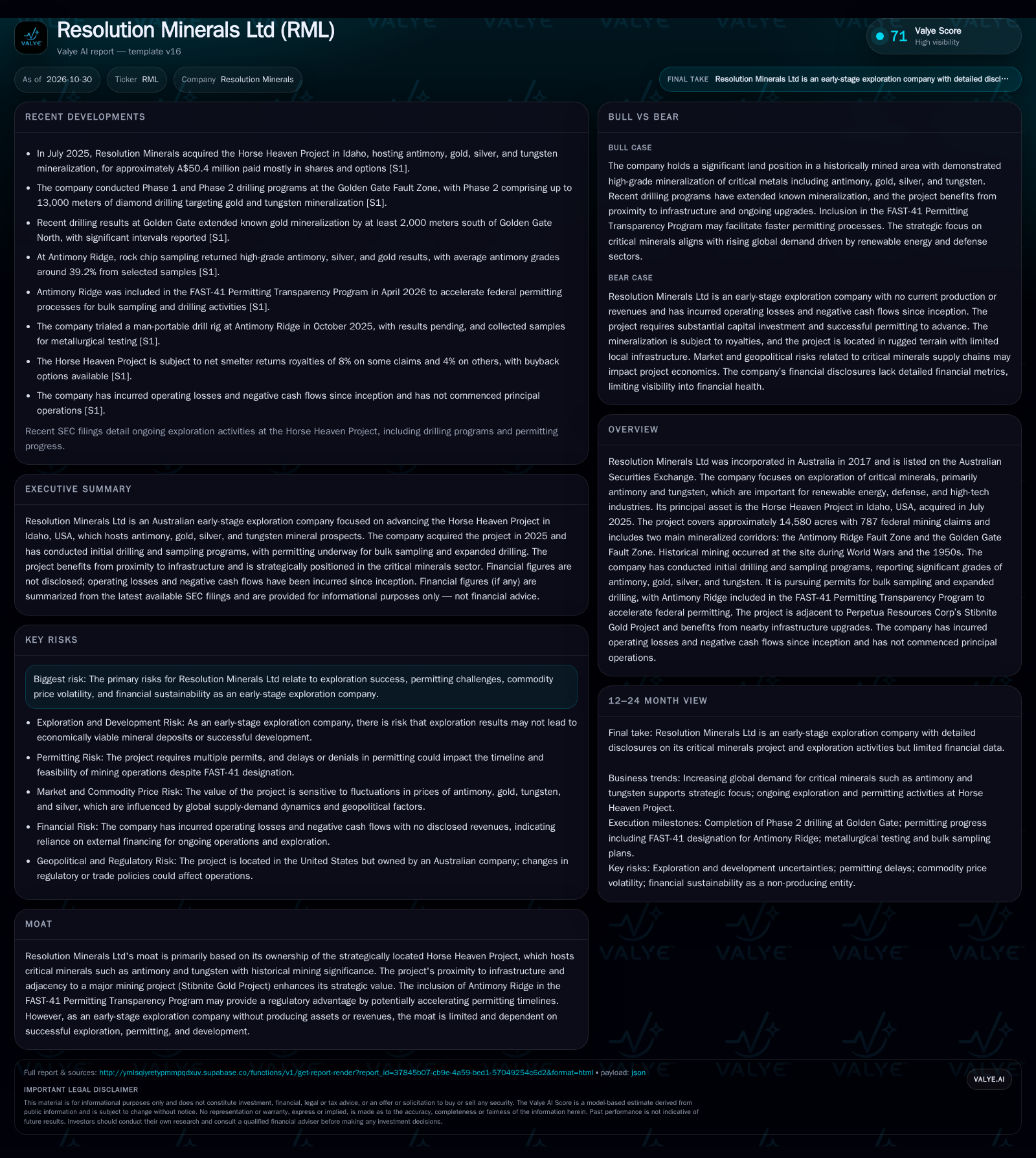
Resolution Minerals Ltd has acquired the Horse Heaven Project in Idaho, targeting antimony, gold, silver, and tungsten. The company’s inclusion in the FAST-41 program could streamline permitting, but there is no production or revenue, and operating losses persist. The real test will be whether ongoing drilling and sampling translate into economically viable mineral resources and eventual project development. [S1]
Resolution Minerals Ltd stands at the intersection of rising critical mineral demand and the daunting economics of early-stage exploration. With the 2025 acquisition of Idaho’s Horse Heaven Project—a 14,580-acre property hosting antimony, gold, silver, and tungsten prospects—the company has secured a strategic footprint adjacent to major mining infrastructure and benefited from regulatory acceleration via the FAST-41 program. Yet the path from promising surface samples and extended drill intercepts to economic extraction is fraught with capital intensity, permitting risk, and the challenge of converting geological potential into bankable resources. The next phase will test whether Resolution can move beyond exploration into a credible development trajectory. [S1]
Recent Project Acquisition and Exploration Milestones Shape the Opportunity
In July 2025, Resolution Minerals acquired the Horse Heaven Project in Idaho for approximately A$50.4 million, paid mostly in shares and options, positioning itself in a region with historical mining activity and proximity to infrastructure upgrades. The project covers 14,580 acres and includes two main mineralized corridors: the Antimony Ridge Fault Zone and the Golden Gate Fault Zone. Recent exploration has delivered several technical advances: Phase 2 drilling at Golden Gate is underway (up to 13,000 meters) and has extended known gold mineralization by at least 2,000 meters, while rock chip sampling at Antimony Ridge returned high antimony grades (averaging 39.2% in select samples). Importantly, Antimony Ridge was accepted into the FAST-41 Permitting Transparency Program in April 2026, a designation intended to streamline federal permitting for bulk sampling and large-scale drilling. Despite these advances, the company remains pre-revenue and continues to report operating losses and negative cash flows, with no principal operations commenced and no disclosed financial metrics. [S1]
Early-Stage Exploration Economics: Capital Outlay, Royalties, and the Cost of Progress
Resolution Minerals’ current business model is typical of early-stage explorers: capital is deployed upfront for land acquisition, geological surveys, drilling, and permitting, with no operating cash flow until commercial production is achieved. The economics hinge on several conditional steps: first, proving up a mineral resource with sufficient scale and grade to justify development; then, securing permits and environmental approvals; finally, raising the capital required for mine construction and infrastructure. The project is subject to net smelter returns royalties of 8% on some claims and 4% on others (with buyback options), which will directly impact future margins if production is achieved. Until a maiden resource is delineated and feasibility studies are advanced, the company’s value is largely option-like, tied to exploration success and market perceptions of critical mineral scarcity. The capital required for transition to development—potentially hundreds of millions depending on project scope—will likely necessitate equity or joint-venture financing, which could be dilutive to current shareholders.
A critical consideration in early-stage exploration economics is the timing and scale of capital deployment relative to milestone achievements. Each phase of drilling and permitting increases the financial commitment, yet the probability-weighted value of the project depends heavily on positive exploration outcomes. If initial drill results fail to demonstrate consistent mineralization or if permitting encounters unexpected environmental or community challenges, subsequent capital raises may become more costly or difficult to secure. Conversely, early technical success can de-risk the project and enhance access to strategic investors or joint ventures, potentially reducing dilution. Therefore, the company's financial strategy must remain flexible, balancing aggressive exploration to define resources against prudent capital management to sustain operations through inherent uncertainties.
Strategic Positioning in Critical Minerals: Advantages and Counterforces
Resolution’s competitive positioning rests on several factors. The Horse Heaven Project’s location in Idaho, adjacent to Perpetua Resources’ Stibnite Gold Project, provides access to existing infrastructure such as roads, power, and an airport, reducing potential development hurdles. The area’s historical production of antimony and tungsten, now classified as critical minerals, aligns the project with growing demand from renewable energy and defense sectors—both of which seek secure, non-Chinese supply chains. However, Resolution faces competition from other North American critical mineral explorers, global mining majors with deeper financial resources, and substitutes for antimony and tungsten in end-use markets. The FAST-41 permitting advantage could provide a near-term edge by accelerating regulatory timelines, but this advantage is contingent on maintaining compliance and community relations. The project’s royalty burden and rugged terrain present additional challenges compared to lower-royalty or more accessible deposits.
The strategic advantage of proximity to existing infrastructure not only reduces upfront capital expenditure but also shortens project timelines, which can be decisive in attracting investment and advancing through permitting stages. However, this advantage is conditional on the infrastructure's capacity to support expanded mining operations and the compatibility of local environmental and social governance (ESG) standards with modern mining practices. Additionally, the critical minerals market is influenced by geopolitical factors and supply chain dynamics; thus, Resolution’s positioning benefits from alignment with national security priorities and import substitution policies. Yet, these macro factors can also introduce volatility in commodity prices and regulatory frameworks, underscoring the importance of adaptive project planning and stakeholder engagement to maintain competitive positioning.
Resource Definition and Permitting Acceleration Drive a Re-Rating
The most favorable outcome is one in which ongoing drilling at Golden Gate and Antimony Ridge confirms a substantial, high-grade resource of antimony, gold, tungsten, and silver, with metallurgical testing showing strong recoveries. FAST-41 status enables Resolution to secure bulk sampling and large-scale drill permits on an accelerated timeline, narrowing the gap to a maiden resource estimate. Rising prices for antimony and tungsten, driven by supply chain concerns and new energy/defense demand, further enhance project economics. Successful bulk sampling, positive metallurgy, and a published resource estimate would attract strategic partners or major mining companies, enabling non-dilutive funding for development. Confirmation of this scenario would come from: 1) substantial drill intercepts and resource upgrades; 2) timely permitting milestones; 3) favorable metallurgical results; and 4) partnership or offtake announcements.
In a scenario where resource definition and permitting proceed favorably, the integration of robust metallurgical data could significantly enhance project economics by optimizing processing methods and reducing operational costs. High recovery rates for antimony and tungsten, coupled with byproduct credits from gold and silver, would improve cash flow projections and project resilience against commodity price swings. Furthermore, successful demonstration of resource continuity and grade consistency may enable the company to advance to feasibility studies more rapidly, attracting higher-quality financing options. Strategic partnerships formed under these conditions could also facilitate technology transfer, operational expertise, and market access, collectively accelerating the path to production and increasing the likelihood of shareholder value realization.
Gradual Progress Amid Exploration Uncertainty and Capital Constraints
The most plausible path is one of incremental progress punctuated by technical and financial hurdles. Resolution continues its phased drilling, achieves permitting milestones with some delays, and gradually delineates a resource, but results are mixed—demonstrating potential but not yet at a scale or confidence level to justify immediate development. Commodity prices remain volatile, and while interest in critical minerals is high, financing conditions are challenging. The company may need to raise additional equity to fund ongoing exploration, potentially diluting existing shareholders. Confirmation of this scenario would include moderate resource updates, periodic permitting progress, and continued operating losses offset by periodic capital raises. Falsification would come from a breakthrough in resource size/grade, a major permitting setback, or a decisive move into development.
Exploration Disappointments and Permitting Delays Undercut Value
Adverse outcomes could arise from a combination of technical, regulatory, and financial setbacks. Drilling at Golden Gate and Antimony Ridge may reveal lower-than-expected grades, limited continuity, or metallurgical challenges that undermine resource potential. Permitting, despite FAST-41 designation, could face delays due to environmental opposition, regulatory scrutiny, or litigation. Commodity price declines further erode the economic case for development. Evidence of this scenario would include disappointing drill results, slow or stalled permitting, lack of progress toward a maiden resource, and repeated down-round financings.
Milestones That Will Test Resolution Minerals’ Transition from Explorer to Developer
Progress on Phase 2 drilling at the Golden Gate Fault Zone, including length, grade, and continuity of gold and tungsten intercepts. [S1]
Permitting outcomes and timelines for bulk sampling and expanded drilling at Antimony Ridge under the FAST-41 program. [S1]
Results of metallurgical testing on Antimony Ridge samples, which will impact process recoveries and economic feasibility. [S1]
Publication of a maiden mineral resource estimate for either Antimony Ridge or Golden Gate, if disclosed.
Capital raising events, including terms and dilution, and any evidence of strategic partnerships or joint ventures.
Commodity price trends for antimony, tungsten, and gold, as these will shape project economics and investor interest.
Updates on infrastructure access or potential agreements with neighboring mining projects, which could lower development hurdles.
Disclaimer: This is research-only, informational analysis and not investment advice. It may include AI-generated interpretation and general industry context. Always verify important details using primary sources.

Comments