
Allegro MicroSystems: Navigating Automotive Exposure and Semiconductor Cyclicality with Innovation and Strategic Discipline
Allegro MicroSystems’ heavy reliance on the automotive sector, combined with supply chain and competitive headwinds, shapes both its risk profile and its growth potential. Recent product launches and leadership changes aim to capture opportunities in a rapidly evolving analog semiconductor landscape, but the company’s fortunes remain tightly linked to volatile end markets and external supply dynamics.
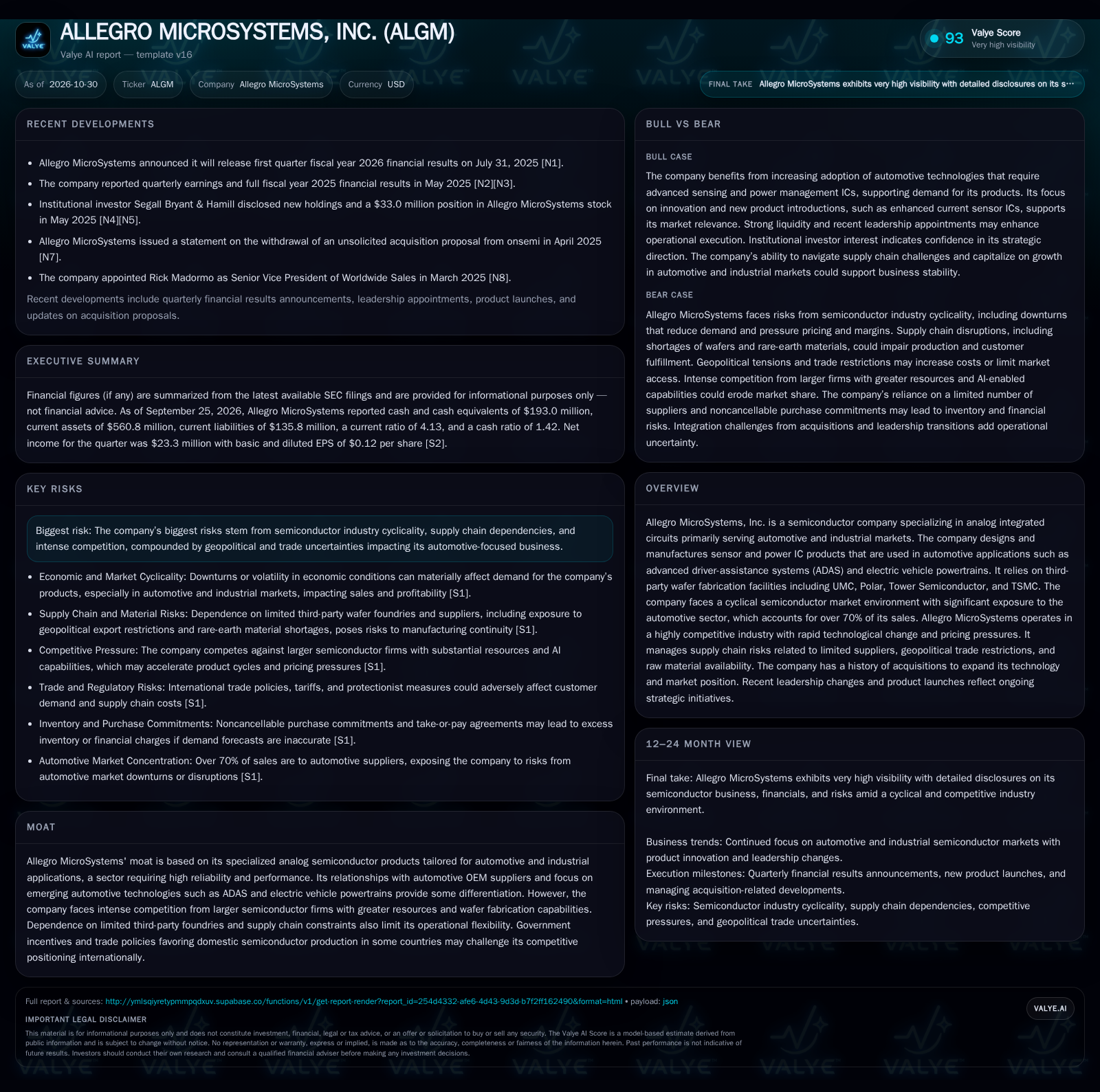
Allegro MicroSystems is a specialist in analog semiconductors for automotive and industrial markets, with over 70% of sales tied to automotive customers. Monitoring inventory management, execution on new product adoption, and market conditions will be critical for testing the durability of Allegro’s current trajectory. [S2]
Allegro MicroSystems stands at a strategic crossroads, balancing its deep entrenchment in the automotive semiconductor supply chain with mounting pressures from market cyclicality, supply disruptions, and aggressive competition. The leadership team’s recent changes and targeted innovation efforts underscore Allegro’s intent to maintain relevance and resilience—but the risk profile remains tightly coupled to industry and macroeconomic swings. [S2]
Recent Financials, Product Initiatives, and Leadership Shifts Define the Present
As of September 25, 2026, Allegro MicroSystems reported $193.0 million in cash and cash equivalents, $560.8 million in current assets, and $135.8 million in current liabilities, resulting in a current ratio of 4.13 and a cash ratio of 1.42. Net income for the quarter was $23.3 million, with basic and diluted EPS of $0.12 per share. These figures suggest a reported liquidity position and ongoing profitability. [S2]
The company’s business mix remains highly concentrated, with over 70% of sales linked to automotive suppliers—exposing Allegro to sector-specific volatility. [S1]
Product innovation continues, with the launch of current sensor ICs ACS37030MY and ACS37220MZ targeting enhanced automotive and industrial sensing applications. [S2]
Leadership changes include Mike Doogue’s appointment as President and CEO and Rick Madormo as Senior Vice President of Worldwide Sales, reflecting a refreshed focus on commercial execution and strategic growth. [N8]
Analog IC Economics: Volume, Mix, and the Realities of Automotive Supply Chains
Allegro’s core business is the design and sale of analog integrated circuits—primarily sensors and power management ICs—for automotive and industrial applications. Revenue is fundamentally driven by volumes shipped to tier-one automotive suppliers and manufacturers, with pricing and mix influenced by design wins in high-growth segments such as advanced driver-assistance systems (ADAS) and electric vehicle (EV) powertrains.
The analog semiconductor segment tends to feature relatively stable gross margins compared to commodity digital chips, reflecting specialized engineering and qualification processes, especially for automotive-grade parts. However, Allegro remains exposed to significant price pressure, particularly from large OEMs and well-capitalized competitors able to leverage scale or vertical integration.
The company’s use of third-party foundries like TSMC and Tower Semiconductor introduces a largely variable cost structure for wafer procurement, but Allegro’s noncancellable purchase commitments and take-or-pay agreements can force the company to absorb excess inventory or financial charges if demand forecasts prove inaccurate. Capital intensity is thus somewhat muted versus fully integrated peers, but working capital swings can be pronounced during demand shocks.
Operating leverage is available if volume ramps from new design wins outpace fixed SG&A and R&D spend, but margin expansion is heavily contingent on successful new product adoption and pricing discipline amid cyclical swings.
How Allegro Competes in a Crowded Analog and Sensor IC Landscape
Allegro’s differentiation is rooted in its focus on high-reliability, automotive-grade analog ICs, especially current and position sensors tailored for emerging ADAS, electrification, and safety applications. Relationships with major automotive suppliers and a track record in meeting rigorous qualification standards provide some customer stickiness—but do not create insurmountable switching costs.
Competition is fierce: large analog and mixed-signal semiconductor companies, some with substantial in-house wafer capacity and AI-enabled design capabilities, can outspend Allegro on R&D and price aggressively to win share. The rapid pace of technological change—driven by electrification, autonomy, and connected vehicle trends—puts a premium on innovation speed and the ability to secure design slots in next-generation vehicle platforms.
Allegro’s reliance on third-party foundries means it is less exposed to the capital intensity of in-house fabs, but also has less control over wafer allocation during industry-wide shortages. Supply chain flexibility thus remains a strategic vulnerability, especially if geopolitical or trade disruptions intensify.
The company’s acquisition history suggests a willingness to buy technology or market access to supplement organic growth, but integration and retention risks may erode the intended advantages if not managed carefully.
Capturing the Next Automotive Wave: When Product Innovation and Market Timing Align
The most compelling upside for Allegro would be a scenario in which the ongoing electrification and automation of vehicles accelerates, driving robust, multi-year demand for advanced sensor and power ICs. If Allegro’s new product introductions—including the ACS37030MY and ACS37220MZ current sensors—secure major design wins in electric or autonomous vehicle platforms, the company could achieve outsized volume growth and improved pricing power.
Further upside would be realized if Allegro manages to deftly navigate supply chain constraints, converting noncancellable purchase commitments into reliable, just-in-time inventory, thereby avoiding write-downs and maximizing fulfillment rates during demand spikes.
Confirmation of this scenario would include: sustained above-industry revenue growth, rising gross margins (indicating favorable mix and pricing), and visible design wins with leading automotive OEMs. Material increases in automotive content per vehicle and evidence of recurring business from platform wins would also support the thesis.
Conversely, failure to demonstrate adoption of new products in high-growth segments, or persistent margin compression due to pricing pressure or excess inventory, would undermine this upside.
Business as Usual: Navigating Cycles, Managing Commitments, and Incremental Progress
The most plausible near-term scenario is that Allegro continues to track the broader automotive semiconductor cycle, with moderate growth and margin performance shaped by end-market demand and its ability to manage inventory swings. Product launches and leadership changes may incrementally improve execution, but the company’s fortunes remain tightly coupled to automotive production volumes and macroeconomic health.
If Allegro executes well on supply chain management—matching noncancellable purchases with realized demand—it can avoid major inventory write-downs and maintain profitability. However, pricing pressure from OEMs and competition from larger analog IC suppliers will likely cap margin expansion.
Evidence confirming the base scenario would include steady, but not accelerating, revenue and earnings growth, gross margins in line with historical norms, and absence of major supply chain disruptions or inventory charges. Design win announcements and customer diversification would be positive, but not transformative, unless accompanied by step-change growth.
Deviations from this path—such as a sharp automotive downturn, significant competitive share loss, or inventory mismanagement—would signal a shift toward the downside.
When Cyclicality, Supply Chain Rigidities, and Market Concentration Collide
A credible adverse scenario arises if the automotive sector enters a sustained downturn or faces a shock (e.g., due to regulatory, consumer, or supply disruptions), sharply reducing demand for Allegro’s products. With more than 70% of revenue tied to this sector, such a contraction would quickly pressure top-line results.
In this environment, Allegro’s noncancellable purchase and take-or-pay agreements with suppliers could lead to excess inventory and financial charges, further eroding margins and cash flow. If competitors respond to the downturn by discounting aggressively or accelerating innovation cycles, Allegro could face both market share losses and margin compression.
Evidence of this downside would include revenue declines outpacing the broader market, inventory write-downs or elevated working capital, and shrinking gross margins. Prolonged supply chain disruptions—whether from geopolitical, trade, or material shortages—would exacerbate the risks.
Failure to integrate acquired businesses or to retain key talent after leadership changes would further impair execution and increase operational risk.
Milestones and Metrics That Will Determine Allegro’s Strategic Trajectory
Quarterly inventory turnover and the relationship between noncancellable purchase obligations and actual sales volumes—if disclosed—will be critical for assessing inventory risk management.
Gross margin trends, particularly in relation to new product introductions, will help gauge Allegro’s ability to capture value from innovation and defend against pricing pressure.
Design win disclosures in next-generation automotive platforms, especially in electric or autonomous vehicles, would indicate future revenue visibility and competitive relevance.
Revenue mix evolution—movement toward greater industrial or non-automotive sales—would suggest progress in diversifying end-market risk.
Evidence of recurring business or long-term supply agreements with leading automotive OEMs would help confirm customer stickiness and revenue durability.
Integration milestones and retention rates for key talent following acquisitions and leadership changes would be useful for monitoring operational continuity.
Updates on supply chain resilience, such as dual-sourcing or localization strategies, would help assess vulnerability to geopolitical and material disruptions.
Institutional investor activity, such as significant stake changes by major holders, could provide an external check on management credibility and market confidence.
Disclaimer: This is research-only, informational analysis and not investment advice. It may include AI-generated interpretation and general industry context. Always verify important details using primary sources.

Comments