
Harmony Gold’s Copper Drive: Cash Flow Inflection, Diversification, and the Stakes of Regulatory Uncertainty
Harmony Gold’s record free cash flow and surging dividend highlight a transformation underway: the company is leveraging copper expansion to counter gold cyclicality, but faces persistent South African regulatory risk and execution demands as it scales its multi-metal ambitions.
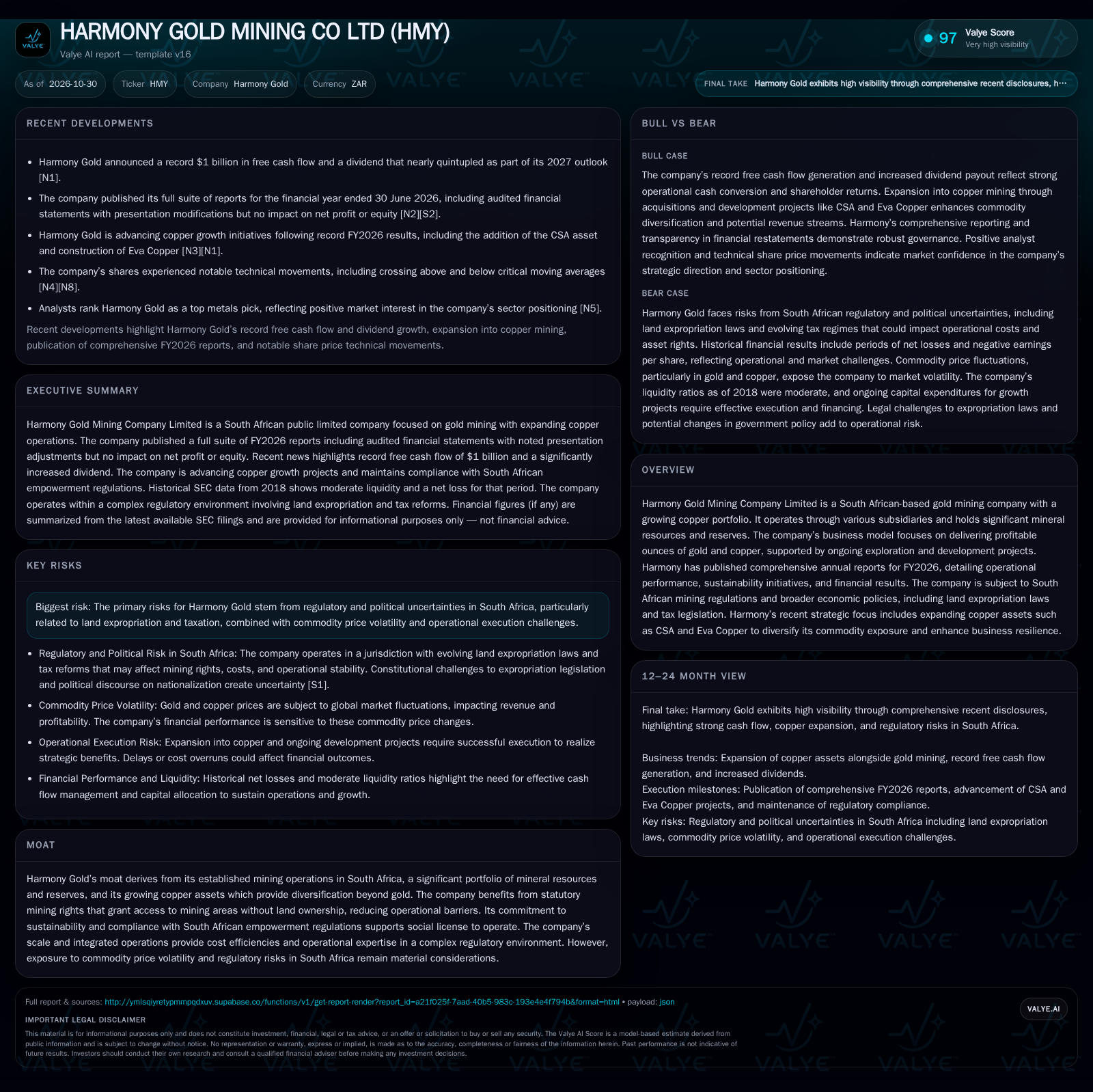
Harmony Gold generated record $1 billion free cash flow and nearly quintupled its dividend, signaling a cash conversion inflection. The company is advancing copper projects (CSA acquisition, Eva Copper construction) to diversify beyond gold and build resilience. However, its South African base exposes it to land expropriation and tax uncertainties, while capital allocation and project execution remain critical to sustaining momentum. Analyst favor and robust reporting transparency support the investment case, but commodity price swings and local regulatory flux remain material risks. [N1] [N3] [S2]
Harmony Gold Mining Company is at a strategic crossroads: after delivering record free cash flow and a dramatic dividend surge, it is betting on copper expansion to reshape its business profile. The company’s recent operational and financial disclosures underscore a turning point, with copper assets positioned to complement its traditional gold base and inject greater earnings resilience. Yet, as Harmony leverages its South African mining heritage and broadens its portfolio, it must also navigate persistent regulatory uncertainty and the execution risks that accompany large-scale capital redeployment. The next phase will test whether Harmony can sustain its cash flow momentum and strategic transformation amid shifting commodity cycles and local policy headwinds.
Recent Financial and Strategic Milestones Set a New Baseline
Harmony Gold reported record free cash flow of $1 billion and nearly quintupled its dividend as part of its 2027 outlook, marking a significant operational and financial inflection point. This surge in cash generation coincides with a clear pivot toward copper, as evidenced by the acquisition of the CSA asset and the ongoing construction of the Eva Copper project. These moves are designed to diversify Harmony’s revenue base and mitigate the inherent volatility of gold mining. The publication of a comprehensive suite of audited FY2026 reports, including a restatement that did not affect net profit or balance sheet integrity, underscores the company’s commitment to transparency and governance. Analysts have also ranked Harmony as a top sector pick, reflecting heightened market interest in its evolving strategy. [N1] [N3] [S2] [N5]
How Copper Expansion Could Transform Harmony’s Earnings Mix and Capital Cycle
Harmony Gold’s core business remains the extraction and sale of gold, a commodity with high operating leverage and exposure to global price cycles. Historically, gold mining economics are sensitive to grade, cost inflation, and capital intensity; margins can swing sharply with price or operational disruptions. The company’s record free cash flow in FY2026 signals strong operational cost control and favorable gold pricing, but this windfall is not structurally guaranteed.
By investing in copper assets—CSA and Eva Copper—Harmony is targeting a more balanced commodity mix. Copper generally offers lower price volatility than gold and is structurally supported by global decarbonization and electrification trends. If executed well, copper could provide steadier cash flows, improve asset turnover, and lower earnings volatility. However, large-scale copper projects are capital-intensive, with long development lead times and risk of cost overruns. The decision to sharply increase dividends alongside copper investment suggests management confidence in near-term cash flows, but also raises questions about future capital allocation discipline as project demands rise.
Harmony’s fixed cost base, typical of deep-level South African mines, may limit short-term margin flexibility. Copper’s economics—if efficiently integrated—could introduce more variable-cost leverage and potentially higher blended returns on invested capital over time, but this outcome depends heavily on project execution and commodity markets.
Positioning Amid Gold-Copper Hybrid Peers and Regulatory Headwinds
Harmony’s competitive profile is evolving as it seeks to join the ranks of global mid- and large-cap miners with multi-metal portfolios. Its established South African gold operations confer scale, resource access, and technical expertise, but also expose it to higher regulatory and political risk relative to miners with more diversified geographic footprints.
The addition of copper projects could help Harmony reduce reliance on a single commodity and partially offset the cyclical weaknesses of gold. However, it now competes not only with single-commodity gold miners but also with diversified mining groups active in both gold and base metals. These peers may enjoy lower jurisdictional risk, more diversified cash flows, and in some cases, superior capital efficiency.
Harmony’s statutory mining rights and local empowerment compliance provide a degree of operational resilience within South Africa, but do not fully insulate it from ongoing debates about land expropriation and tax reform. The competitive landscape is further shaped by the ability to execute large-scale project development without eroding returns or triggering balance sheet stress.
If Copper Integration Delivers: Pathways to Durable Cash Flow and Premium Valuation
The favorable scenario is one in which Harmony successfully brings its new copper assets online, integrating them operationally and commercially without major delays or overruns. If copper prices remain robust, these projects could meaningfully diversify revenue and reduce the company’s exposure to gold price downturns.
Evidence that would confirm this scenario includes: steady or rising copper production volumes, stable or improving project development timelines and budgets, and a free cash flow profile that remains strong even as capital expenditures for new assets ramp up. A narrowing valuation gap to global diversified miners, coupled with continued analyst upgrades, would further support the case that Harmony’s transformation is being recognized by the market.
Copper Ramp Balances Gold Cyclicality, But Regulatory Drag and Execution Hurdles Persist
The most plausible path is one where Harmony gradually increases its copper contribution, but the group’s earnings and cash flow remain dominated by gold for at least the medium term. Operational progress at CSA and Eva Copper is incremental, with modest delays or cost pressures typical of large mining projects. Dividend levels reflect current cash flow strength, but may need to be recalibrated if project capex or commodity prices swing.
Regulatory and political risk in South Africa remains a persistent drag on valuation, with land expropriation and tax debates periodically resurfacing. The company continues to generate solid cash flows, but its cost of capital and risk premium stay elevated relative to global peers with more stable operating environments.
This scenario would be confirmed by: incremental copper output, stable but not accelerating free cash flow, and periodic headwinds from local policy shifts or project cost inflation. Analyst sentiment remains positive, but upside is capped by risk overhangs and the slow pace of business mix transformation.
Project Missteps or Regulatory Shocks Could Erode Cash Flow and Investor Confidence
In a less favorable scenario, Harmony’s copper projects face significant delays, cost overruns, or operational setbacks, eroding expected diversification benefits. Simultaneously, a downturn in gold and copper prices compresses margins and puts pressure on the company’s ability to sustain elevated dividends or fund further expansion.
A severe regulatory event—such as more aggressive land expropriation measures or substantial tax hikes—could directly impact mine asset security, increase operating costs, or reduce future investment returns. In this environment, investors could demand a higher risk premium, and Harmony’s share price may lag both gold and diversified mining peers.
Confirmation of this scenario would include: negative project updates, unexpected capital needs, cuts to the dividend, or adverse regulatory actions that materially affect asset rights or cost structure. Any sign of deteriorating balance sheet health or sustained negative analyst revisions would further reinforce the downside case.
What Will Determine Whether Harmony’s Multi-Metal Pivot Succeeds?
Progress and cost discipline in the development and commissioning of the Eva Copper project—any delays or budget overruns would test management’s execution capabilities.
Quarterly and annual copper production volumes and realized prices, as reported—these will indicate the pace and economic impact of diversification.
Sustained free cash flow generation in the context of elevated capex and commodity price swings—a useful metric would be free cash flow per share, if disclosed.
Regulatory and legal developments in South Africa, especially regarding land expropriation laws, mining rights, and tax changes—monitor for any new legislative or constitutional challenges.
Analyst estimate revisions and changes in sector ranking—continued recognition as a top metals pick would signal market confidence.
Credit metrics and any material changes to leverage or liquidity—would help test resilience to commodity or operational shocks.
Disclaimer: This is research-only, informational analysis and not investment advice. It may include AI-generated interpretation and general industry context. Always verify important details using primary sources.

Comments