
Organon & Co.: Portfolio Transition, Margin Pressures, and the Stakes of Biosimilar Growth
Organon’s latest results reflect a company in the midst of portfolio transformation—navigating sharp declines in legacy contraceptives and respiratory products while pinning its hopes on biosimilars, new product launches, and operational restructuring. Whether these emerging growth levers can offset ongoing erosion in established brands remains the central question for the company’s future economics.
Organon is contending with steep sales declines in core legacy products due to generic competition and pricing, while seeing growth in select biosimilars and new launches like Vtama. The company is actively restructuring operations and divesting non-core assets, with gross profit under pressure from mix and cost factors. The main thesis is whether new growth segments can outpace legacy attrition and restore margin expansion.
Organon & Co. stands at a strategic crossroads as its legacy women’s health and respiratory franchises face accelerating erosion from generics and price competition. With significant sales declines in long-standing products offset only partly by gains in biosimilars and new launches like Vtama, the company’s transformation hinges on its ability to execute a shift toward differentiated, higher-growth assets. Recent restructuring, product divestitures, and cost control measures underscore management’s urgency, but the margin pressures and goodwill impairments of 2025 highlight the scale of the challenge. The critical test is whether Organon’s newer products can build enough momentum to counterbalance ongoing declines in its core revenue base.
Organon’s Recent Performance: Legacy Pressures and New Growth Levers
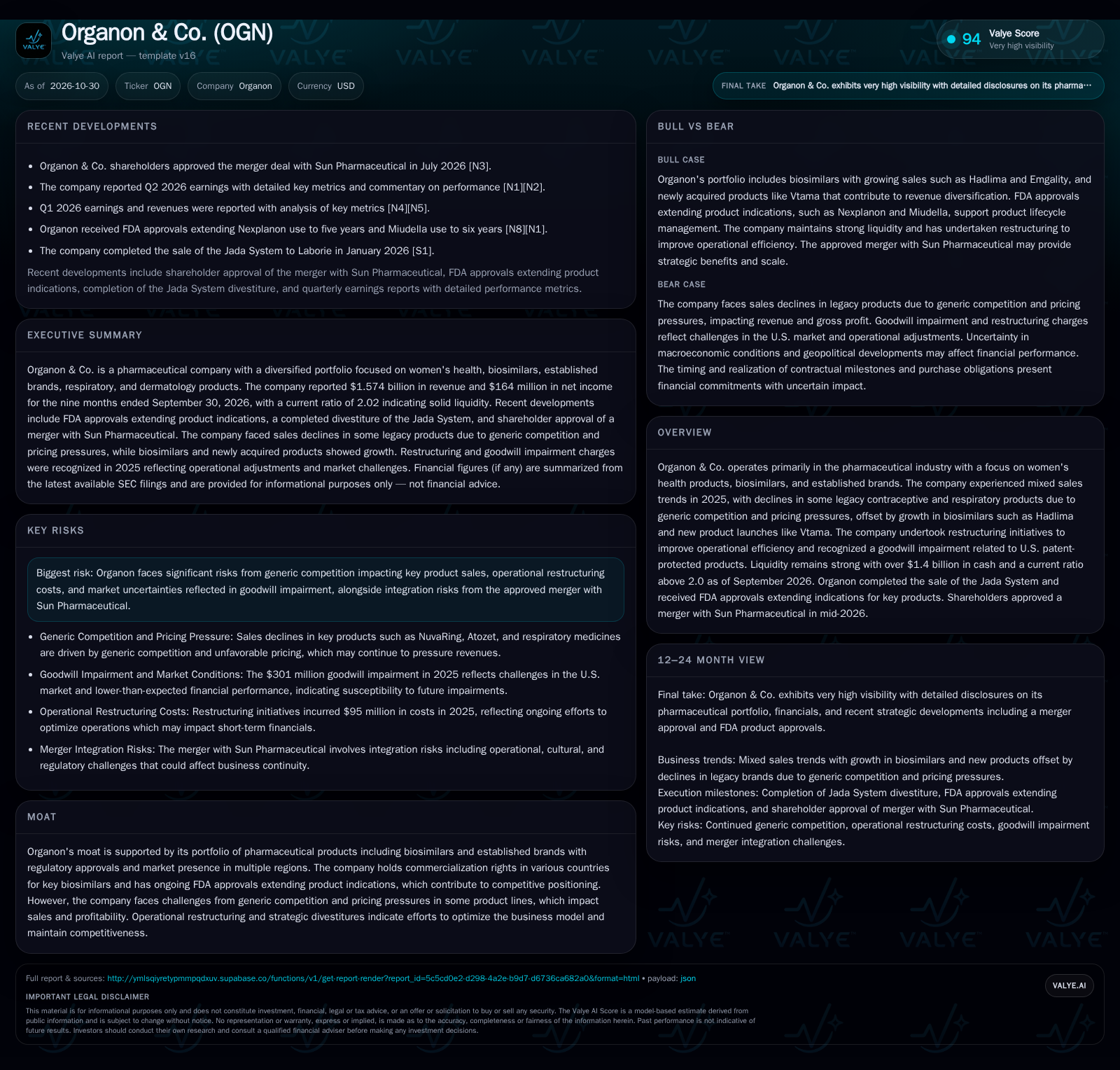
Organon reported $1.574 billion in revenue and $164 million in net income for the nine months ended September 30, 2026, with a current ratio of 2.02 and $1.455 billion in cash and equivalents [S2]. The company’s 2025 results reveal pronounced declines in key legacy products: NuvaRing sales fell 21% due to both contract loss and generic encroachment, while Marvelon and Mercilon contraceptive pills dropped 5% with regional variation [S1]. In contrast, biosimilars such as Hadlima saw a 60% sales surge after its U.S. launch, and the newly acquired Vtama generated $128 million in sales following expanded indications [S1]. Gross profit, however, decreased 11% in 2025, pressured by higher manufacturing costs and an unfavorable shift in product mix [S1]. Organon also recorded a $301 million goodwill impairment tied to underperforming U.S. patent-protected products, and incurred $95 million in restructuring costs, reflecting aggressive cost-cutting and business model adaptation [S1].
How Product Mix and Cost Structures Shape Organon’s Profitability
Organon’s economics are in flux as high-margin legacy products decline and growth shifts to segments with different margin profiles. Historically, established contraceptives and respiratory brands provided stable, high-margin cash flows due to exclusivity and mature market positions. However, the entry of generics has compressed both volume and pricing, eroding gross profit and forcing a reevaluation of fixed vs. variable cost structures.
Biosimilars such as Hadlima offer a volume-driven growth lever, but typically at lower gross margins compared to legacy patent-protected drugs, especially as pricing competition intensifies post-launch. The rapid 60% sales growth of Hadlima demonstrates the opportunity, but the segment’s long-term margin contribution depends on scale, payer uptake, and the company’s ability to manage manufacturing complexity and cost of goods sold [S1].
New therapeutic launches like Vtama and Emgality (now with expanded rights outside the U.S.) may offer higher contribution margins if they achieve meaningful scale and reimbursement traction. The sale of the Jada System and ongoing restructuring suggest an attempt to realign the cost base to lower fixed overhead and focus on higher-return assets. SG&A expenses fell 2% in 2025, but gross margin pressure from unfavorable mix and manufacturing inflation remains a risk [S1].
The net effect is a business with shrinking legacy cash flows, uncertain margin upside from new launches, and a cost structure in transition. The company reported cash and liquidity metrics for the period; these figures do not by themselves establish operating runway, investment capacity, financial flexibility, or financing capacity.
Competitive Dynamics: Generic Erosion, Biosimilar Battles, and New Entrant Threats
Organon faces acute competition from generic pharmaceutical manufacturers, particularly in women’s health and respiratory where loss of exclusivity has triggered rapid share and price erosion. NuvaRing’s 21% sales drop and Atozet’s 31% decline in 2025 underscore the intensity of this pressure [S1]. In biosimilars, the company competes not only with other large pharma players but also with agile, cost-focused entrants leveraging scale and aggressive pricing.
The biosimilars segment’s growth potential is evident in Hadlima’s U.S. launch, but this market is characterized by payer-driven price competition, limited differentiation, and the need for broad distribution. Organon’s ability to leverage its commercial infrastructure and relationships in women’s health may provide some advantage, but switching frictions are modest where payers and providers drive adoption based on price and reimbursement.
New launches like Vtama and Emgality face established incumbents and require significant investment in education, market access, and post-launch clinical data to drive uptake. The sale of the Jada System suggests a focus on core areas where Organon can build defensible positions, but the threat of further genericization and the challenge of scaling new assets remain significant.
If New Launches Outpace Legacy Decline: Margin Stabilization and Growth Reacceleration
The bullish scenario for Organon rests on the ability of new biosimilars and specialty products to not only offset but exceed the revenue lost from legacy brands. If Hadlima continues its rapid adoption curve and Emgality expands successfully outside the U.S., the biosimilars segment could become a durable growth engine. Vtama, with $128 million in first-year sales post-acquisition, could scale further if new indications and reimbursement wins materialize [S1].
Operational restructuring, if successful, would lower the fixed-cost base, amplifying the margin impact of any incremental revenue growth. If gross margin stabilizes due to improved product mix and manufacturing efficiencies, Organon could see renewed operating leverage. Confirmation would come from sustained double-digit growth in biosimilars and specialty assets, a rebound in gross margin percentage, and reduced impairment or restructuring charges in future periods.
Portfolio Transition: Mixed Growth, Margin Volatility, and Ongoing Cost Pressures
The most plausible scenario is one of continued portfolio transition with offsetting trends: legacy products continue to decline at high-single or low-double-digit rates, while biosimilars and new launches deliver pockets of growth but face their own margin and competitive headwinds. Gross profit remains under pressure from unfavorable mix, even as SG&A and R&D are managed down through restructuring and program discontinuations.
Liquidity remains sufficient to absorb volatility, but net income growth is modest and dependent on the pace of legacy attrition versus new product ramp. Evidence would include sequential biosimilar growth that fails to fully offset legacy erosion, gross margin that remains below historical norms, and periodic restructuring or impairment charges as the portfolio is further reshaped.
Accelerated Legacy Erosion and Underwhelming New Product Uptake
The bear case envisions a scenario where legacy brands decline faster than expected due to intensifying generic competition, payer-driven price cuts, or additional contract losses. New launches such as Vtama and biosimilars may face slower-than-anticipated adoption, reimbursement hurdles, or regulatory setbacks, limiting their ability to offset the revenue gap.
If gross profit continues to contract due to mix and cost inflation, and restructuring fails to deliver enough savings, Organon could face further goodwill impairments, negative operating leverage, and potential pressure on credit metrics despite current liquidity. Confirming signals would include further double-digit declines in core products, weak biosimilar ramp, rising restructuring charges, and additional asset sales or program discontinuations.
What Will Determine Whether Organon’s Transformation Succeeds?
The pace and sustainability of biosimilar revenue growth, especially for Hadlima and Emgality, as reported quarterly [S1] [S2].
Gross margin percentage trends—stabilization or further contraction would reveal the balance between mix headwinds and cost efficiency [S1] [S2].
Quarterly sales trends and market share for legacy contraceptive and respiratory products, especially NuvaRing, Marvelon, and Atozet [S1] [S2].
Progress on cost reduction and restructuring, including realized SG&A and R&D savings, and any additional impairment or restructuring charges [S1] [S2].
Uptake and expanded indications for Vtama, including reimbursement wins and geographic rollout (if disclosed).
Liquidity and capital allocation, especially any shifts in cash balance, debt, or proceeds from asset sales [S2].
Any regulatory, payer, or competitive developments that affect biosimilar or new product market access and pricing.
Disclaimer: This is research-only, informational analysis and not investment advice. It may include AI-generated interpretation and general industry context. Always verify important details using primary sources.

Comments