
Perella Weinberg Partners: M&A Advisory Momentum, Expansion Bets, and the Test of Operating Leverage
A surge in Q3 revenues, client base growth, and the Gleacher Shacklock acquisition spotlight Perella Weinberg’s strategic ambitions. Yet the firm’s dependence on deal completions and rising costs underscore the challenge of converting advisory scale into resilient, high-margin economics.
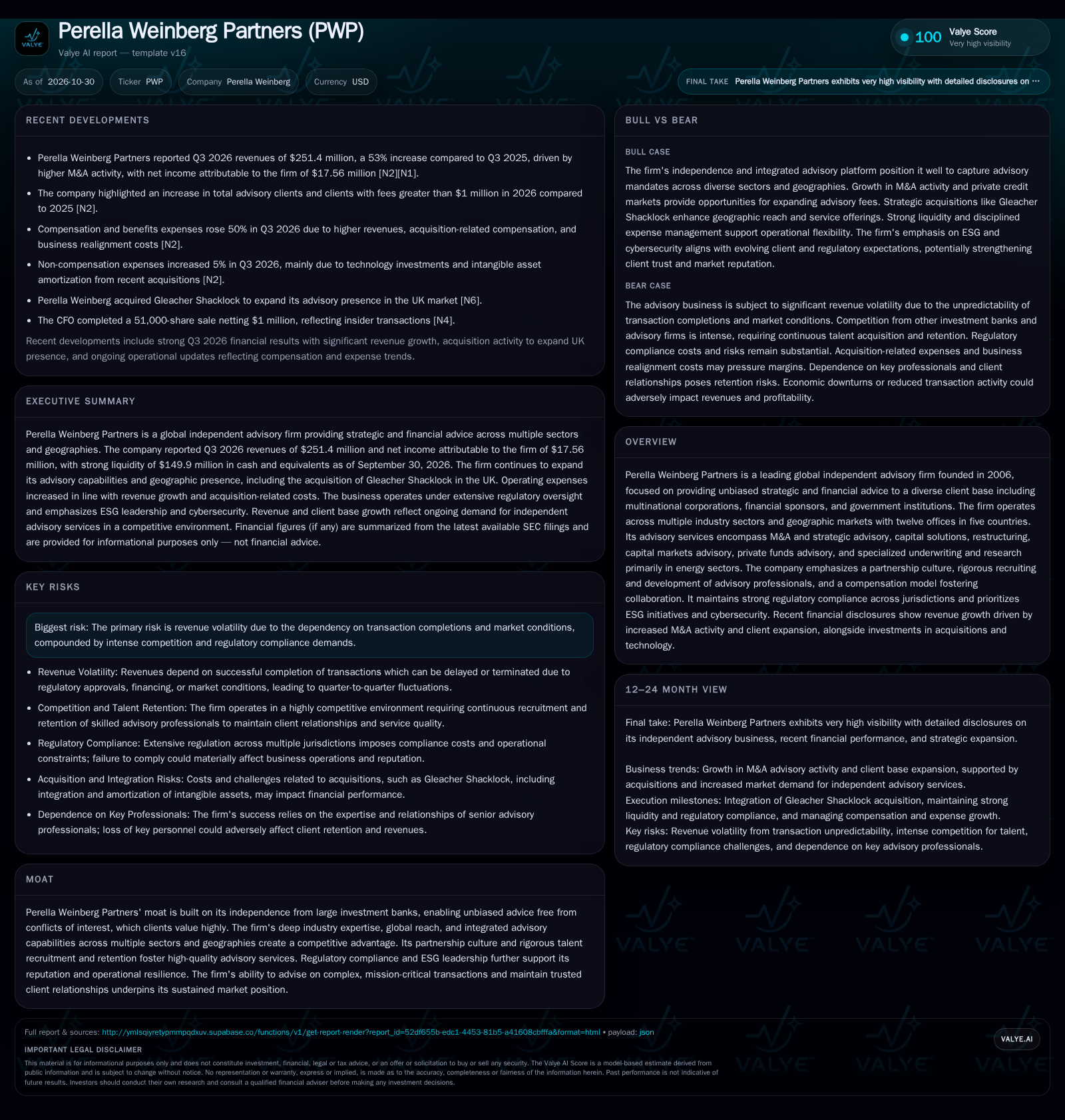
Perella Weinberg Partners posted a sharp Q3 2026 revenue jump and expanded its client base, reflecting a rebound in M&A activity and success in large advisory mandates. The Gleacher Shacklock acquisition increases UK market exposure, while compensation and technology costs rise alongside revenue. The core question is whether elevated activity and geographic scale can consistently translate into durable profitability amid a competitive, transaction-dependent landscape. [S2] [N2] [N6]
Perella Weinberg Partners’ latest results underscore both the strengths and structural challenges of the independent advisory model. Q3 2026 saw revenues climb 53% and an uptick in high-fee clients, fueled by a rebound in M&A activity and the strategic acquisition of Gleacher Shacklock in the UK. However, as compensation and technology investments rise in tandem with top-line growth, the firm’s ability to convert episodic deal surges into sustained margin expansion remains a central question. In a business where revenue volatility is inherent and competition for talent is fierce, the next phase will test whether scale and expanded geographic reach can deliver more predictable and profitable economics. [S2] [N2] [N6]
Recent Momentum: Revenue Surge, Client Wins, and Expansion Moves
Perella Weinberg Partners reported Q3 2026 revenues of $251.4 million, a 53% year-over-year increase, and net income of $17.56 million—signaling a robust rebound in M&A and advisory activity [S2] [N2]. This momentum was accompanied by a rise in both total advisory clients and those generating fees above $1 million, suggesting success in capturing larger, more lucrative mandates [S2]. The firm’s acquisition of Gleacher Shacklock expands its UK footprint and sector coverage, positioning it to compete for cross-border and regional deals [N6]. Compensation and benefits expenses rose 50% in the quarter, reflecting higher revenues, acquisition integration, and business realignment costs [S2]. As of September 30, 2026, the company reported $149.9 million in cash and equivalents, with no outstanding borrowings on a $50 million credit facility [S2].
Advisory Economics: Episodic Revenue, High Fixed Costs, and the Operating Leverage Puzzle
Perella Weinberg’s core revenue model is transaction-driven: fees are typically tied to the successful completion of M&A, restructuring, and capital advisory mandates. This creates a lumpy, episodic revenue profile highly sensitive to market cycles and client activity. While the firm’s broad sector and geographic coverage can help smooth volatility, the underlying economics remain tied to deal flow—meaning revenue can swing sharply quarter-to-quarter.
Compensation is the dominant cost, often representing over half of revenues in the advisory industry. The Q3 2026 50% year-over-year jump in compensation and benefits—driven by higher deal activity and acquisition-related realignment—illustrates how talent costs rise in lockstep with top-line growth [S2]. Non-compensation costs (technology, amortization) also increased, albeit at a slower 5% rate, reflecting ongoing investment in digital tools and acquisition integration [S2].
Operating leverage is theoretically available if revenue growth outpaces the need for incremental hiring and platform investment. However, in practice, the need to continuously attract, incentivize, and retain senior professionals—especially in a competitive market—means that margin expansion is often modest and easily reversed in slower periods. The company reported cash and liquidity metrics for the period; these figures do not by themselves establish operating runway, investment capacity, financial flexibility, or financing capacity.
Where Independence Meets Scale: Competitive Advantages and Pressures
Perella Weinberg’s independence from large, product-driven investment banks is a core differentiator, allowing the firm to market itself as a provider of unbiased, client-first advice. This positioning is valued by clients wary of potential conflicts of interest at larger institutions. The firm’s partnership culture and focus on senior talent recruitment and retention underpin its ability to win complex, high-stakes mandates.
The acquisition of Gleacher Shacklock is intended to deepen sector expertise and enhance UK/EU market access, potentially making Perella Weinberg a more credible competitor for cross-border and domestic mandates in Europe [N6]. However, the advisory landscape remains fiercely competitive, with global banks, other independents, and boutique advisory firms all vying for talent and client relationships. Switching costs for clients are moderate—while relationships matter, mandates are often awarded based on perceived expertise, past results, and team continuity.
Technology investments may enable better client service and deal execution, but are unlikely to create durable competitive moats absent proprietary data, analytics, or workflow platforms that change how advisory work is delivered. ESG positioning and regulatory compliance are important for reputation and access, but do not by themselves confer pricing power.
Sustained Deal Activity and Integration Synergies Unlock Margin Expansion
A favorable scenario would see M&A and restructuring activity remain elevated, allowing Perella Weinberg to consistently win large, high-fee mandates across geographies. The successful integration of Gleacher Shacklock could deliver cost and revenue synergies—expanding the firm’s sector reach and cross-selling opportunities in the UK and Europe. If the firm can leverage its expanded platform without proportionally increasing fixed costs, operating leverage could drive sustained margin expansion.
Confirmation of this scenario would come from several quarters of elevated revenue and net income, with compensation expense growth moderating relative to revenue gains (implying improved productivity per head). Evidence of cross-border mandates involving the combined UK and global teams, or new client disclosures with fees above $1 million, would further support the thesis. A stable or improving operating margin, despite ongoing investments, would be a key signal.
Recurring Volatility: Episodic Growth Amid Persistent Cost Pressures
The most plausible outcome is a continuation of the industry’s historical pattern: strong quarters tied to spikes in M&A and restructuring activity, interspersed with periods of slower deal flow and compressed margins. Perella Weinberg’s expanded client base and geographic reach may modestly dampen volatility, but transaction timing, regulatory outcomes, and macroeconomic conditions will continue to drive quarter-to-quarter fluctuations.
Compensation and non-compensation expenses are likely to remain closely tethered to revenue, limiting the firm’s ability to achieve material operating leverage except during the strongest market periods. Integration of Gleacher Shacklock could deliver incremental revenue, but may also bring additional costs and complexity. Confirmation would come from ongoing swings in quarterly revenue and net income, with compensation ratios remaining high and operating margins fluctuating accordingly. A steady increase in high-fee clients would indicate franchise health, but not eliminate the underlying volatility.
Deal Drought, Margin Compression, and the Talent Retention Squeeze
A negative scenario would be triggered by a downturn in global M&A and restructuring activity, whether due to macroeconomic shocks, tighter credit markets, or regulatory delays. With revenue generation highly dependent on deal completions, a sharp drop in activity could quickly expose the high fixed-cost base—especially compensation tied to senior advisory talent.
Failure to realize expected synergies from the Gleacher Shacklock acquisition, or the loss of key professionals to competitors, could further erode margins and franchise value. Rising compliance or technology costs, without corresponding revenue, would amplify the squeeze. Evidence of this scenario would include several quarters of declining revenue, persistent or rising compensation ratios despite lower deal activity, and increased departures of managing directors or partners. If disclosed, a drop in the number of clients generating fees above $1 million would also be a warning sign.
Testing the Thesis: Metrics and Developments with Franchise Consequences
Quarterly revenue and net income trends: Watch for sustained growth or renewed volatility, especially after the Gleacher Shacklock integration.
Compensation as a percentage of revenue: A declining ratio would suggest improved leverage; a rising ratio flags cost pressure.
Number of advisory clients and clients with fees above $1 million: Further increases would indicate franchise strength and success in winning larger mandates.
Operating margin progression: Evidence of margin expansion would support the upside scenario; margin compression would confirm cost rigidity.
Integration milestones for Gleacher Shacklock: Updates on cross-selling, team retention, and UK/EU revenue contribution would help gauge acquisition success.
Managing director and partner retention: Departures or turnover rates (if disclosed) would be an early sign of franchise risk.
Pipeline of announced but not yet completed transactions: A useful metric would be backlog or deal pipeline, if disclosed, to anticipate future volatility.
Regulatory or compliance developments: Any new costs, constraints, or fines could affect profitability and operating flexibility.
Disclaimer: This is research-only, informational analysis and not investment advice. It may include AI-generated interpretation and general industry context. Always verify important details using primary sources.

Comments